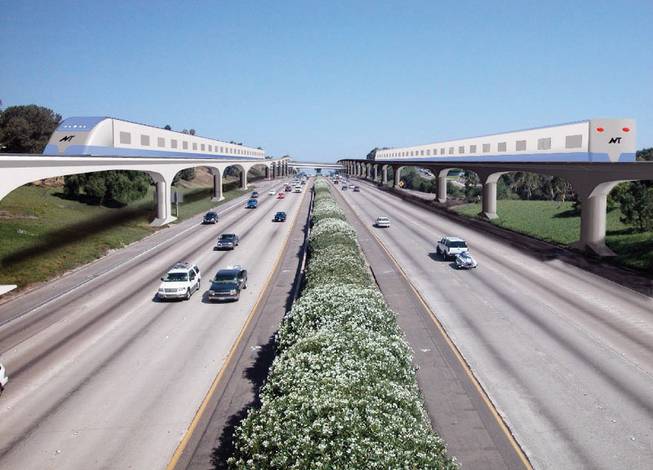
Backers of less traditional high-speed projects air plans
COURTESY of AVT solatrek
Developers of AVT SolaTrek’s system envision transporting vehicles and passengers on an elevated network of rails.
Tuesday, Oct. 20, 2009 | 2:10 a.m.
Sun Archives
- Analysts aboard for rail hub (10-8-2009)
- Millions for maglev: So, where’s the money? (9-24-2009)
- Transportation secretary: Gibbons 'not accurate' in noting maglev earmark (9-23-2009)
- Maglev money sparks a Gibbons-Reid quarrel (9-18-2009)
- High-speed rail competition heats up with new funding (9-16-2009)
- Beyond Victorville: Coloradans covet high-speed rail, too (9-14-2009)
- DesertXpress train aiming for March construction start (9-1-2009)
- Forum to address DesertXpress train proposal (6-28-2009)
- High-speed train plan gets notice in D.C. (6-24-2009)
Sun Coverage
Beyond the Sun
Backers of three upstart transportation systems vying to be the ride of the future could all agree on one thing at a forum conducted Monday night at UNLV – it won’t be easy for them to be accepted by the public and by regulators when their ideas are so far from mainstream thinking.
And far from it they were.
Boosters of AVT SolaTrek, America’s Sunlight Bullet Expressway and Tubular Rail offered outside-of-the-box thinking and then some, leaving some of the 50 in attendance nodding their heads in agreement and others shaking their heads in disbelief.
The session, the third in a series sponsored by UNLV’s Transportation Research Center and the Ward 5 Chamber of Commerce, brought in new, unusual technologies that their backers contend could be better alternatives to the conventional steel-wheels-on-rails DesertXpress proposal and the more futuristic American Magline Group magnetic levitation system, both of which have plans to link Las Vegas with Southern California.
The up-and-comers concur that their plans are largely conceptual and far from the point of carrying passengers.
The two plans that seem to have the most momentum are Houston-based Robert Pulliam’s Tubular Rail and Thousand Oaks, Calif.-based Frank Randak’s SolaTrek systems.
Pulliam spent more than an hour with a team of prospective developers to explain Tubular Rail, which he thinks could be applied on a Las Vegas-Los Angeles run with a different route than those proposed by DesertXpress and American Magline.
Tubular rail would operate as a single rigid train unit that runs through elevated support rings like thread through a series of needles. The train would be in contact with at least three of the rings at all times as it passes from one to the next. Guidance rails would be mounted on each train and electric motors would be a part of each O-ring. Pulliam said trains should be able to achieve speeds of up to 150 mph.
Pulliam introduced his team of developers who explained their contributions to the project: Triumph Group, an aerospace company that would build the vehicles; CB&I – the old Chicago Bridge and Iron company that now builds water towers and wastewater system vessels – for the precision O-rings; Rockwell Automation, which would develop the locomotion system; and Raba Kistner, which would handle much of the administrative coordination.
Pulliam said he came to Las Vegas a few days early so he could drive along the proposed route to Southern California. Instead of using the Interstate 15 right-of-way as DesertXpress and American Magline have proposed, Pulliam suggests a route along U.S. 95 south along the eastern edge of the Mojave National Preserve toward Twentynine Palms, Calif., then west from near Palm Springs to the Ontario International Airport.
Pulliam said his system is less expensive than traditional rail because it eliminates the need to build track. The O-ring pillars would be far less expensive to build, greatly reducing the expense.
“For places like San Francisco and Pittsburgh, our system wouldn’t be very good,” Pulliam said. “But for long, straight routes across the desert, it would be ideal.”
Randak’s AVT SolaTrek (the AVT stands for “Advanced Vehicle Transport”) is actually a maglev hybrid system. The company’s patented design envisions a system that would take cars off highways and put them onto solar-powered maglev trains on elevated guideways.
The Randak system proposes cars pulling into an automated shuttle vehicle that increases its speed until it matches the speed of a moving train and then loads it with a conveyor system. Once loaded, passengers can get out of their cars within their private train compartments that have air conditioning, vending machines, restrooms and entertainment centers.
Randak said the power of his system is that it doesn’t try to alter the behavior of motorists who like their cars. Instead, the car is on the train with the passengers and can be used when the passenger arrives at his or her destination.
Both Tubular Rail and SolaTrek are to the point that developers want to build a full-scale proving track to demonstrate the technology. Pulliam has a site he’s eyeing in Pecos, Texas, to build the Tubular Rail demonstration, while Randak wants to take advantage of the millions of visitors to Las Vegas and build 600-foot demonstration track at an overflow parking lot near the Thomas & Mack Center.
Randak said he thinks his test track could be built for $5 million while Pulliam wants to raise $30 million to build a two- to three-mile track in Pecos.
The third technology, America’s Sunlight Bullet Expressway – known as ASBE – is a system advocated by Las Vegas-based Transcontinental Transmission & Transportation Network, which proposes a nationwide network of electricity-powered trains with guideways that also could house high-tension transmission lines.
Lou Baker, who gave the ASBE presentation, described the transportation element as a broad-based air-cushioned vehicle similar to a large hovercraft. The main routes of the system would extend from San Francisco to New Orleans and from Newport, Calif., to Chicago with the tracks intersecting at Las Vegas.
Baker said he expects the system would be built in connection with the U.S. Department of Defense and that up to 1,400 passengers could ride each train at speeds of up to 500 mph.

Discussion: 8 comments so far…
Comments are moderated by Las Vegas Sun editors. Our goal is not to limit the discussion, but rather to elevate it. Comments should be relevant and contain no abusive language. Comments that are off-topic, vulgar, profane or include personal attacks will be removed. Full comments policy.
Post a comment
Spotlight
- Most Read
- Discussed
- Most E-mailed
- Ritz-Carlton Lake Las Vegas to close in May
- Pricey land buy on Strip a bit of a surprise
- Engineering marvel taking shape near Hoover Dam
- Harry Reid’s co-writer unloads while discussing polls, Obama quote
- Grim numbers show Nevada leads nation in suicides over 60
- Police: Legal runner returned to home, shot husband and wife
- The 10 best steakhouses in Las Vegas
- UNLV back in the polls: No. 23 in AP, No. 25 in ESPN/USA Today
- MGM Mirage to leave N.J. in dispute over Macau partner
- GOP should blame itself for deficit, not Democrats
Blogs
Politics: Ralston's Flash
Miners sue to block mining tax initiative (1 Comment)
Shark Bytes
Willis reminds me of another great UNLV guard (5 Comments)
Elsewhere
With aggressive push, Internet gambling again in play
The Kats Report
A very quick list of which females could replace Steven Tyler in Aerosmith (16 Comments)
A 3.5-day sprint, highlighted superflously at Flamingo with Las Vegas newcomers
Politics: Ralston's Flash
Horsford: No taxes now, but tax reform later (14 Comments)
Gibbons: Cutting the budget can help me raise money (12 Comments)
Calendar »
- 9 Tue
- 10 Wed
- 11 Thu
- 12 Fri
- 13 Sat
-
Far East Movement at Blush
Blush Boutique Nightclub | 10 p.m. to 11:59 p.m.
-
Benji Madden at Moon
Moon Nightclub | 10 p.m. to 11:59 p.m.
-
Hugh Fink at the Riviera Comedy Club
The Riviera Comedy Club
The Sun
Locally owned and independent for more than 50 years.
Technorati


Im sure everyone will agree that something needs to be done,but after all the impact report bull,and 15 years later,it still wont be up and running for another 30 years?Just pick one that does the best job,and build the damn thing!Let the peace groups cry after it saves more than uses later!!!!
cab company's have too much power to allow people to ship their car to vegas
Build a maglev that has a stop next to downtown Las Vegas, then hook the monorail right into the Maglev station. Unfortunately the cab/limo companies made sure to shoot down the monorail as thoroughly as possible by shooting down any plans to actually make it useful (IE a airport extension).
Can anyone provide any useful information as to when, where, and how a potential Vegas-to-LA rail project will be built?
For weeks we heard about the battle between DesertExpress and MagLine. Now, there are 5 more proposals being considered?!
This is beginning to look like the "neverending story"
Don't hold your breath waiting for the shovel to hit the ground.
Transporting your friggin car does not exactly improve per passenger energy efficiency. Nor does it help reduce inner city traffic congestion.
Why is it so hard for people to wake up to the issues that face this country; namely the rising cost of energy and worsening traffic congestion?
If all 21,000 employees at the Empire State Building drove their own cars to work, how big would the parking garage have to be? 2x or 3x the size of the ESB? Get it? Efficient use of an urban landscape does not lend itself to automobile transport.
Expending lots of energy (and money) to transport your car just so you can pay lots of money to park it while you lose money in casinos is beyond idiotic.
It's of interest that the ASBE approach has a levitated design without the use of magnetics, therefore less costs, using an air cushion system very much like a helicopter or hovercraft it uses aerodynamics to attain weigth lessness.
No resistance or friction allows the transporter train system to move at high speeds while requiring very little electrical energy. Rather than just a high speed transportation train it incorporates other features like an electrified highway for electric vehicles, four new lanes of highway, the generation of its own electricity by solar, wind and hydro, a water collection and piping system to storage resovoirs for emergencies and the hydrolic water generation of electricty with transmission lines lines to carry the loads. It also is designed to tie East to West along two 1500 mile routes, that interface with high speed rail interchanges proposed by the administration along the East and West Coast. It would seem with all the inovations and components suggested by the concept, that it would still be less expensive to build and operate, while offering so much more. It's also likely that there are more forms of revenue, more jobs, less complications and greater potential than any of the other proposals. If it were a part of the National Emergency Defense System as suggested, we maybe better prepared for another Katerina or 9-11. Having compared all the other systems this one stands out head and shoulders above the rest, apparently offering more for less, with savings, security and speed as a bonus. lets hear more. Blue Man
Blue Man:
Except for one little detail - this system does not exist, except in somebody's head and computer graphics program.
In other words, it stands head and shoulders above nothing.
You can't deploy a system that has never been built, tested, and vetted.
On behalf of the Tubular Rail team, we want to thank Dr. Peck at the UNLV Transportation Research Center for the informative forum held Monday night at the College of Engineering. And engineering is indeed the discipline that enables our "trackless train" technology to work, by disassembling the train as we know it and reassembling it in a way that reduces capital costs by 60% or more (because we don't need a continuous guideway or bridges to run on as do all other train technologies) and still reach speeds of 150 mph or more. TR technology has taken the rails out of the ground and put them on the passenger car; it has taken the locomotive engine and put that function in the O-Ring stanchions that define the route. There is no rocket science with us, just existing, very well understood technology put together in a simple yet revolutionary age. Tubular Rail, being in pre-prototype stage, may seem an outlier technology to some, maybe even this Sun reporter, but what has been proven by "proven" train technologies like Maglev or even the DesertExpress (DE) is that they are so expensive to build that, in the case of Maglev, only one system exists in the world even though the technology has been "proven" as early at the 1960s. As for the DE, it still runs on steel rails in the ground, and we know from looking at the costs of other steel-wheel-steel-rail systems that real per-mile costs can easily top $100 or more per mile. Tubular Rail's patented technology needs neither rails in the ground or bridges, because we operate "in the air space" as opposed to "on the ground space." Unlike all other train technologies that need Right of Way ground space that disrupts all existing infrastructure, Tubular Rail is "impact-sensitive" because we have a small "foot print" that can tip-toe where we want to go. For a thoroughly explanation of who we are, how we work and why we are clean, efficient, fast, green and a fraction of the cost of the other so-called front runners in the race to link Las Vegas with Southern California, go to www.tubularrail.com and see for yourself why we, and four powerhouse American companies who are ready to partner with Tubular Rail because they see (as we do) the global need and profitability of TR technology, joined Dr. Peck in Las Vegas, where smart, stylized alternatives to the same old same old set this city apart from all others on the planet and make it the destination Mecca it is. Transportation technology, specifically with trains, has been curiously resistant to change, but Tubular Rail hopes to change all that soon.