Sunday, Oct. 11, 2009 | 2 a.m.
Enlargeable graphic
Reader poll
Related Document
Sun Archives
- More Nevadans will need help as economic storm worsens (9-27-2009)
- Nevada's jobless rate could hit 17 percent (9-25-2009)
- The potential for prosperity in Las Vegas (9-9-2009)
- Experts: Despite downturn, Las Vegas has hope (9-8-2009)
Sun Coverage
The images streaming from Las Vegas during the past two years — foreclosed homes, long unemployment lines, unfinished eyesores on the Strip — must be shocking but also achingly familiar to many Americans.
For although they’ve come to expect, from media images and their trips here, a dazzling Las Vegas of perpetual change, growth and prosperity, at the same time they know all too well the signs of economic decline.
These are Americans from the Rust Belt — the string of cities from the Northeast to the upper Midwest, whose industrial decline began after World War II and continues today.
Residents of places such as Cleveland, Buffalo and Detroit have grown accustomed to the latest news. Another factory headed overseas. Another drive-by shooting in a forsaken part of town. A late-night comedian using the city as a punch line. And, perhaps most painfully, a friend, a neighbor, a son or a daughter joining hundreds of thousands of others and leaving town — usually for the Sun Belt.
Las Vegas residents could afford to look back on those cities, for many of them home, with an air of pity and smugness.
A combination of good weather, affordable homes, plentiful jobs, a live-and-let-live attitude and minimal taxes and regulation had created — seemingly — recession-proof prosperity.
Goodbye to all that.
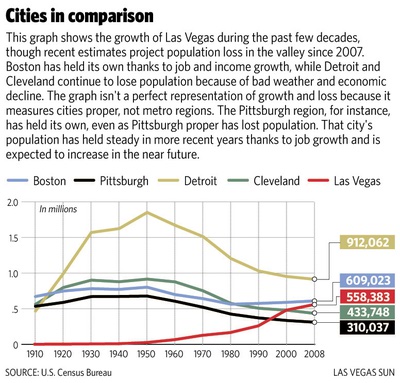
The recession has hit here harder than just about anywhere else. The depressing data are familiar: Unemployment has topped 13 percent, and is much higher when part-time workers and those who have quit looking for work are included; Las Vegas has more foreclosures than any other large city in America, and our home values have utterly collapsed; the largest foreclosed commercial building in the country is on Las Vegas Boulevard, and, most shockingly, after being the fastest-growing city in America for the better part of two decades, a net of at least 28,000 people have left Las Vegas since summer 2007, according to recent estimates.
Nor are the near-term prospects at all comforting. There are too many hotel rooms, too much commercial real estate and too many empty houses for any kind of building boom to return, and economists say Las Vegas should learn to live with diminished expectations.
We can no longer be sure that we are the city of the future. Like it or not, we’ve got a little bit of Detroit and Cleveland in us.
Keith Schwer, a UNLV economist, has collaborated with a University of Michigan colleague, George Fulton, examining how similar Las Vegas and Detroit are in their heavy reliance on one industry — travel and tourism here, cars in Detroit.
“Lo and behold, now we see how similar they really are,” he says sheepishly. “Before, they were always two economies going in different directions, and now they’re going in similar directions.”
The question facing Nevada’s elected officials, business leaders and civic activists: How do we stop the slide and secure long-term, sustainable prosperity?
How do we avoid becoming Detroit or Cleveland or Buffalo — once prosperous cities now deeply scarred by decay?
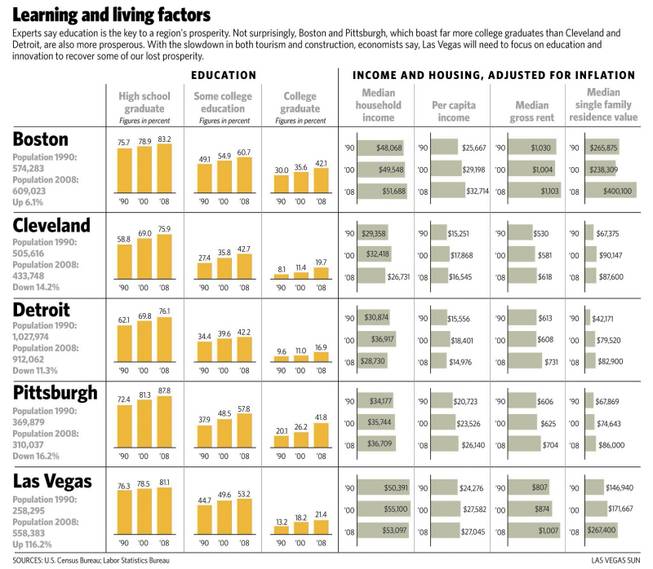
More pointedly, what can we learn from their failures? Also, what can Las Vegas learn from those Rust Belt cities that have transformed themselves and are now thriving — cities such as Boston and surprising gems like Pittsburgh?
The Sun interviewed a bevy of urban economists and economic development experts, mostly from the Rust Belt.
Here, the lessons learned.
Get your head out of the sand
Denial is a common reaction to economic upheaval, stagnation and eventual decline.
And nothing is more dangerous, the Rust Belt veterans say.
“Face reality. Face facts — not what you would like to see happen, but what is happening,” says Donald Grimes of the University of Michigan’s Institute for Research on Labor, Employment and the Economy.
Detroit, he says, has never faced the new reality, even as foreign automakers began to make deep inroads in the domestic car market in the 1970s and as the city’s population was halved by declining job opportunities and social decay.
Cleveland has been similarly foolish, says Andrew Welki, a professor of economics and finance at that city’s John Carroll University.
“There’s no doubt there’s an unwillingness to accept the fact that the world has changed. Whether you like it or not, it’s not coming back,” he says.
So has the world changed for Las Vegas?
That depends on whether Las Vegas is suffering because of the business cycle — in which case, we can expect things to return to normal soon enough — or if our economy is structurally flawed, in which case, we have much bigger problems.
Most experts say it is a combination of the two. On one hand, forecasters expect a modest uptick in travel and tourism next year, albeit not matching the go-go years.
Americans are in the process of what economists call “de-leveraging,” paying down debt. They are saving, chastened by the crash and suddenly remembering the lessons of youth — save, save, save and don’t buy what you can’t afford.
Pacific Investment Management Co. strategic adviser Richard Clarida says the U.S. savings rate may soon exceed 8 percent, according to Bloomberg.
That in turn will mean less spending on items such as trips to Las Vegas.
“What’s more discretionary than a trip to Las Vegas?” says Ross DeVol, director of regional economics at the Milken Institute.
Although tourism will recover slowly, the second leg of the Las Vegas economy — construction — will not return soon.
So is Las Vegas in denial?
It is too early to tell, but there are discouraging signs, including endless assurances from city fathers that the light at the end of the tunnel is nearly visible.
“There’s a lot of inertia,” Schwer says.
“These types of events should serve as a wake-up call,” DeVol quips, “but sometimes, the recipient is dead drunk.”
But presuming we wake up from that stupor, then what?
You’ve got a good thing — now build on it
The reason Detroit has suffered such decline, notes Grimes, isn’t because people stopped buying cars. Rather, the automakers’ cost structure was such that Detroit was unable to deliver cars that could compete with foreign offerings in price or quality. Some of that was out of its hands, but he adds that the automakers never had a long-term strategy for controlling costs or improving or diversifying their product mix.
David Champion, director of auto testing at Consumer Reports, takes a harsher view, writing in The New York Times: “In the 1970s, Detroit car company executives failed to grasp that foreign car companies made inroads because car buyers were fed up with products that offered poor gas mileage and appalling product quality.”
The lesson here for Las Vegas is to evolve its core industry — continue working hard to be a premier value destination for travel and conventions, a lesson that seems to have sunk in for the city’s main industry and elected officials.
Las Vegas continues to add new attractions, convention space, airport capacity and the like, positioning the city to become highly competitive with other destinations here and abroad.
Still, experts believe Las Vegas can do more to leverage its travel and tourism. Schwer says we could develop a cluster of companies that support the industry — say, more software and professional services firms.
Mark Muro and Rob Lang of the Brookings Institution have suggested that Las Vegas’ real strength comes from the convention industry, which could lead to more permanent business opportunities.
Cleveland, for instance, has been trying for three years to create a “Medical Mart,” a convention center and hotel complex that would host specialty medical trade shows, the foundation of which would be the famed Cleveland Clinic.
According to Welki, however, the idea has stalled because of bureaucratic infighting and inertia.
We’ve developed something similar with our permanent furniture trade show at World Market Center, but the Medical Mart seems a plausible idea for Las Vegas, especially now that the Cleveland Clinic has opened a subsidiary in the city.
But building on what you have is more than just developing your core industry. It’s also using the fruits of that industry — both private profits and tax revenue — to build other, new industries, says Bill Flanagan, vice president of corporate relations for the Allegheny Conference on Community Development, the parent organization of Pittsburgh’s chamber of commerce.
(In the Detroit area, by contrast, governments and nonprofit organizations failed to use the resource they had — the auto industry cash cow — to build a new future. They didn’t develop an electric car or build up Wayne State University, for instance.)
For decades, Pittsburgh’s well-paid, unionized steel workers — living in a conservative town during a time when Americans saved more — socked away money, which went into regional banks. Strong regional financial institutions helped anchor the city’s new industries such as health care. Taxes from the city’s older companies, which included not only steel but also Westinghouse and Mellon Bank, were used to clean up the air and water and build good education and health care infrastructure.
Barons of steel and other older industries plowed profits into the city’s two large research universities, Carnegie Mellon University and the University of Pittsburgh, as well as the region’s massive philanthropies, all of which drove growth in more sophisticated manufacturing, and in health care, energy and information technology.
Pittsburgh now has 201,300 jobs in education and health care, or “eds and meds,” as its transformation is known. That’s a 100 percent increase from 30 years ago, in two highly valued employment sectors.
Pittsburgh’s unemployment is two percentage points below the national average and nearly six percentage points below that of Las Vegas; more than 30,000 jobs currently need filling.
Its commercial real estate market is the healthiest in the country; although it never had a real estate boom, it hasn’t had a crash either.
Pittsburgh, which struggled for years after the collapse of steel, now has a diverse economy with high-skill, high-productivity jobs.
How did a declining steel town become one of the most thriving cities in America?
Build a culture of education
As Schwer notes, there are a few ways for a region to grow wealthier: Sell more of what you currently produce, which in our case is the Vegas experience; figure out a way to sell something else to the world, or start producing at home what you once had to import, like, for instance, the Cleveland Clinic’s contribution to cutting-edge medicine here.
How do you achieve these goals and become more prosperous? The answer is simple: You have to produce something fresh and new, such as a renewable energy technology that will blow the doors off the marketplace, or a resort so incredible — like the Mirage in 1989 — that tourists just have to see it. That, or you produce the same goods you’ve always produced but for less money.
In either case, you have to innovate.
Where does innovation come from?
In part, from sheer entrepreneurialism.
“Develop an entrepreneurial class. They’re going to determine where the future is,” Welki says.
Detroit, with its large unionized, heavily bureaucratic companies in one industry, has struggled to develop a culture of entrepreneurialism and has been far too resistant to change, DeVol says.
On the one hand, Las Vegas is now home to a few large, unionized companies that dominate the market, which could stifle creativity.
On the other hand, we nurture a culture of risk-taking here.
Sheldon Adelson, after all, had the good sense, when he opened the Venetian in 1999, to imagine Las Vegas not as bunch of gambling halls but as a convention town where business people would come and pay $200 for a hotel room.
But there’s almost always another component of innovation, experts say: education. There’s just no getting around it. Welki says Cleveland failed to see that overseas competitors could make the same goods for less money. The only way out, he says, is to innovate by creating new products or inventing new, more efficient methods for making the same products.
Education is usually the path to that kind of innovation, Welki says.
“So now your workforce is going to require a more sophisticated level of education, and though you pay them more, they add value.”
Although it may be nice that bellhops with high school diplomas can make good wages here, a whole city of bellhops and cocktail waitresses and cabdrivers will always struggle to innovate.
And though conservatives are right to point out that spending lots of money is no guarantee of educational success, it just so happens that Rust Belt cities that have evolved have also dumped money into creating a culture of education.
As Harvard economist Edward Glaeser notes in a paper on Boston’s history of economic crisis and reinvention, “In 1980, Boston was a declining city in a middle-income metropolitan area in a cold state.”
Boston was going the way of its northeastern mill town brethren, forgotten cities like Lowell, Mass., and Waterbury, Conn.
In some respects, Boston just got lucky, Glaeser notes.
Once higher education became imperative at the dawn of the information economy in the early 1980s, Boston was well situated to capitalize because it claims some of the world’s best universities, several of which are at the forefront of rapidly evolving computer science, biochemistry and advanced physics.
Today, Boston leverages that resource, and in large part because of its highly educated populace, the city is a leader in biotechnology and health care, information technology, financial services and higher education.
Nevada’s mediocre K-12 and higher education systems will mean an inability to innovate either in its core industry or in the development of new industries, experts fear.
“There’s a relative paucity of super high-powered innovation inputs at this point. You don’t have a massive, patent-driving R&D university,” says Muro of Brookings. “And they know they have a lot of work to do on that.
“Well-educated places are productive places.”
Laissez faire isn’t always the answer
Angie Schmitt, a graduate student at Cleveland State and a proprietor of the blog Rustwire, points to an intriguing paper from the Federal Reserve Bank of Cleveland. It draws a comparison between two socio-economically alike, low-income, mostly black neighborhoods — one in Cleveland, one in Pittsburgh.
How is it that the Cleveland neighborhood had a foreclosure rate of 20.75 percent in 2007, four times as high as the Pittsburgh borough’s rate of 5.2 percent?
The paper posits that the answer comes in Ohio’s more laissez faire attitude toward subprime lending, and a failure to enforce predatory lending laws.
If this sounds familiar, it should. Nevada regulators failed to adequately oversee mortgage companies, according to a legislative audit released last year. Not surprisingly, law enforcement officials here can’t keep up with the mountains of mortgage fraud that occurred during the boom. This has worsened the real estate crash and continues to be an expensive mess.
Other areas of regulatory success and failure in the Rust Belt are also instructive. For decades Cleveland dumped its industrial waste into Lake Erie, which prevented what could have been a source of prosperity — lakefront development. When the Cuyahoga River caught fire, the city’s image as an industrial wasteland was set in stone. Both waterways have been cleaned up, to a large extent, but too little, too late.
Pittsburgh, on the other hand, has acted more aggressively. Flanagan says it was likely one of the most polluted cities on the planet during World War II.
But the city’s business community, including Big Steel, got together with government leaders and helped clean the skies beginning in the 1940s and ’50s.
Same with the city’s famed rivers, which are now safe for drinking, swimming and fishing.
Will the same be true of Lake Mead? And where will we get our water in 30 years?
Not just a place to work, a place to live
If an educated, entrepreneurial populace is the key to an innovative and, thus, prosperous economy, then Las Vegas has to either grow its own or recruit those people to come here.
In either case, it will need to create a place in which college-educated people want to work, and live.
Pittsburgh reclaimed its riverfronts and built a network of parks and trails. It built a theater district and two sports stadiums. Next up, a new home for the NHL’s Penguins, in the first LEED Gold Certified, environmentally friendly arena in the country. (This is just the latest in a series of green-building triumphs — the building community enthusiastically took up the cause after a push from the foundations, delivering another economic skill set Pittsburgh can export.)
Rob Stephany, executive director of the Urban Redevelopment Authority of Pittsburgh, said the city had reclaimed all but one of the hulking, shuttered manufacturing plants, and turned them into commercial, retail and residential developments and parks.
Flanagan says the low unemployment rate, and myriad amenities and diverse neighborhoods of the city, have combined to retain the young people who once left Pittsburgh in droves.
Cleveland has tried to revitalize its downtown with sports stadiums and the Rock and Roll Hall of Fame, but the flight to the suburbs has continued apace. The continued loss of jobs, as well as urban blight and crime, have continued to make the inner core a difficult sell.
In the area of creating a livable community, Las Vegas has some natural advantages. The weather is excellent roughly nine months a year. The Strip offers all kinds of entertainment, dining and night-life options. The region also offers great outdoor activities within driving distance. And there seemed to be great progress in the livability category the past two decades, with the art museum, the symphony and proposals to create urban, walkable neighborhoods downtown.
But that progress has been decimated by the crash. The film festival CineVegas announced a one-year moratorium, the Vegoose music festival shut down, the art museum closed, and the symphony is financially struggling.
As Schwer notes, the Smith Center for the Performing Arts will be a step in the right direction.
Cultural amenities and a more diverse streetscape are just part of what’s needed, though. Educated professionals also look ahead to the future, consider raising a family here and then ask themselves: Will Las Vegas provide good schools and a healthy environment? It’s an open question.
A civic culture that will build for the future
Jimmy Dimora, the smooth-talking former janitor who until recently ruled Cleveland’s Democratic machine, now faces a wide-ranging federal corruption investigation. For Cleveland residents, business leaders and civic activists, the episode has been demoralizing and led to paralysis, Welki says. Corruption can infect an entire community, ensnaring otherwise ethically sound businesses and making progress on important public projects all but impossible. It’s difficult to ink deals that require public approval when it’s not clear the person in charge isn’t headed to prison.
“It’s a political machine without any of the benefits,” Schmitt says.
Welki says the alleged corruption in Cleveland has created inertia and stalled the city’s attempt to leverage the Cleveland Clinic and the universities to benefit the entire economy.
Detroit Mayor Kwame Kilpatrick, on whose shoulders many hopes rested, had the cash-strapped city lease a luxury SUV for his wife and then wound up in jail after a salacious affair and cover-up.
Experts say cities that thrive are those with a clean political system and a civic culture that encourages cooperation and giving back. (Chicago is an obvious exception, though for what it lacks in the former, it makes up for in the latter.)
Pittsburgh, by contrast, has a history of civic engagement and cooperation — and none of the corruption of its Rust Belt counterparts. “By and large, our business leaders are Republicans,” Flanagan says, “but they have a tradition of working with Democratic mayors to make the city a better place.” That tradition goes back to cleaning up the air pollution, and continues today across a range of efforts, from neighborhood revitalization to economic development, from environmental cleanup to support for arts and culture.
Money flows into the big philanthropies, and while Pittsburgh businesses aren’t thrilled with their tax burden, Flanagan says in the early 1990s the region enacted a one-cent sales tax for a series of strategic investments that have since paid off.
Stephany says the city’s dozens of neighborhoods each have councils that meet monthly, so that even when Pittsburgh faced decline during the 1980s, neighborhoods were maintained.
Can Las Vegas achieve this kind of civic culture after no small amount of apathy, corruption, cronyism and favors to the favorite industry during its young history?
It goes back to that earlier question: Is Las Vegas ready to confront reality, lest we become like those failed cities so many of us left behind?
Time will tell.



Wow what a great article about Pittsburgh. I was born and raised in one of those rust belt cities that once graced this general region of the country. In the early 1980's there was no work so me and the wife moved to Florida and found work and massive growth. The growth we witnessed was in housing and commercial development like shopping centers, but there was no growth in the employment sector. The general south Florida area depended on 3 things tourist, lawyers and services for the snow birds (seasonal traveler). We did not like what we saw for the futture and decidd not to buy a home, our decision was right on the mark. South Florida has some of the highest forecloser rates in the nation.
We moved back to Pittsburgh and now have 2 well paying jobs, great benefits our son is in a good college and we live comfortably.
The article was spot on when they mentioned that the Pittsburgh area is quite conservative it is but most of the politicians are democrats. This is not new. The small borough we lived in had a democratic mayor for well over 50 years with 75% of the voters registered Rebublicans, it may sound nuts but it works. It is called checks and balanaces. The thinking is not one person or group of people benefit from decisions, it is either everyone of nobody at all. Look at the three new stadiums that we have, before each was built a certain amount of money had to be set aside for development in and around that eastablishment. The new Rivers Casino, which recently opened just cut a check for $2.5 million dollars for economic developement with another 6 million due within a year.
One must ask themselves why is someone from Pittsburgh writing a response to this article, well I recently turned down a job offer in Vegas, which would of paid me well. Our decision not to move comes from past experiences living in an area that targets just one industry.
One final note the 33,000 jobs that was stated in the article is so true. In fact Pa just passed the table games bill that will add hundreds if not thousands of new jobs to the casino industry locally and statewide. It is time for everyone (democrats, republicans, etc) to come together to make things work, without cooperation you will be spinning your wheeels for years to come.
Take care
p
perhaps vegas can develop another model - b/c pittsburgh, cleveland, and detroit are STILL far removed from a status of success. even pittsburgh.
vegas is perhaps a one-trick pony -- tourism. and like in detroit (autos) and cleveland/pittsburgh (steel) - believe that their position is undeniable and impentrable. but we are all at the mercy of econ. cycles - as it has been proven currently.
If those who demand we turn Las Vegas into one big red light district are listened too we will forever be a one horse town. A one trick pony.
Lets diversify our economic base away from tourism rather than sinking further and further into the economic abyss like Detroit and a couple of other cities mentioned in the article.
California's got some seriously low hanging fruit ripe for the picking so far as companies that provide the kind of jobs and economic diversity we need so badly here in Nevada.
As for a trained work force, most of the employees on the job in Cali will simply transfer here to Nevada along with their jobs. Better housing at a much lower cost along with a shorter commute time translates into a much improved quality of life.
The Echelon site could be something for a film studio. Some older hotels should temporarily shut down for some real hard acton drama gambling movies. You might even include the financial crisis as one of the subject. Would be something....card sharks, credit gangsters, videopoker mechanics , murder, all that stuff that goes hand in hand. The Echelon site is the perfect place for such kind of movies. right in the middle of the action, and still, in the middle of nothing but sand and dust.
Today's excellence in posting award goes too, Thumper.
Congats dude, you earned it.
LOL
Wow, I would hate to wake up to this "journalist", Mr. Coolican, every morning...speak of doom and gloom...and this is not a reluctance to face reality...he should open a church next door to Brian Greenspun and call it the Church of Doom, and he can preach from the pulpit. And, as far as calling on others to diagnose our problems...calling on newcomers, and out of towners, students, and college professors. All, perhaps, well intentioned, but out of step. Too many hotel rooms? Our mission should be to fill them as it brings visitors, creates jobs, impacts economy? Is Mr. Schwer kidding about Sheldon Adelson in 1999 being the only person recognizing the importance of conventions...Sheldon Adelson made all his money running a convention...the Comdex Convention...and, he complained about room rates when he was a convention manager, and when he bought the tired Sands, the first thing he did to his Comdex attendees was double and triple the rooms rates. The convention spaces at the Las Vegas Convention Center, the Las Vegas Hilton, and the old MGM, now Ballys, was around from the 70s...the smart operators knew the importance of conventions and group business as a foundation of business upon which to build. Please do not insult us who have been here by lecturing us on the need for conventions. We have more hotel rooms on one corner, than most other cities have in total...certainly referring to Boston, Pittsburgh, and Cleveland...or any other city other than Orlando. And, educational institutions? How could we ever compete with the schools and universities of Mass., and Pa. Come on...UNLV is a joke...admit it. We are what we are...a one industry town...let's start there and make it the best...being honest, the 'supposed' smart casino operators, just less than 15 years ago, did not want conventions...now that is their new mantra..."conventions and group business"...look at that we have three convention centers that most major cities wished they had one...we have magnificent hotels, world class, with over 100,000 hotel rooms, fabulous restaurants and entertainment, the weather, great air service, and let's not forget, the airport is 10 minutes from the strip hotels. What took these other cities so long to recover is that they had no foundation...so it took decades to recover, and most are not there yet. We have the foundation...let's preserve and grow the tourism industry and develop other industries after we solidify our position with what we have. Don't insult the citizens of Las Vegas and Nevada by demeaning the jobs of dealers, maids, cocktail servers, waiters and waitresses...
WHO ARE YOU PEOPLE...Journalists? Educators? Wow, you have met with great success as well! Get your heads out of the sand.
I felt so depressed after reading this... But reading the comments so far has just made me even MORE depressed. Too many folks here are either still in denial or so pessimistic that they're just ready to give up and let Vegas become a ghost town.
Cheese, louise! How about using this to motivate us to change? How about actually investing in P-16 education, especially making UNLV into the R & D powerhouse that we know it can be? We're right at the epicenter of the renewable energy revolution, and we're already starting to bring in the medical research institutes that can bring us thousands more good biotech jobs if we do it right.
Sure, tourism won't go away. But come on, this should teach us a lesson that Vegas is now too big to depend on tourism alone. In order for us to thrive again, we need to diversify our economy and stop gambling on our future.
Great article.
Maybe those of you complaining of doom and gloom missed this section:
Get your head out of the sand
Denial is a common reaction to economic upheaval, stagnation and eventual decline.
And nothing is more dangerous, the Rust Belt veterans say.
"Face reality. Face facts -- not what you would like to see happen, but what is happening," says Donald Grimes of the University of Michigan's Institute for Research on Labor, Employment and the Economy.
There are two things that the rust belt cities have in common which caused their demise. They are governed by Democrats and they are heavily unionized.
We have no major RR station,no shipping ports,we are in the middle of the desert.What industry is going to move here?
We spent 5 yrs in Las Vegas 98-04 worked on the strip, in that time we watched the city grow, and grow, with the new casinos. Too,many (I thought).Then came the invasion of all the Illegals..at one point I felt like Vegas would be like LA..so, we packed up and left..the town was not the wonderful diverse place it used to be..we went back to our home in "MICHIGAN"...need I say more..
Thumper You are a fool. Thanks to the Republican Party and all of the Republican leaders in Las Vegas as well as Nevada for thinking only of themselves and not education,infastructure and a the quality of life in the slot machine and buffet center of the world. Quick profits and move on the Republican mantra.
Who the hell are you to tell anyone to spell check, you jack ass? This is not an English class and you are not the instructor. Just another big mouhted, right winger bully.
Thanks Jim Gibbons for taking Nevada to new lows. And now for the John Ensign show, puke.
The world has become wise to the fact the there is no "value" in the product Las Vegas offers.
You can only rip off the rubes so many times before even they get it.
jlb101 Are so lame you forgot what eight years of George Bush and his administration did to America. Anyone with a brain knows the union movement has decreased during the last forty years. What about the temendous trade imbalance and the shipping of the good jobs to third world countries to make the rich richer and the poor poorer. You have a glaring sense of the ignorance followed by to much Fox News and Rush. You are not old enought to have experienced any of the things you write about. Think you spoon fed ninny.
To make a point I have a friend who chastised unions until his employeer HSBC moved his upper management job to India where they hired twenty people for his one salary.He now has a different opinion on the matter.
New casinos are opening all over the country further eroding the visitor volume we rely on so heavily.
The era of big box strip casinos may have already passed us by and we just haven't noticed it yet. So to continue on with our heads in the sand at this point in time while relying on our one trick economy is nothing short of economic suicide.
Just ask the people of Detroit what they would do now if they were in our shoes today. Not the politicians,not the union bosses but the people who live there today..
Remember folks, this is the 2nd dumbest city in America. Any ideas to make the city better goes in one ear and out the other.
The business climate here does not support outsiders. If you weren't born here, you don't get business here.
The facts are what the facts are.
Until their is an open business environment for companies coming to town, this town will continue to fail!!!
homer, I'm curious what your background is that you are so wise?
Why don't they hire a wealth guru like/ pscho-babbler like Laural Lang Meyer, Marshall Silver or James Ray (who just saw some of his clients/chumps die in a sweat lodge in Sedona) to save Las Vegas.
The politicians always boot licked the casino industry, and they have gotten their way. The high tech, bio tech and light manufacturing has always taken a back seat. The developers (i.e. Rhodes) have warped the system as well.
What we need is the death penalty for serious economic crime and political corruption. Hang-em high!
meanwhile, does anyone know where I can get a stimulus contract?
First get rid of "what happens in Vegas stays in Vegas" ad. It is stupid,idiotic and dumbest ad I ever saw.
It really cheapens the city.
Who in the right mind with professional degree would move to Vegas with kids?
There is going to be always stigma with Vegas and promoting the stigma is not a wise long term plan.
I will say this;no sane family man with kids would move to Vegas with its poor eduation system, high crime and sin city mentality.
The vegas will recover faster than Pittsburgh because it has gambling revenue but will go bust again and again unless some half-witted politicans and casino CEOs realize that putting 10 billion dollar development in 2 mile stretch of highway was not a wise move.
when will this people learn
you know its really bad when Vegas is compared to Cleveland, aka "the mistake by the lake" pass the prozac, please. So right, education for the long term, and seducing big business from California short term. sun industries, las vegas sun, that spells destiny.. solar power center of the world.
"Well-educated places are productive places."
Hey, didn't Vegas just rank second to last on the smartest cities list?
it will always be a one industry town. if we wanted a diverse economy we would have one by now.
look at east fremont street. a "good" location in the heart of oscar's precious downtown. what do we put there?
training schools? high tech jobs? offices? medical?
nope...more bars and clubs.
brilliant.
everyone thought the high pay - low skill tourism jobs would last forever and they didn't.
now we've used up most of the useable land in the valley for places like "cannery east" and "m resort"...did we REALLY need MORE "locals" casinos?
if you're too poor and lazy to drive 5 miles to gamble, you shouldn't be driving 2 miles to gamble.
So in 20-years will we look back and say Vegas followed the Pittsburgh model or the Detroit/Cleveland model? I think it will most assuredly be the Detroit/Cleveland model. Why? There is no education system in place. Pittsburgh had an education system in place with a strong public school system, and two great, and I mean great, universities in Carnegie-Mellon and Pitt.
Vegas has UNLV where the latest greatest concern seems to be that the Alumni have to wash their cars after football games.
IMO the best chance Vegas has to survive and possibly thrive is to embrace the concept of sustainability and reject greed.
In 1998, Kurt Andersen favorably compared Las Vegas to Detroit ("the Detroit of the 21st Century") by noting the ease with which anyone could move here and, with a high school education, earn a good living, buy a home and raise a family. Oddly, that egalitariansm is exactly what all those folks who moved here chasing the dream in the past 20 years find so repulsive. They brought with them old ideas of who deserves a good living, and with them, they eroded the sense of community that Las Vegas once had (yes, it did).
Las Vegas has always suffered a boom-and-bust cycle, it's just that the newcomers (a) weren't informed enough to expect it, and (b) the pressures created by their "sophisticated" expectations upended the apple cart.
So, Las Vegas evolves. And that's a good thing. First step? Get rid of all the haters. Their pleasure in pointing out failure and struggle is a sign of insecurity. Time, instead, to build upon the successes of the past while adapting for the future - something Las Vegas, whether anyone admits it here or not, is quite adept at doing.
I'm from Phoenix.
(or should I say I live here now). Phoenix is going through the same turmoil right now.
Vegas reliance on gaming/hospitality = Phoenix and the entire state of AZ's reliance on homebuilding, tourism and retail. Vegas has the Strip and Lake Mead, we have most of the Grand Canyon and a few mountains, and a couple of ritzy-snitzy shopping malls, and $200/night resort hotels.
Phoenix has nothing even remotely close to the educational powerhouses of Boston or Pittsburgh or the Bay Area, we just have ASU (Sun Devils), which is probably half a step either above UNLV, or half a step below in academic excellence depending upon who you ask.
Las Vegas - and Phoenix - needs to beef up the educational infrastructure and create smart, intelligent people who create startup businesses and JOBS. Las Vegas should emulate Pittsburgh, but it might also take a couple of tips from Austin, Texas, the city I plan to relocate to in a few months (means no more road trips on US 93, so I'll miss that...). Austin has the University of Texas and a few other colleges nearby, and they made a decision long ago to attract high-tech and startups. Make UNLV a powerhouse research school, make it easy for non-gaming business and non-gaming startups to thrive, get a major private/Catholic university in the area - educate your people and let them innovate...then watch REAL growth happen and a BALANCED local economy take hold. The tourists will still fly in to McCarran and blow their money on the Strip but the LOCALS will also have something else to do and somewhere else to work besides gaming.
I tried to live in Vegas during the spring of 2004. Only lasted about 4-5 months. The only jobs I could find (I'm a graphic designer) were call center jobs. Everything else was gaming-related, and newcomers were almost discriminated against. Phoenix was better at the time but even this town is dead. I still visit Vegas as a tourist and enjoy it, but I will NEVER try to live there again. The desert Southwest needs to wake up.
Everything was good 3 years ago. People working,hotels full,casinos busy and money flowing. What happen? zero percent down on a house(I wonder who thought of that) CEO making million dollar bonses(eat my heart out)and giving all are money out for (OIL) and getting nothing back. I am old but wise,I have seen the ups and downs of life but nothing like this.I feel so sad for the next generation with the gov.debt that we did and they must pay back.It took 3 yeas to bring the world economy down and 20 years to bring it back,(GREED DID THIS)
Well, I guess we can try to elevate our population to acceptable levels. But when your fastest growing community is from third world countries where reaching the third grade is considered an achievement-that makes it a lot tougher than we might expect. And since these people reproduce much faster than the general population, we will need to provide them with entry level jobs at best. So we are stuck. Do we spend a fortune hoping that these expanding populations reach a higher level, or do we give up, and let them remain on a Mestizo Indian level? God knows...
Vegas may not have realized it's potential like those cities. Those communities had their day, has Vegas peaked and we missed it?
Even as they decline, those cities have twice the households in their markets than Vegas. They had a chance to build roots and culture and great learning institutions.
Maybe many of you fled those places for opportunity or for better weather, but even as they decline, they're great cities...sadly Vegas is not and probably will never be.
Cleveland, Detroit and Pittsburgh have what Vegas will never have, water and more importantly, community.
Time to grow the sex trade to broaden the revenue base. Booze, gambling, sex, the only thing missing is legalized pot smoking. Come on - Let's go all the way!!!
Great comments from all above. It is this kind of thinking that made America great. Vegas is more than a a one trick pony. Nellis and Creech air force bases. New solar companies and solar projects in the general area. Wind farm in Searchlight. There is still a lot happenng in Vegas. Too many shortsighters.
Great article. No wonder the Sun wins awards.
The Sun is lucky to have Patrick Cooligan.
Nevada politicians act like the gaming industry, think like the gaming industry and tax as if they were working for the gaming industry. In short, what got us here is not going to get us where we need to go. In order to intelligently invest in education (which is the prime mover) we need to build strong k-12, community colleges and universities. Where will the money come from? It's already here. Franchise fee on deep well injection geothermal, solar, and more reasonable tax rates on gaming and mining. Mining really doesn't pay any taxes in this state (they pay lots, lots more to others) and gaming pays 6.75%. The next state up collects 18%. In Florida, the rate is 50%, with every other state variable in between. Face it, we've got the best state government that being OWNED by the gaming and mining industries can produce.
Change will not come to Nevada, and certainly not to Las Vegas, until we wake up to what the fundementals are, and then put'em to work.
Every day-tens of thousands of people walk up & down the strip. Some of them are working people & some of them are CEOs. When you have people on the main strip of Las Vegas handing out cards offering various escort services-this directly becomes the STREET level impression that all people get of Las Vegas. It becomes a fun place to visit for 3 days-but most CEOs or working people are never going to want to move their companies or their families into that type of environment-regardless of any cultural diversity. Business diversification also becomes very difficult. Today-with everybody living within 20-100 miles of a local Casino & with easy credit & loose money long gone, people just don't need to travel to Las Vegas to gamble like they once did.
Homer is a moron. Those eastern rustbelt cities started falling apart years ago long before G.W. Bush was heard of, back in the days of Lyndon Johnson. Homer sounds like one of those useless union goons who needs the government to feed and clothe him. The unions are falling apart, they can't take care of the fool any more.
A lot of mud slinging and finger pointing in the earlier comments; get real the need is to think positive. You will never get rid of all of the greed and corruption, but you can move in a positive direction. Things to consider: virtually most, if not every, Native American Nation (tribe) in the United States has a casino system; not to mention Atlantic City. So Vegas is not the only place to go. But Vegas is a place with warm weather most of the time and the Convention and Visitors Bureau should promote that fact to the people of cold northern Europe. Also, there is a city named Macao, but think of the sites that can be seen within a one hour drive of Las Vegas or less than a three hour plane ride. So don't forget China and the rest of Asia when you do your promotions. Back to Americans, think about the Snow Bunnies. Las Vegas is cheaper than Palm Springs and doesn't have the bugs and humidity that you find in Florida. As far as higher education and business/manufacturing attraction are concerned, they are not going to look at Vegas unless they know that their kids will have good if not excellent schools to attend. These are a few suggestions, there are more out there, so come on Oscar, the Clark County Commissioners, Senator Harry Reid, and others think about it, talk about it, and get with it. It is time to start innovating; use the resources and assets you have in place and develop the new ones necessary to succeed!
Sergio I was with ya until you started with the "no more welfare". In Phoenix we have "America's Toughest Sheriff" Joe Arpaio who the right wing wackos of Phoenix and Sun City and Mesa drool over but Amnesty International has on their watch list. I'm sure you looooovvve him too, because he makes his prisoners live in tents with no AC. In Phoenix. In July. Maricopa County is almost bankrupt in part because of all the settlement money paid out to the families of county inmates who died in Joe Arpaio's jail system. I'm not saying coddle criminals but keep them alive enough to serve their sentence.
I've known Vegas for 50 years now, It's been a wonderful place, and has always been in a constant state of change. Over the last 2 decades I've watch the cooperate junk bond masters kill the goose that laid the golden egg. Is there a CEO in Vegas who understands what made Vegas great is value?
A couple of decades ago Vegas offered a lot of bang for the tourist dollar! Before casinos were taken over by corporations, that built multi-billion dollar monuments to their ignorance and greed. Out of state family & friends don't come to visit near as often as they use to, their complaints are the same "everything has gotten so expensive, minimum gaming bets, food, and shows" are the most common complaints I hear.
After Atlantic City opened most folks couldn't resist the temptation to go visit, the visitors that I know said at the time they'd never go back. They were expecting the Vegas experience, what they found was that everything was so expensive! And nothing like Vegas at all, so they continued to make the pilgrimage to Vegas.
It seems the longest lines in Vegas these days are casino executives lining up to re-negotiate loans, bonds, and to file for bankruptcy, I'm left to ponder two things, is there anyone at the head of the line asking for their "player's rewards card" and will these actions result in low hanging fruit that the mob won't be able to resist thus resulting in Vegas becoming a mob run city again?
Has anyone heard of Michel Moore, I think he directed a few movies, one being about McDonalds and the other about the auto industry? As I recall, one of those exposes was about the demise of the auto industry, revealing that Michigan's main employer, General Motors, which closed a factory, due to the economy, laid off sever hundred blue collar union workers and the city -- Detroit, had no alternative industry to absorb the newly unemployed masses.
Their city bureaucrats too, then, like Las Vegas, now, brainstormed and suggested that their hopes of remaining a relevant city would be to create an alternative industry for revenue. Detroit could not depend on being a manufacturing city any longer, but, because of all the in-place infrastructure- airport, rail, lake ports, and geographical location, it would be prudent to reinvent the city as a tourist/ conventioneers' destination.
Stimulus monies where granted, big plans where touted, and yes, big future returns where bragged about being around the preverbal corner block, once the city's revitalization plan was completed. A new multi million dollar hotel and convention center was built, it also had the only escalator in the city too, and the citizens' pride was palpable.
Well, just like Las Vegas, Detroit was grasping at ideas (pipe dreams) of becoming something it wasn't. The new hotel went bankrupt within the year, as did the entire tourist oriented mouse traps, built in hopes of becoming the new Azetlan of destination.
In the end, the flight, reduction of population corrected the high unemployment dilemma, which may be what Las Vegas needs, a correction of population, survival of the fittest, al- natural. The odds are, there are few available U-haul trucks these days, and if you opened a discount suit case business, you will be in tall cotton for the next three years.
To those who don't walk-away from the table, hold-on to any job you have now, don't listen to anyone who tells you to change your career and stay put, move, move to where you can apply your skills now, American intellect remains our last bastion.
To prolong invests in retooling or a pursuit of student loans (slow death) will not balance the books anytime soon, it takes 30 years to pay back those school loans and then start making untapped money in most new careers.
This is NOT your every decade family style recession.This is as close to a depression you will get. So deep...even Vegas couldn't ride it out.So many many lessons to be learned here.I only pray they have learned those lessons.I seriously doubt they have.If they haven't...well the next wave will drag them out to sea....
"Nevada's mediocre K-12 and higher education systems will mean an inability to innovate either in its core industry or in the development of new industries, experts fear."
Good point....
Just an idea off the top of my head - and not researched in any way at all, so take it for what it is, an idea:
I agree 1000% that we can't rely on a single industry for our future and that we need to diversify, but even if we diversify we still have that behemoth of a single industry to contend with.
Renewable energy & conventions seem to me like the lowest-hanging of our fruits that we could use to diversify our economy, but what if the resort/tourism industry itself diversified?
What if each of the major resorts put aside some floors as condos and "sold" them? Obviously the resorts would still ultimately control them, but then they could offer their normal staff as additional paid services (housekeeping, security, maintenance, etc.). People could live there, run "home-based business" there, rent or time-share them out, resell them., etc. The resorts could act as a property manager for people who might not want to live there 24/7. Etc. Etc.
Like I said, not really thought out, and just one small idea, but just trying to think outside of the box. I can obviously see the fact that MGM-Mirage owns damn near everything that they wouldn't be too keen on competing with their own City Center, but still... there has to be a way to innovate within the main industry while simultaneously growing new ones.
Oh, and then there's the running out of water thing. Ugh.
Reading many of these comments has been an education.
We need leaders invested in our state and communities. Leaders willing to be in it for the long run, not in it for the quick buck. Our history of corrupt officials isn't a whole lot different than other regions aka Chicago, but a long term vision, reasonable taxation, fair and equitable taxation for businesses rather than the "take all" mentality. If our businesses, county, and city governments aren't willing to invest in our communities(which are made up of citizens) do we really have a state, or a county, or even a city, except in name only?
I once heard a casino executive say the ideal situation would have casino workers living across state borders and coming to work in Nevada. No schools, no community services, etc.
It isn't a matter of money. It is a matter of committment and definition. Jim Gibbons suggested closing down our universities as a way to save money-said students could go to college in other states!
So far, we are defined by a slogan which encourages dishonesty, and deceitfulness.
I believe we are more than that.
i agree with thumper, reid did help those border-crossers. i have pictures of him driving a school bus full of illegals from AZ to LV and that isn't AmeriKKKan!
ha ha ha
where should i go thumper? back to california (old mexico)?
Diversification of the LV economy will not help alot of the currently unemployed if their work was formerly with the gaming or construction industry. Gaming will be right-sized to the new economy where many of those gaming jobs will not come back. Construction work will not be the big LV industry it once was either. New industries will require new skills and unless there entry-level jobs they will have to be imported. A diverse economy will be good for LV but the mix of people living here will also evolve.
If you want to build better schools, provide vouchers so the best "public" and private schools survive and prosper and not support bureaucrats.
An excellent new source of revenue is taxing politicians and the Democrat/Republican parties. This results in two advantages by removing the incentive for corruption and raising money for public services.
Just think of half of Harry Reid's $50 million campaign fund or John Ensign parent's hush money used for good .
Now that Ikea has a decent priced cafe, no need to fly to Las Ripoff for meals. LV is a great relief valve to catch all the loose screws heading to CA. Just add directional billboards to I-10, I-40, I-70 with John Ensign welcoming you to Vegas, Yeah Babbyy.
Jez immigrants are all over, its not a Vegas thing.
If people here learned to do more than pour ice tea or swing a hammer they would not have a reason to worry.
Sergio: tl;dr
Las Vegas, desperately, needs to broaden its economy beyond gaming. It seems that the only thing our leaders do is whatever it takes to make the gaming industry happy.
Las Vegas can still be a destination city and I think gaming can be an important part of the mix; I can't imagine Las Vegas without it. I just think we need to adjust our economy so the tallest buildings in the city are not all gaming establishments. That reinforces the image that Las Vegas can't be a serious city. Broadening the economic base would also encourage more business for gaming since there would be "serious" reasons for coming to Las Vegas.
We are the "Saudi Arabia" of solar power. Why don't we do more to lure solar cell research here? The Nevada Test Site is a unique resource. Why can't we use it as a commercial nuclear research center, now that weapons testing is no longer conducted there? We're uniquely positioned for producing zero carbon emissions energy.
How about trying to lure a movie studio out of California? How many studio execs would pay for luxury office space overlooking the Strip?
We have some of the best Internet connectivity in the nation. Are there high tech businesses we could pursue?
I hate to say it, but Nevada needs to start thinking like a large state if we're going to get out of this mess. We have to fund education and that might require, dare I say, a state income tax. We should *never* emulate California, but we need to broaden our education funding beyond gaming taxes. Sales, gaming, and property taxes are very regressive, especially if they are the government's only forms of revenue.
Once again, we're catering to the gaming industry at the expense of all others with our tax policy.
We have to make Las Vegas more livable for families and workers in the non-entertainment industries. Talk to your kids and you'll find there's very little for people under 21.
The people under 21 are the ones bankcrupting us.
50% of our taxes go to kids. We need LESS families looking for handouts, tax breaks, and free education.
IF Nevada raises taxes you can forget attracting anyone from CA especially companies. What we need is TRANSIT. Companies look for infrastructure.
Sergio again blames "illegals". They have saved NV. Expensive healthcare for lazy Americans that pour ice tea needs to end. Also if Sergio paid attention he would realize the republican health plan gives free healthcare to immigrants where the Obama plan would make them pay.
Education is a black hole. Throwing millions at it will not improve it. Unskilled workers with low IQs have DNA that produce the same. We need to attract educated people and get rid of the unskilled crowd fast.
9/11.
September 11, 2001.
Ummm... do you think that all of the construction jobs lost after the amazing amount of development has something to do with woeful employment reports for Las Vegas?
Do you know of any city in the United States that built more then Las Vegas in the past 10 years?
A Harvard, MIT or Boston College in Las Vegas... Well... they have about 200 years+ in development to consider and insane requirements to get in before you can make comparisons to UNLV.
I'm certainly for a Culture of Education but this is not going to happen overnight and is going to involve some leadership with a clear vision to make this happen.
Besides...
"Although it may be nice that bellhops with high school diplomas can make good wages here, a whole city of bellhops and cocktail waitresses and cabdrivers will always struggle to innovate."
I don't think so. If anything.. they are better innovators then a bunch of starving artists in San Francisco, Politicians in California or Auto Union workers in Detroit.
By the way.. the great innovator with a vision you reference:
http://www.onlinenevada.org/sheldon_adel...
"A combination of good weather, affordable homes, plentiful jobs, a live-and-let-live attitude and minimal taxes and regulation had created -- seemingly -- recession-proof prosperity.
Goodbye to all that."
And homes are not affordable today? Did you ever stop to think that $300,000 median priced homes during the boom days were doing more damage then good? (Fundamentally for Las Vegas... they were not affordable in 2006.)Where do the interest payments on those big mortgages go? (I have no idea why people consisently think that high home values with big mortgages are good for an economy.)
Sure... cashing out equity from the artificial appreciation and blowing it in the local economy was great for anybody who opened up a business... but was it sustainable?
A big suggestion is for everybody to stop comparing today to the bubble days of easy money and start comparing today to Las Vegas pre-2002.
I think if somebody in the media took the time to compare the economic reports of Las Vegas pre-cheap and easy credit days... you'll see that Las Vegas has certainly come a long way.
Get your head out of the Sand should apply to thinking that the Las Vegas economy of 2005 & 2006 was sustainable. Yes... Americans are deleveraging... deleveraging all of the debt that created the boom years. Get back to reality and you'll look at things a little differently.
And Here is a News Flash... there are cities all across the United States with nothing to sell and in far worse shape then Las Vegas. (No future..)
They just did not have the recent Explosive growth Las Vegas had to compare how bad it supposedly is today.
Sure.. business is not as easy as it was in 2006.. but it's certainly still easier then 1999.