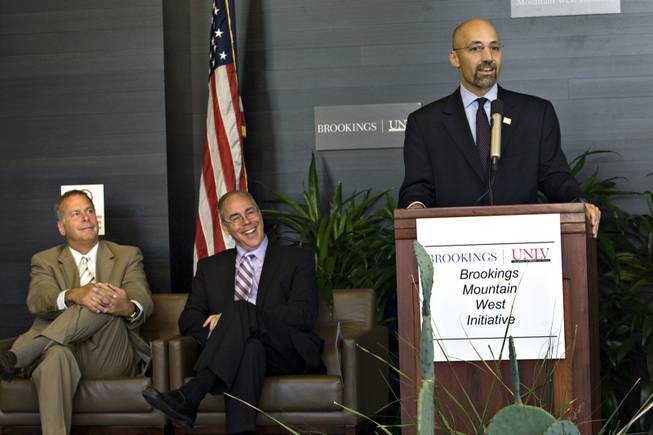
Brian Greenspun, left, and UNLV President Neal Smatresk listen as new director William Antholis speaks at the announcement of the Brookings Institution’s new Mountain West Initiative at UNLV’s Greenspun Hall on Tuesday, Sept. 8, 2009.
Tuesday, Sept. 8, 2009 | 3:03 p.m.
Brookings Institution Annoucement
Viewing video requires the latest version of Adobe's Flash Player
The Brookings Institution and UNLV announced its new Mountain West Initiative Tuesday morning at UNLV's Greenspun Hall.
Yes, things are bad Las Vegas, but there’s hope if you look in the right places.
That’s the view of urban policy experts Mark Muro and Robert Lang, who kicked off UNLV’s new relationship with the Brookings Institution on Tuesday with a state-of-the-city lecture on the UNLV campus.
Aside from the obvious bad news that Las Vegas residents are dealing with every day – record unemployment, sky high foreclosure rates, massive structural budget deficits – Las Vegas has other important deficiencies, Muro said.
There’s a weak transportation system, with no highway between here and Phoenix and just four lanes to Los Angeles. There’s no rail system. The valley is almost entirely auto-dependent.
Very little of the population is employed in research and development, which is the mark of widely shared and sustainable prosperity in other cities such as San Jose and Salt Lake City.
Lang offered a more hopeful vision. He said the growth of the convention business in Las Vegas is a great untold business story, as the city has become a vital trading hub, a rich cultivator of sales relationships and new business networks.
“In the end, you have to look someone in the eye and trust them,” he noted, explaining the importance of trade shows.
Las Vegas, he said, “is a leading market exchange for establishing relationships.”
Lang said policymakers should focus on creating an environment where those conventioneers create a permanent home for their businesses here, much as the biotechnology industry moved to the Bay Area in the wake of important conferences there in the 1970s. He noted that this has happened with the furniture industry in Las Vegas.
Lang apparently believes in a thriving future for Las Vegas. He is moving here.
Find additional coverage in Wednesday’s edition of the Las Vegas Sun.



This is amazing. Its like I have been saying, having UNLV expand and develop a heavier research focus would be a great way to diversify our economy. It will be interesting to see what comes of this.
This is so huge and so exciting... congratulations, UNLV, Brookings, Lincy...
Academic hogwash.... How is this going to help Vegas recover in any way? Maybe someone based in reality rather than academics can give us a clue!!
Dipstick, about 10,000 people daily drove between Phoenix and Las Vegas in the mid-2000s. That's about 60 planeloads of people. I don't think there are 60 flights daily between Phoenix and Vegas.
blah, blah, blah..... we are living up to our name TRASH VEGAS! Stop the rah rah rah. Face reality
dave202, felix28, what is so hard to understand about this article?
Using real world examples in Salt Lake and San Jose, the plan is to diversify the Las Vegas economy by introducing more technological research oriented jobs which are proven to be far more stable compared to construction and tourism oriented jobs.
This is the same group that helped organize the Marshal Plan that fixed war torn Germany after ww2. They also assisted in forming the New Deal and the military mobilization of the USA during WW2. For decades they were liked by every presidential administration for there research capabilities (save for Nixon) and it is considered one of the greatest think tanks the world has ever seen.
They tackle very real problems and have produced very real results. To blow them off because they are to "academic" for you would be the biggest mistake Vegas could ever make.
Biotech coalesced around SF because Berkeley and Stanford are around SF. Other reputable schools are also in and around the Bay Area, the University of San Francisco and U.C. Davis, just to name another two. UNLV doesn't even hold a candle to Cal State Hayward (Cal State East Bay).
That said, what are we going to do? Give up? Heck no. We have to start somewhere, though unfortunately, we're starting at the very bottom. But tightening enrollment standards and attracting feature institutes like this can perhaps slowly start attracting quality faculty and students. When a critical mass of talented students start to graduate, both homegrown and transplant hi-tech firms will put down roots, here in the valley.
It's not like we have a choice. Growth from construction is dead, and good riddance to that anyway. The strip is in for hard times -it will survive, but will be leaner and meaner to do so. So this is a step, albeit a baby step, in one of the directions we must go. I'm behind this.