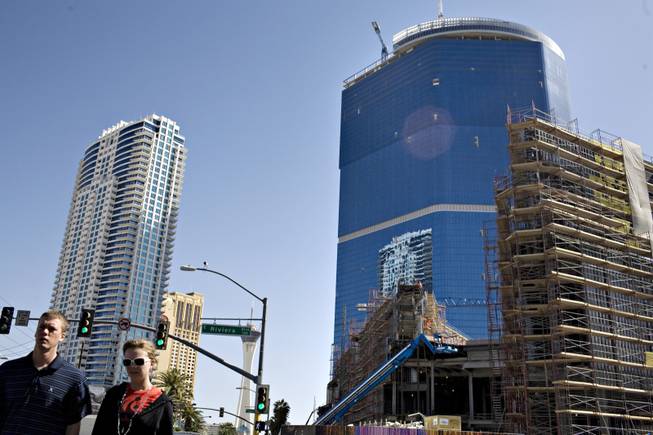
Though close to finished, the Fontainebleau may cost another $1.5 billion to complete, on top of $1 billion already owed to lenders.
Published Tuesday, Nov. 17, 2009 | 7:15 a.m.
Updated Tuesday, Nov. 17, 2009 | 10:09 a.m.
Related Document (.pdf)
Sun Archives
- Fontainebleau subcontractors organize to finish project (11-5-2009)
- Fontainebleau developer plans appeal of rulings (11-2-2009)
- Subcontractors fall short in effort to move Fontainebleau case (10-26-2009)
- Executive named examiner in Fontainebleau bankruptcy case (10-16-2009)
- Fontainebleau president among execs leaving project (10-15-2009)
- Fontainebleau a symbol of bad timing, not the only victim (10-12-2009)
- Fontainebleau judge wants quick sale of bankrupt project (10-2-2009)
- In reversal, Fontainebleau lenders suggest liquidation (9-25-2009)
- Fontainebleau: Bank no longer ‘seeking to destroy’ project (9-17-2009)
Penn National Gaming Inc. on Monday made a $50 million "stalking horse" bid to buy the stalled Fontainebleau casino-resort in Las Vegas, with plans to spend another $1.46 billion to complete the project.
Penn's offer, filed in Miami's bankruptcy court, sets in place an auction process in which other investors will have an opportunity to bid for the property.
Fontainebleau also said in a court motion Monday that Penn National and unnamed lenders have agreed to provide $51.5 million in debtor-in-possession financing to cover its costs since filing for bankruptcy and to keep the company afloat during the sales process.
Court papers indicated Penn National has committed $50 million to buy the project, less unspecified "remediation costs" and costs to cure defaults on leases and contracts it would inherit.
The Penn affiliate offering to buy the project is Nevada Gaming Ventures Inc. Penn for some time has been looking at opportunities to enter the Las Vegas gambling market, the nation's largest.
In a regulatory filing, Penn said that if it purchases the resort for the $50 million, less the adjustments, Fontainebleau will not have to re-pay the debtor-in-possession loan.
If the deal doesn't go through, Fontainebleau will have to repay the loan and under certain circumstances agreed to pay Penn National a break-up fee of up to $1.5 million.
Other companies or individuals not currently active in the Las Vegas gaming market may team up with Penn as investors or financing sources for Fontainebleau, Fontainebleau said in court papers Monday.
Fontainebleau is proposing a Jan. 15 deadline for competing bids for the project.
Penn National, based in Wyomissing, Pa., agreed in Monday's sales contract that the target completion cost for the project is $1.46 billion and that it would share with Fontainebleau's owners any cost savings achieved if the project comes in at less than that amount.
Approval of the Penn deal is not a sure thing, as Penn in the contract disclaims liabilities for Fontainebleau's existing bank loans, bondholder debt and contractors liens.
A group of contractors, believed to be owed $350 million to $400 million, has said it's looking for investors and partners to team up with in acquiring the project so its members' liens can be paid.
Executives and attorneys for Fontainebleau, Penn National and the bankruptcy case's examiner have spent weeks crafting Monday's 82-page sales agreement and it's unclear -- given the depressed state of the gaming industry -- whether other potential investors will step up to commit the time and money necessary to make a competing bid.
But attorneys for Fontainebleau said they're hopeful Monday's bid is not the only offer for the project, which was developed by affiliates of Miami-based Turnberry Associates. Turnberry is known in Las Vegas for developing high-rise luxury condominiums and the Town Square Shopping Center.
"The debtors are both hopeful and optimistic that finalizing the purchase agreement marks the beginning of a competitive sale process that will drive substantial incremental value to the debtors' estates and their creditors over and above the purchase price offered by Nevada Gaming Ventures," Fontainebleau attorneys said in Monday's court filing.
Once valued at $2.9 billion, $1.675 billion has been borrowed against the 3,815-room Fontainebleau, where construction shut down this summer after Bank of America and other big banks canceled a loan agreement because of cost overruns and other problems.



Fifty million less costs? It's literally a token amount, and a reflection of how much that "blue elephant" is really worth...nothing! Is it possible that another entity might offer more for it? Sure, I suppose, but why would anyone want to? There's too much capacity in LV and it will be years before it can all be absorbed. Those who suggest imploding it do so only half in jest.
I bid $52 million. Where do I pick up the keys?
ok let me get this straight.penn national and unnamed lenders put up 51.5 million to keep fountainebleau operating until there's a resolution to the sale process.so penn's offer for a 3 billion dollar project is 50 million,minus leases and contracts that fountainebleau owes.
Anyone else out there? Anyone who wants F-bleau? If not, then Penn will be getting it in a real steal of a deal! I hope they'll finish it soon so that it won't be just another North Strip "abandoned construction" eyesore. Hopefully by late 2010 and early 2011, the economy will have recovered enough to absorb the new rooms online.
It's a beautiful tower, just needs to be completed for whatever use it will have.
I hope that Penn National will change the name from the Fountainebleau.
Hmmm.... Let's see, it needs to say something about Penn National.
How about PENNetrate?
The feds are looking for a place to house the Gitmo terrorists.
rejco:
I used to work in one of those IBM Office towers back in Chicago!!!! The IBM Building right on the river. I remember back in the 80's workers coming in and removing the asbestos in the ceilings and walls - and all that was done to protect us was putting up plastic tarps.
Anyone who puts a dime into that place is crazy. I cannot see it ever turning a profit.
"A group of contractors, believed to be owed $350 million to $400 million, has said it's looking for investors and partners to team up with in acquiring the project so its members' liens can be paid."
ROFLOL!!!!
Of course this is what they want. And out of the 7 billion or so people on the planet precisely 0 are going to agree to that. Too bad for them.
Wave liens bye bye! :sadwave:
It looks like an insurance building in mid-town Manhattan. I don't know when Vegas casinos decided to ditch the unique architecture in favor of sterile blue glass buildings.
This sort of sale, at a price well below the total of the liens on the property, is made under Section 363 of the Bankruptcy Code.
It used to be, as a matter of due process, and as expressly stated in the code section, that the Bankruptcy Court Judge couldn't sell a property under Secftion 363 unless the sale proceeds totalled the lien amounts or unless the individual lien holders agreed to take a discount.
Were the "real" text of that law to apply, Fontainbleau could not be sold unless the "group of contractors, believed to be owed $350 million to $400 million in liens" would be paid.
However, thanks to the Obama Administration's intense pressure on the bankruptcy courts in New York, at the height of the Chrysler bankruptcy, the real text of Section 363 was completely disregarded, and Chrysler was sold even though there was a group of dissident lienholders who refused to take pennies on the dollar. The Chrysler bankruptcy judge said "Too bad, I'm selling this property". The dissidents got nowhere on their appeals to the U.S. District Court, and the U.S. Supreme Court refused to stop the sale while the issue over forcibly taking away the lienholders rights, without any compensation, was litigated.
The proper way to sell a property like Fontainbleau, free and clear of lienholders rights even though they are not being paid in full, is to get a Chapter 11 Plan approved by a majority of creditors, under the Chapter 11 Plan procedures set forth in the Bankruptcy Code. However, now bankruptcy judges like the one on the Fontainbleau case have become lazy and impatient, and lienholders are routinely being deprived of what they own, by Section 363 sales, without full compensation to which they are entitled by that code section.
If the mechanics lien claimants lose their liens when this Fontainebleau project is sold, and never get paid anything, they will have the Obama Administration, the Second Circuit Court of Appeal and the Supreme Court to thank.
Basic constitutional protections for businesses are being destroyed in the name of protecting the economy, and then people wonder why it's nearly impossible to get a loan to operate a business or build a new commercial property.
I've said it before and I'll say it again...
Implode.
Fontainbleau's owners have always said that they did not put the retail portion of the project real estate into bankruptcy, because it would do not good, because one of the mortgage lenders on that retail property is the bankrupt Lehman Brothers.
The logical reason Fontainbleau's owners had been saying that, in connection with the sale of the Fontainbleau retail property, is that the Miami based Bankruptcy Court cannot take away the mortgage lien of bankrupt Lehman Brothers without the New York based Bankruptcy Court's approval.
In the agreement to sell Fontainebleau, posted by the Sun, the agreement initially calls for the sale of both the hotel and the retail portions of the project.
However, buried in the agreement, at Paragraph 2.2(b) on Page 24 is a provision saying the sellers can pull the retail portion of the project out of the sale, at will.
It seems like that provision is a nod to the power of the Bankruptcy Court in New York to protect the interests of bankrupt Lehman Brothers. The Lehman Brothers bankruptcy case is in New York, where Bankruptcy Court Judge James M. Peck presides.
From watching the actions and rulings of Judge Peck for more than a year, and from reading the occasional transcript in that Lehman Brothers bankruptcy case, I think the chance of Judge Peck agreeing to release, for free, that Lehman Brothers mortgage loan money claim and lien on the retail portion of Fontainebleau are slim to none.
So the real world conclusion: The Miami bankruptcy judge cannot take away bankrupt Lehman Brothers mortgage lien on Fontainebleau's retail project, but he can take away the mechanics lienholders' claims, giving them nothing.
Very nice. Justice in America.
At appx. $1.5 billion to complete, this is still a risky investment for Penn. That is the real tale of what is going on here. $50 million is just to get the process going. It does not reflect the real cost of investment for the company obviously.
Let's just finish this DEAD HORSE put the guys back to work and stop all these idiots from makeing future COMMENTS!!!
One other interesting concept in the Fontainebleau purchase agreement is the concept of "Remediation". That term is effectively defined, on Pages 14 and 25, as the cost to fix construction defects and weather damage to the Fontainebleau tower.
Section 2.5, starting at page 25, describes in detail how an "Inspection Team" of inspectors, led by "Thalden Team" is going to inspect the buildings twice. That Inspection Team is supposed to determine the probable costs of that "Remediation".
The contract then sends one back into the definitions, to "Material Adverse Effect" on Page 11. The general concept is that the buyers can back out of the deal if there is a Material Adverse Effect on the building, prior to the sale closing, if the Material Adverse Effect has a damage amount to the extent of $75 Million after insurance. However, the agreement then gets really weird in defining Material Adverse Effect, containing two phrases which are very rare:
A "Material Adverse Effect" will be deemed to have occurred if "(y) the building and improvements on or in the Real Property or a material portion thereof collapse or (z) there exists or occurs any Defect (other than any Defect existing as of the date hereof to the extent neither structural or latent) (1) that, individually or in the aggregate, presents a material risk of collapse of the buildings or improvements on or in the Real Property or any portion thereof"
Not if they burn in a fire. Not if they are substantially damaged in a wind storm. Not if the glass facade is substantially damaged by some freak accident. But instead IF THE BUILDING COLLAPSES.
What exactly is Penn National Gaming and its New York based lawyers worried about? The potential for a collapse in an earthquake? The potential for collapse if the building is hit by an airplane? The potential for a collapse because of negligence on the part of Clark County's building inspectors ala the mistakes in inspecting the Harmon Tower at City Center?
Here's an investigative story for you Steve Green.
Tungchow,
Some readers have written decent opinions on this thread. In fact, CynicalObserver seems to have researched the case long enough to have a very informed opinion. Furthermore, his writing flows in a manner that makes his ideas easy to understand. In other words, he's not an idiot.
As far as my opinion is concerned, the lien holders need some recompense. It's only fair.
Second, the project needs to be finished. Even if some think the building is ugly, it will still lure plenty of guests once it's doors are open. From the outside, it hardly looks inspiring. It's no Bellagio. I think the same thing about New York's Empire State Building. It's not nearly as beautiful as the Chrysler Building. Funny though that both buildings have stood the test of time for nearly 80 years.
Yes, Tungchow, let's finish it.
"A far as my opinion is concerned, the lien holders need some recompense. It's only fair."
"Second, the project needs to be finished."
I think the problem the bankruptcy court deals with is the fact that it may be impossible to satisfy both conditions. If the lienholders must be paid "$350 million to $400 million", then there may be nobody willing to buy the building and complete it.
Question: Why would anyone (even as a group) let a debtor get into them for $400 million? That doesn't seem like smart business.
I bid 53,000,000.00
$299 Down and $99/Month for 137 years
(It may take this long to re-coup my costs)
The only casinos within reasonable walking distance of Fontainbleau are Circus Circua, Riviera and Sahara, all ancent bottom-end hotels. Penn will have a hotel that was designed to be high end, with condos that are impossible to sell in todays market, that they will have to market to the lower end of the market. Penn is taking a substantial risk, even if they pay nothing ($50 million) for the property as it exists today. It will be 2011 by the time Penn can open, and they will then have over a billion invested, and the market could deteriorate evenfurther by then, with even more capacity (City Center) driving room rates lower. Penn might want a Las Vegas presence to promote their existing portfolio of riverboats, although coming up with $1 billion plus at the same time they have to invest at least $250 million each in 2 Ohio casinos might be a problem in todays credit market. What ever happened to the concept that the way to economically revitalize a city was to introduce casino gambling? Wait 10 years and look at what will be left of Las Vegas.
Maybe they can implode it and rebuild the Stardust?
Anybody think Penn National is just trying to buy it cheap and hold onto the land and build something else in the future? Or flip it in 20-years? I'm serious. It's property on the strip and if you can get it when it's undervalued now and sell it when the market corrects itself later on down the line then what's wrong with that for Penn National? I'm not saying that will help Las Vegas, but it makes good business sense. Penn National may never open F-Blue, they might just implode it and have the debris hauled off and sit on the property for years and sell it to some developer in 2029. It seems like the demand for high end resorts has been met for now to me. Ah... All we can do is speculate. We don't have access to the information and the relationships these big wigs do. We're just the ants marching to their beat...
If ever there was a case for "pure ugly" in hi-rise design, F-Blue would easily qualify for a seat in the finals. Someone actually thought this attractive?
This property has lots of potential as a hotel/casino. It just needs to be completed, and marketed to the every day person looking for value and a fair gamble. There are plenty of 'em out there just waiting for a good deal in today's crap economy. It doesn't need to be anything to fancy, just finish it, dress it up and call it The New Stardust or something and get on with it.
Just wondering what could happen if the subcontractors get stiffed and eat their entire contract.
1. If the Fire Protection Contractor is owed 5 Million, and gets nothing, does he simply walk away while the unfinished floors are littered with his equipment? Since it's for sure he won't have a thing to do with PNG, does the Contractor conduct a commando raid on the building, since he may have already paid for much of the stuff? So he owns it. Does PNG have the right to confiscate the equipment? I don't think so.
2. The Unions. If Union contractors are stiffed by PNG, will the Unions simply allow PNG to hire new Union contractors to finish the project? And say "Screw you" to the first contractor? Unions aren't famous for their ethics, but this time it might be right for them to get off their lazy butts, and protest such actions.
3. And what about the City? Does it care that Contractors are being screwed? Do they just go along with that massive POS proposal from PNG that literally absolves them of any impact of any kind at any time for anything?
This PNG is starting to stink big time. That judge in FLA smells just like them. This is a giant BK joke, and to reference CynicalObserver, it's obvious that PNG is taking the Chrysler way, and stiffing everyone in sight. Thanks, Barack and Geithner, you've created a monster.
I would be willing to volunteer a week's worth of time (unpaid, of course) just to put in a few missing windows to spruce it up a bit, then maybe the price tag could skyrocket to $75M
More Deal Terms from the Fontainbleau Asset Purchase Agreement, Part 1:
It should be noted there is no guarantee Bankruptcy Court Judge Cristol, in Miami, will approve the Asset Purchase Agreement signed by Fontainebleau as seller/debtor and a Penn National subsidiary as buyer. For example, there will be aggressive objections from Fontainebleau creditors who will receive nothing from the sale. However, the unique provisions in the Asset Purchase Agreement are worth mentioning:
Recital C on the first page of the Asset Purchase Agreement posted by the Sun, provides that Penn National is paying $50,000,000 for the Fontainebleau (where the money will go to Forntainebleau's most senior lien creditor) plus Penn National will make a $53 Million loan directly to Fontainbleau. How Fontainbleau will use that loan money is not stated. When and how Fontainbleau will pay back that loan is not stated.
Section 2.10(a)(ii) and (iii) say that if Penn National buys Fontainebleau, Penn National has no obligation to complete the development of the project, or a casino, or a hotel, or an entertainment complex on the property.
Section 2.10(a) says that there Penn National has sole and absolute discretion concerning the manner in which the project is finished, in terms of design, construction and decoration decision making.
Section 2.10(c) says that on the earlier of (a) a resale of the Fontainbleau within one year after purchase by Penn National, or (b) three (3) years after the project is completed and open to the public, the seller (i.e. the Fontainbleau bankruptcy creditors) may get a "Contingent Payment" from Penn National, based upon the ultimate cost completing construction, furnishing and fixturizing the project. There's no way to tell how much that Contingent Payment will be, because it is dependent on ultimate costs to complete, fixturize and furnish the hotel/casino in the manner determined by Penn National.
However, the formula for calculation of the Contingent Payment is described in Paragraph (e) on page 36. The payment is 50% of Penn National's cost savings on completion of the project, as compared with a completion cost estimated made by the parties now. If the project is sold within that period, the Contingent Payment is 33.3% of Penn National's cost savings on completion of the project, as compared with that completion cost estimate made by the parties now. If the completion costs exceed that estimate, the seller's bankruptcy estate receives nothing at the three year mark or when the project is sold. Essentially, the meaning of this paragraph is that if Penn National decides to finish the project "on the cheap" the seller bankruptcy estate gets a piece of the cost savings.
More Deal Terms from the Fontainbleau Asset Purchase Agreement, Part 2:
Under Section 3.7, the actual bankruptcy court auction under the proposed auction process will be in late January 2010, if the judge approves.
Section 4.1(j) of the agreement recites that the buyer may want to assume certain construction subcontracts and other contracts associated with the project, implicitly at the "stale" prices under those subcontracts and contracts which were entered into so long ago. Under Bankruptcy Code Section 365, the debtor's power to do that exists, and that power is being assigned to Penn National.
At the bottom of page 42, there is a fascinating representation that the presently existing "groundwater treatment system for the dewatering system" for the project is operating in accordance with the requirements of the Nevada Department of Environmental Assessment. [Does this project have underground water problems like the Cosmopolitan???]
On page 51, paragraph 5.6(a) provides that "Prior to the revocation of the Nevada General Contractor License of Turnberry West Construction, Inc. ("TWC") the sellers will use commercially reasonable efforts to cause TWC to transfer the [building] Permits to a general contractor reasonable satisfactory to Purchaser and Sellers. [Looks like Turnberry thinks they are going to lose their license because they haven't and won't be paying their subcontractors.]
Section 5.8 says the sellers will make no press releases without approval thereof by Penn National.
More Deal Terms from the Fontainbleau Asset Purchase Agreement, Part 3:
Under subparagraph (d)(ii)(B) on page 55, the closing of the sale will not occur unless Clark County issues a letter of assurance to Penn National in the form Penn National wants.
Section 8.1(b) requires the closing of the sale to occur no later than February 9, 2010.
Subsection (h) on Page 62 requires a filing of a Chapter 11 bankruptcy for the owner of the retail complex at Fontainebleau, and requires that the bankruptcy judge for that retail entity (probably Judge Cristol) has to approve this sale. [Reprise: However if Lehman Brothers' Bankruptcy Judge Peck won't approve the release of Lehman Brothers' mortgage on the commercial part of the project, for free, Penn National has the option to simply scrap its purchase of that commercial property but still buy the hotel and casino.]
Section 8.3 on page 63 provides that if Penn National is overbid at the auction, and ultimately does not win the auction, Penn National will be paid a "Break Up Fee" equal to 3% of $101,503,734.
There are lots of other very interesting and complicated terms in this purchase agreement, and anyone directly involved in the Fontainebleau case should try to read it. However, the foregoing is enough information for the average person interested in the project.
Some responses to NedNougat's questions Part 1:
1. If the Fire Protection Contractor is owed 5 Million, and gets nothing, does he simply walk away while the unfinished floors are littered with his equipment? Does PNG have the right to confiscate the equipment? I don't think so.
If he has equipment left in the building, he can hire an attorney in Miami to file a motion asking the judge for an order to let him into the building to get it. However he will probably have to prove the equipment is his, because there's a bankruptcy case law presumption in belongs to Fontainebleau, simply because the equipment was left there.
If there are stacks of supplies he paid for, but the debtor didn't same deal as above. However, if the stuff has been installed, by this late date in the case he doesn't have the right to come in and rip it out.
2. The Unions. If Union contractors are stiffed by PNG, will the Unions simply allow PNG to hire new Union contractors to finish the project? And say "Screw you" to the first contractor?
Yes to the hiring of new union contractors, even if old union contractors were stiffed. A key question will be whether any unin multi-employer pension funds were stiffed out of contributions by Fontainebleau. If yes, there may be resistance by the union to letting its members work for a new finish-up contractor, but realistically the union workers need jobs so I think there will be peace not resistance.
Response to NedNougat's Questions Part 2:
3. And what about the City? Does it care that Contractors are being screwed? Do they just go along with that massive POS proposal from PNG that literally absolves them of any impact of any kind at any time for anything?
Your question gets into one of the most sensitive areas of the conflict between the bankruptcy courts and state/local government. The bankruptcy judge has no power to force a city, county or state to do anything, or agree to anything, but if the public agencies are "asleep at the switch" the lawyers for the buyer load up the 363 Agreement or Chapter 11 plan with all sorts of stuff violating "States Rights", and the state, county, city governments just get stuck with the bankruptcy court's order. This is a huge problem in California right now, with aggressive bankruptcy lawyers and stupid/asleep at the switch public agency lawyers. BTW, the 10th and 11th Amendments to the U.S. Constitution ("States Rights") as well as 2 key bankruptcy code sections which protect those rights are the key laws affecting state, city and county agencies which bankruptcy judges violate with impunity across the country unless someone vehemently objects.
As to the Asset Purchase Agreement, I read the whole thing and didn't see any provision ordering the County or the City or the State to do anything. However, I did not get to read the proposed order from the judge, to approve this sale, so there might be obnoxious unconstituional stuff in it, trying to push the state, city and county around.
However, realistically, we all know that all of our public agencies will bend over backwards to get this project going, so I suspect they will sign whatever Penn National puts under their noses.
OK commenters who know something about Fontainebleau, I want your opinion on whether Penn National Gaming has realistic concerns about the tower or the shorter commercial building actually collapsing prior to the closing of the sale in February 2010?
If you don't know what I'm talking about, read the quote from the purchase contract above.
Do they know something we don't know about the Fontainebleau buildings, like more big time screw ups by city or county building inspectors and structural subcontractors, in the nature which casused the shortening of the Harmon Tower at City Center?
How about legalizing prostitution in Vegas and make this the first-ever massage parlor casino club every on the Strip. There's enough floors available to guarantee enough privacy for the high-rollers going for some trick-job done to them.
Great stuff, CynicalO. Great. Please elucidate this particular section you quoted:
Section 8.3 on page 63 provides that if Penn National is overbid at the auction, and ultimately does not win the auction, Penn National will be paid a "Break Up Fee" equal to 3% of $101,503,734.
Who pays this tribute? The winning bidder? Why would a company pay 3 mil extra to get this disaster? But now I have to ask the stupid question-Who signs and agrees to this ridiculous proposal? I guess it's FBleu, but since the project is insolvent, and they keep saying that they are trying to get the best "incremental value for their debtors", and they hope there are other bidders to "increase the value" of the deal, my question is simply this-Since the "Stalking Horse" proposal is obviously going to be the only proposal, aren't FB and PNG simply going through the motions hand in hand, with FB bailing out under BK, and PNG getting the projects for dimes on the dollar? What kind of judge thinks that this proposal is proper with all the obvious collusion occurring? No other company in its right mind would want to get involved in this mess. Something really stinks here, and it sure does look like BK is the way-today. No wonder several of my friends are dumping their houses under BK, and moving to classier digs down the street, despite no financial problems of any kind. Seems the sh*t will have to hit the fan someday.
guns4hire, Steelman was the design architect, but Carlos Zapata out of NY designed the exterior. His original design (prior to VE) had two "knife-blade" appendages that extended out from the perimeter of the building at the roof level.Included in one of the appendages was a swimming pool, but sadly these incredible features didn't make it past TWC's myopic/amateur management team.
BTW, Recently heard that it is costing $5.3 million a month to keep this "blue elephant secure" and non-functional !!
Sincere "Thanks" to CynicalObserver for your informed , intelligent and very interesting comprehension as offered to the sales agreement submitted by PNG.
I have followed the Fontainebleau story with great interest for a number of months and find it all to be fascinating !
The "collapse clause" is interesting insomuch as to think that something concerning the structural integrity may be suspect and will be given greater attention during the inspection process. Or are they merely protecting their selves against non-acts of god ?
I have read the agreement and will not pretend to understand the content in the complete legal sense , but it would seem that Fontainebleau is not compelled to accept this agreement even if approved by the court ... and that Fontainebleau knowing that for whatever the eventual outcome ,( that they are really not in position to effect ) would best serve their own interests by not being seen to endorse any sale where compensation to lien holders is non-existent to the agreement. ( ? )
penn nat. patrionizes the smaller player in their other casinos, might turn things around if given the chance.
Maybe Penn would be good small fry to have and might run the old dinosaurs (MGM/Mirage & Harrah's) down.
Another boring looking blue glass hotel that looks like an office building. It could be part of City Center with its lack of exterior uniqueness.
The plan was to be a nice competitor next to the Echelon that, once finished, in a great economy, would attract thousands of players, daily. Then, under such circomstances, the F-Bleau would have a great location and make good business.
Boyd Gaming was smart enough to skip its plan long time ago when they realized that there's no chance of survival for such a highly ambituous project. The F-Bleau people thought about differently and fell on their nose.
Since the builing is pretty much like a bank tower, it would be something for Bank of America or Wells Fargo. Great office space in the center of Vegas. Or perhaps a FBI building.
hey i hope no one's anywhere near that place when it goes down
my husband is one of the contractors that is getting screwed in this deal
the day they closed the site down, all of the contractors were kicked off and weren't given the opportunity to remove their equipment; they were told they would be contacted in a couple weeks to come back and either finish or remove their stuff...never happened
a side note to Penn making the bid...they have been working with a small local company that has an incredibly bad track record, to come in with them and run the management part of finishing the project...if Penn gets this, its going to turn into an even bigger mess
O.K.
My Final bid is $53,000,002.67
I will put $599/down and pay $139.75 a month for the next 277 years.
That is all...
The Fontainebleau site consist of 24.5 acres on the Las Vegas strip. If the $50 million bid is the entire purchase price free of any liens or debts then Penn is getting the land (plus some huge building liability) for just over $2 million an acre. Just a few years ago it was not unheard of for land on the strip to sell for between $10 and $30 million dollars an acre. Based of the language of the asset purchase agreement it almost sounds like this might just be a land play by Penn. They can demolish the current structure and build an entirely new building to their own taste for likely less than it will cost to finish the existing structure.
Maybe they could obtain the Stardust name from Boyd Group and give Las Vegas a fresh new outlook.
I agree the place is ugly so why don't they make the joint into a all state Cathouse and get the card Thumpers off the strip that are bothering the paying guests of Las Vegas. And then turn a profit.
There's a big money hedge fund out of
Chicago Citadel run by Ken Griffen.
He has a big position in F-bleau.
Also gave alot of campaign money to
Obama. Reid can't be far behind.