TRANSPORTATION:
Public or private, rail line will need major subsidies from government
Sunday, June 14, 2009 | 2 a.m.
Reader poll
Sun Archives
- Maglev train to press on without Reid (6-10-2009)
- Reid sides with Desert Xpress fast train option (6-9-2009)
- State sends no representative to talk on high-speed trains (6-5-2009)
- Obama outlines vision for high-speed rail network (4-16-2009)
- 8 states seek stimulus money for high-speed rail (4-15-2009)
- No waste in rail dream (3-5-2009)
- Economic crisis an opportunity to be greener (3-1-2009)
- Vegas, Midwest seek the $8 billion for fast trains (2-23-2009)
- Calif. bond would launch bullet train project (9-26-2008)
Sun Coverage
Railroad building is not for the financially timid.
Except for a few tourist trains hauling sightseers up scenic mountains, private passenger rail companies don’t exist in this country for a reason.
Railroads don’t make money.
“Transportation of this sort in this country is not something that’s at all profitable,” said Clifford Winston, a senior fellow at the Brookings Institution in economic studies. “Passenger rail on its own cannot make money.”
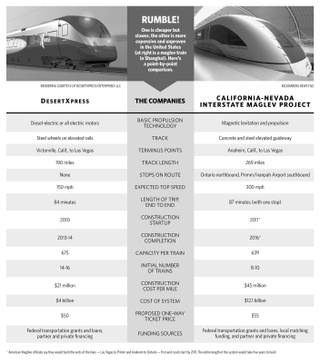
Two proposed Nevada projects show different approaches to developing rail.
The maglev project is a nonprofit entity, overseen by the California-Nevada Super Speed Train Commission, founded by the governments of both states. It hopes to tap the $8 billion the Obama administration and Congress have unleashed for high-speed rail development as part of the economic recovery act.
DesertXpress is a private undertaking, bankrolled at least in part by a few powerful and profit-minded Nevada figures. The company believes the Vegas-to-California route is so lucrative, it will accomplish what no private venture has successfully done in the United States.
Subsidies Common
Rail has always been a public-private undertaking, from the time the federal government awarded land to build the nation’s first passenger train lines more than a century ago to the formation of Amtrak in 1970.
With the government deeply subsidizing other forms of transportation, it would be difficult for rail to compete without such an assist.
Highways are subsidized by the collection of gas taxes at the pumps. Airports are built and expanded with taxpayer dollars. That rail could go it alone seems doubtful.
Robert Puentes, a senior fellow at the Brookings Institution’s Metropolitan Policy Program in Washington, said the nation’s financial crisis has upturned traditional ways of doing business, creating an opportunity for creative financial endeavors, such as leveraging private money to support innovation.
DesertXpress initially prized its status as the nation’s only privately-proposed passenger rail line. “We think that’s unique feature,” president Tom Stone said recently.
But the company has also increasingly suggested it would be interested in low-cost government loans available for rail development, given the stingy credit market.
An existing government loan program offers 100 percent financing for up to 35 years to develop rail lines.
Winston has seen this private-public financing model before, and his analysis is not kind.
“These private concerns have an interest in these projects. Then they get into it and they say they need funding from the government. Then the whole thing falls apart.”
Public and proud
The publicly-established maglev commission faces its own limitations. It was established by the two states as a nonprofit entity to develop a long-wanted fast train between Las Vegas and Anaheim.
As proud as DesertXpress is of being private, the maglev’s project is equally strident about its standing as a public enterprise that would plow its profits back into operations.
“The commission is going to own it,” said Neil Cummings, president of the American Magline Group, the private consortium of companies that would build the maglev train. “That’s real different from DesertXpress.”
When the group made its case to Transportation Secretary Ray LaHood for stimulus dollars, it vowed to repay any government funding received.
Cummings says the train will make $500 million annually in profit.
“You give us $12 billion to build the whole thing, we’ll pay it back — it may take 20 years,” Cummings recalled telling the secretary. “We’re not looking for a handout.”
Yet the governance of the commission presents challenges.
The California side dropped out of the commission in 1990s, when the state Legislature declined to re-up the law that authorized state involvement.
About that time, California was moving forward on its priority project, the 800-mile north-south line between San Francisco and Orange County that it hopes to break ground on in coming years as perhaps the nation’s most ambitious rail undertaking. The $45 billion route is expected to receive a sizable portion of the $8 billion in economic recovery funds.
As California parted ways with maglev, the commission has been left as primarily a Nevada-sponsored agency, with no official government-backed standing to build a rail line in California.
The maglev commission has pressed on with support from various California government leaders.
County commissioners and transportation agencies along the route support the maglev project, as do high-profile leaders, including the Anaheim mayor. The project also has some documented backing from the California Transportation Department, Caltrans.
Reid takes a stand
Senate Majority Leader Harry Reid, who had long campaigned for the maglev project but has grown weary of waiting for it, now supports DesertXpress. California’s two senators, Dianne Feinstein and Barbara Boxer, have not taken positions on either project.
In Nevada, many political leaders support both projects and say they’ll be happy if either is built.
“I don’t think Sen. Reid’s announcement makes it any easier for them,” Democratic Rep. Shelley Berkley said of the maglev effort. “But if they have their ducks in order, their project is worthy, I see no reason why they can’t receive some of this grant money.”
Winston, at Brookings, has seen this model before, too: a company, or in this case a consortium of companies, that wants to build a massive federal infrastructure project. It partners with a publicly-sanctioned body as its chief contractor, as American Magline Group has done. In many ways, it’s not wholly different from a private venture.
Profits, in this case, are not made in the form of earnings returned to investors, but in the contracts awarded to the companies building the thing.
That is a model used on public infrastructure projects across the nation, he said.
“There won’t be any profit — their profit is their job,” Winston said.
Designation desired
Since Obama took office, Reid has been in frequent contact with the White House, pressing the need to establish the Nevada-California region as a priority high-speed rail corridor.
The Transportation Department has 10 high-speed rail corridors, established during the Clinton administration. But the transportation secretary has the authority under existing law to name an 11th line.
If the Nevada-California route receives a corridor distinction, depending on how the route is drawn, either of the train proposals could become eligible for government grants or expedited treatment.
And that means government money would go toward building this line.
“I can’t think of any time in history when private and public weren’t intertwined in the development of transportation facilities,” said Martin Wachs, a leading transportation expert and director of the Rand Corp.’s Transportation, Space and Technology Program. “I don’t see any possibility it could be private at all without public involvement.”

Discussion: comments so far…
Comments are moderated by Las Vegas Sun editors. Our goal is not to limit the discussion, but rather to elevate it. Comments should be relevant and contain no abusive language. Comments that are off-topic, vulgar, profane or include personal attacks will be removed. Full comments policy. Additionally, we now display comments from trusted commenters by default. Those wishing to become a trusted commenter need to verify their identity or sign in with Facebook Connect to tie their Facebook account to their Las Vegas Sun account. For more on this change, read our story about how it works and why we did it.
Only trusted comments are displayed on this page. Untrusted comments have expired from this story.
No trusted comments have been posted.
Post a comment
Most Popular
- Viewed
- Discussed
- E-mailed
- UNLV can move forward without the burden of losing streak to San Diego State
- A wife’s wisdom shows birth control issue needn’t be divisive
- Surprise links, negotiated deals addressed by commissioners
- Motorcycle accident claims life of man in northeast valley
- Hope and change and … what’s missing?
- New York mayor has the right idea
- We don’t need a CEO in charge
- Paying our own way
- Country has ‘given’ citizens a lot
- Jerry Tarkanian: Mike Moser impresses yet again on a day to remember former Rebel greats
Blogs
The Kats Report
Color from scene at Thomas & Mack: We have a wire job! Rebels win, and Louie Armstrong sings!
South Point owner Michael Gaughan's take on 'Vegas Stripped': 'I'll give it an 8' (4 Comments)
Author relishes writing the life story of ‘larger-than-life’ Oscar Goodman (3 Comments)
Elsewhere
Landowner: All roads could lead to Uxbridge casino
Revel reveals smoke-free casino opening
Cirque du Soleil show in Sands China casino to close this month
Meet the woman behind Sheldon Adelson
The Sun
Locally owned and independent for more than 50 years.


This is the first article I've ever seen that mentions subsidies for other transport modes. Everything you see about subsidies relates to Amtrak, but no one ever considers the Air Traffic Controllers as an airline subsidy, nor do they consider the advanced radar systems installed by the FAA a subsidy. No one ever asks the airlines to make a profit because of the subsidies, and no one in Congress dictates how many flight attendants they must have. Cerainly no one can claim that highways are profitable, yet they consume vast amounts of taxpayer's money. I am glad that the playing field is finally leveling out, and that rail will be treated as other forms of transport are.
With a few exceptions, most of the trackage that Amtrak uses is limited to 79 MPH by Federal law. This is because Amtrak cannot afford to update 1920's technology, and the freight railroads are satisfied with the speed, so most passenger trains poke along at less than 80 MPH.
I have retired in Italy, a country not known for fast trains. However, 90 MPH is the norm with 120 MPH in long stretches, and that isn't even considered "High speed." High speed is 155+ MPH and that is now coming online in the more populated areas. Maybe the US will someday get something better than a Third World passenger train.
If it would make money, even the casinos would pitch in, since they would benefit most from it. But its probably NOT a good idea.
For one, where is the starting and ending point of this rail? You probably will have to drive to your destination and to the origination point of the train, thus negating most of the advantages.
Secondly, what do you do with your family luggage? Load into the car, then into the train, then off the train into either an expensive taxi or another car you rent?
Third, the car leaves whenever you are ready. The train leaves on a schedule, like planes do. Lets suppose you want to go to Riverside, CA. You have to get to the airport at least 80 minutes prior to the flight. Add another 20 minutes to actually get to the airport. Then there is the 45 minute flight to Ontario,CA and then about another 45 minute ride in a car to Riverside. Add bout 10 more minutes to get from the plane to where you get a ride. You got about 200 minutes, or 3 hrs and 20 minutes. Thats about how long it takes to drive there in a car !!! Not to mention that the airline fares and taxes are more than the gas costs for that trip !!
So how is this train thing going to be attractive ? Of course private enterprise isnt going to be so interested if a little logic like this can be done by just one consumer.
Look at what happens when u get government involved, however. You get the LV monorail that doesnt go to the airport because of political pressures. You get major expansion of McCarran when the NEW airport closer to the Calif border is obviously the way to go for the future.
Public support means taxpayers pay for the losses while capitalists keep all the profit.
Lighth rail, mag rail, high speed rail - it is all a scam to help the rich get rich and stiff the taxpayer with the bill.
This isn't the future, this is the past - we already say this happen in the wild west of the 1800s and we got scammed then too (that is why Arizona even has a constitutional provision prohibiting subsidies to private businesses INCLUDING rail - Nevada allows rail subsidies because we became a state before everyone realized the rail subsidies of the 1800s were a scam).
Europe and Asia have had these high speed trains for years.(and have profitably run them.) We are WAY behind them. We need them here for our future.
profitable for years? not likely...
"France and Japan have each spent roughly (after adjusting for inflation) the same amount of money per capita on high-speed rail as the United States spent on the interstate highway system. Americans use the interstates to travel nearly 4,000 passenger miles and ship more than 2,000 ton-miles of freight per person per year.
By comparison, high-speed rail moves virtually no freight and carries the average resident of Japan less than 400 miles per year, and the average resident of France less than 300 miles per year. It is likely that a few people use them a lot, and most rarely or not at all."
http://www.cato.org/pub_display.php?pub_...
Agree with Mr. Gibbons regarding funding ONLY from private sources.
The article and comments on it have made spot-on good points about the extravagant costs associated with one mode of transportation - be it road, rail or plane - versus another. One topic not touched on, however, is finding ways to reduce those cost or finding new technologies that can do the same. On the latter point, I'd like to suggest Tubular Rail, a patented advanced train technology that, by design, does not need tracks or bridges to run on as do conventional trains, as an advanced train technology whose time has arrived. Cutting the cost of the tracks is a solid and smart way to reduce the build-out costs of conventional trains, even those that reach really high speeds like Maglev or TGVs. Speed is the name of the game in rail, if the goal is to get people out of their cars or off airplanes.
The Discovery Channel, in its show called "FutureTrains," highlights the unique but readily available technology behind Tubular Rail's patented technology. The program notes Maglev trains and France's TGV technology, which may need further improvements if it wants to whisk travelers from LA to SF in less than 2 hours 50 minutes, as the bond issues Californians approved last fall stipulates. But the show, which does not discuss finances of the technologies it features, makes an exception with Tubular Rail, the one train technology that has obviated the need for a continues track or guideway. TR technology cuts the cost of conventional train technology by 50% or more, a selling point that should turn eyes and maybe drop some jaws. Moreover, in addition to its many advances, TR is grade separated, which produces benefits beyond safety and reliability.
Watch it for yourself. Click on "Future Trains": http://www.tubularrail.com/video.htm
Then ask yourself why TR technology shouldn't have it's time at bat at a time when the projected cost of infrastructure will eat us all alive in the near term and never pay for itself in the long run?
To see why one Texas town thinks it can become a transportation center, watch this CBS report on TR coming to Pecos:
CBS 7 West Texas, Midland-Odessa
http://www.cbs7.com/news/details.asp?ID=...
Ah yes, the infamous Cato Institute, founded by donations from big oil to do everything in its power to promote things that use the most oil, in this case roads.
And while the stat that you quoted Patrick isn't wrong, it leaves out something very important that they didn't want you to know. That being the fact that more freight in this country moves by rail, than by road.
A quick look at the states from the National Transportation Database reveals that 40% of the freight ton miles in this country moves by rail. That's the highest percentage by the way. The highly subsidized roads come in at 28% of the ton miles moved in this country, based upon the 2006 numbers the latest year reported.
http://www.bts.gov/publications/national...
And if you think that those who build the roads aren't getting rich off the taxpayer dollars, think again. Just last year We The People had $8 Billion of our Federal Income Tax dollars dumped into the Highway Trust Fund because the fuel taxes collected are not paying for the actual costs of our highways.
The estimate for this year and next is $9 Billion, although it remains unclear if the Stimulus monies dumped into the highways this year will prempt the $9 Billion needed for this year. The estimate jumps to $12 Billion for 2011 & 2012, unless Congress raises the Federal portion of the fuel tax and soon.
And all that's just at the Federal level. Most states also have to subsidize road construction.
Well, it looks like their's some nay-sayers here. Anyway, I've retired in Italy where I don't NEED to drive like you poor folks....you should learn, not thinking you're best...that's arrogance personified. I've seen both sides of the coin, and you guys come up short. For those that have never LIVED outside the US, you'd better rethink some of your basic precepts.
I lived in Vegas for 17 years and can state that you have incredibly few transportation options there...you drive or fly...that's it. When you lose options, you lose freedom. The gas here is is about $8/gallon because of TAX...and that tax is used for public transportation because the gov't believes it gives the population a better standard of living. I can attest to that. I live better here than in the US for the same amount of money.
Outside my door I have 55 buses per hour that take me all over the city and into the countryside. That's equivalent to living out on Durango Blvd and catching a CITY bus that goes to Boulder City, and it takes only 30 minutes because the distances are less. The cost...$30/mos with unlimited rides. We take the bus...or heaven forbid...we WALK....something that Americans have forgotten about.
If I want to go to Milan for example (about the same distance as LV-LA), the airfare is $572 RT and with the travel to/from the airport, check-in and all that, the downtown to downtown time is about 7 hours. The railroad can take as little as 4H 20 min downtown to downtown and costs $111.42. And...it is NOT high-speed, only 90-120 MPH....the standard here. That's a no brainer....we take the train.
An Expedia search for LV-LA flights costs $273 RT. At least 2 hours to get to/from each airport plus 2 hours check-in is a total travel time of about 5 hours. Do you really want to do that?? What is your tax burden for 280 miles of freeway? That all has to be factored in to your cost of travel. It IS expensive...and no one ever looks at that.
Driving here...car cost $15,000, parking place $40,000 (hey...you may spend a half hour looking for a spot on the street, then wind up walking 6 blocks home...people buy garage space), insurance $150/mos...and you haven't turned a wheel yet.
Cars here are for FUN...going on holiday, having lunch in the Carso, and for general sightseeing. They aren't the ONLY mode of transportation, but one of many. We have more freedom here than in the Land Of The Free.
In the end it's FREEDOM of choice. You have no choice in Vegas, and therefore little freedom. Get a life.
Alan B,
1) Who funds Cato is irrelevant to the points they make because I could make the same claims for any opposition leaving us at square 1 in the debate.
2) We would probably move more frieght by rail if trucking wasn't subsidized by the gas tax paid for by everyone else, but that doesn't mean rail should get subsidized. Think of how silly that is. If everything got a subsidy does anything really have a subsidy?
The government can give us nothing before it has taken something from us first. The point is, government subsidies are wrong...period. We shouldn't correct a wrong act by doing another wrong act.
Roger,
So your definition of freedom is to take wealth, by force, from other people and give it to people like yourself so you can move about in different ways?
What nonsense. That isn't freedom that is violence. You have no more rights than anyone else. If you want the freedom to travel by train whip out your pocket book and pay for it. The more you're willing to pay the more likely someone is going to build it for you. But you do not have a right to steal from others so you can enjoy your favorite mode of transportation.
And no, Europeans do not, on average, live better than Americans. Europeans have, on average, just 2/3rds the wealth of the average American. Your anecdotal story does not stand up to the hard empirical evidence.
Patrick,
I'm sorry, but who funds the Cato Institute is relevant if you plan to quote their misleading statistics. If they gave out fair and balanced statistics, then who funds them would be irrelevant. If you weren't using their stats, then it would be irrelevant.
And yes, I agree that if we weren't subsidizing the roads, rail would have an even higher percentage than it does right now. It would probably be moving 50% of the freight to trucking's 18% instead of the current 40% to 28% in favor of the rails.
However, those buying gas aren't exactly subsidizing the trucks in this country. It's actually rather complicated just how it all breaks down, but in the simplest terms if you drive a car, then you are underpaying for your road use. If you drive a pickup or a van, then you are overpaying.
When you move to trucks, it's all over the map as to whether one is paying their fair share or not. However it is important to note that trucks pay a higher Federal fuel 24.4 cents per gallon than do cars/SUV's/vans at 18.4 cents per gallon. Trucks also pay extra fees including taxes on tires. All this is at the Federal level.
You can view the actual stats of who pays what at the Federal Highway Administration's website in this report.
http://www.fhwa.dot.gov/policy/hcas/fina...
Roll down to table ES-3 to see the breakdowns of overpayment/underpayments. Note that this is 2000 data.
However, none of that changes the fact that starting as of last year, everyone in the US at the Federal level is now subsidizing the Interstate Highway System, even if they don't own a car. When we took $8 Billion in Federal Income Tax dollars to plug the gap caused by a too low fuel tax; that meant that it wasn't those buying gas subsidizing the trucks.
Now, while I would agree that the best thing would be to stop subsidizing all forms of transportation, that's not going to happen. The second planes start falling out of the sky and roads fall apart, people will be screaming for the government to fix those things. Even though in general those things cost more than subsidizing rail transportation. And I can just see what will happen if we raise the fuel tax to a level where it does pay for the roads without a subsidy.
So the only answer is to subsidize our rails and the superior form of transport. Failure to do so will only mean that our subsidies to the roads will grow at a rate that will eventually become unsustainable.
All of that said; let me be clear that I'm not here arguing for either of the above projects. I for one believe that Mag-Lev is definitely not the answer. It's way to expensive and not really fully tested, despite the few lines in operation in the world today.
And a high-speed rail line from Victorville isn't the answer either. If it reached downtown LA, or at least say San Bernardino, I might start to consider it.
I Say to hell with those socialist countries we should have let Hitler keep them, The best way is real freedom. GOD BLESS THE UNITED STATES OF AMERICA
If you want real freedom Powerplay you can walk or ride a horse. If you are ever fortunate enough to ride a train in Europe you would quickly want to catch up with their train systems.
eevn building this train, would not even compare on the slightest scale to the trains of europe. their whole train system is vast in europe, while this train is only 1 small route, and if its not maglev, would only be to victorville.
Let's say it takes 30gal of gas for a round trip from LV to LA (600 miles. 20mpg avg). Call that $90 at $3/gal. No way will a train succeed unless it can offer tickets at $120 or less for a round trip. And my numbers are on the high side for the fuel cost. My own van gets about 25mpg so it's more like 25gal for a cost of $75 for $3/gal gas. Add in the fact that driving is true door-to-door without the waits and security hassles it is a no-brainer for me. To make matters worse, consider the costs when more than one person is traveling, NO form of transportation other than a car makes any financial sense at all.
Bottom line, the only way to make rail profitable (or even sustainable) is to raise the gas tax sky-high to force people to abandon cars. No thank you, I'll need every dollar I can get just to pay for the new and improved healthcare I'm going to be getting courtesy of Obama.
Railroads do make money, but not carrying passengers. Railroads have been trying to get rid of passenger service since before WWII. When the railroads were deregulated about 30 years ago. most died. I think there are only 7 first class railroad companys left out of more than a hundred in about 1980. The reason that railroads still make money is that they have advantages over trucks and other bulk cargo carriers especially if the cargo is heavy. They have no advantages over airplanes however. There are more cars and locomotives than ever according to the Bureau of Transportation Statistics.
The faster a train goes the more it looks like an airplane without wings. Without wings, a train needs to have a track or guideway fixed at the ground. This cost money to buy, build, separate from other modes and maintain. Airplanes only need 10,000 feet of runway at both ends and someone to scan your body and check your shoes.
The subsidy arguement is interesting but not finished. If two modes of travel get subsidies and do the same thing, why would we want to subsidize both of them at the same time now that Ronald Reagan is dead? He loved to ride the train and had to make himself get on an airplane to campaign.
While it is true that there is a subsidy for airplanes, there is also a tax on tickets and fuel that helps pay for the operation of the airports and the other subsidies to aircraft. At one time that fund had an 8 billion dollar surplus, but thoses were the good old days, maybe 30 years ago. Transit and especially rail has never had a surplus and requires taxes from cars, about 15.5% of the federal tax, plus money from the federal general fund.
Has anyone noticed that a profit of $500 million on an investment of $12 billion over 40 years has a rate of return of 2.77%? That is below the historic inflation rate. It is going to be hard to get people to invest in this.
To recover 12 Billion over 40 years at 4.5% interest would take $652,117,759.32 per year not $500,000,000. this means that the yearly loss to the probable inflation rate would be about $152 million per year.
I heard that the Chinese are losing money on their MAGLEV train because they only can get the tourist to ride it at full price and because of cheaper alternatives. They don't have enough tourist.
By the way, I don't work for the oil company though I have bought a lot of gas.
Roger,
Then you have been misinforming your Italian friends. Maybe your personal life is better in Italy but that does not mean copying Italy will make life better for all Americans
In fact when looking at GPD per capita (and adjusting for cost of living differences) the average the wealth per capita in Italy would rank 47th in the US - just below New Mexico but above Arkansas, Utah, West Virginia and Mississippi.
Your personal experience means nothing in the broad scheme of things because your definition of quality of life may mean absolutely nothing to someone else. The measure of wealth per person is the best indicator of the quality of life precisly because each of us can buy what makes us better off.
Alan B,
If Cato messes up the statistics prove it.
But subsidizing everything is just a really bad idea. The answer is not to subsidize every one of our wants - that does not make sense. We cannot lower the cost of everything we need by taking from everyone and using it to help pay for everything. You get no where.
The correct answer is no subsidies period, including for the federal and state highway system.
Furthermore, subsidies tend to erode innovation and efficiency resulting in long term run up costs.
Roger,
I'm also being generous because the US GDP per capita is about $16,000 higher per person than in Italy (again adjusting for cost differences).
The GSP per capita (state only) with in the states averages out to $38,000 (or $8,000) lower than the GDP per capita. So in fact Italy, if it was part of the US, may in fact be poorer than all the US states.
By Patrick_R_Gibbons: "If Cato messes up the statistics prove it."
Gladly. Consider the following from Cato's Senior Fellow Randall O'Toole:
"How successful is light rail? In 1980, before Portland began building light rail, 9.8 percent of the region's commuters took transit to work. Today, it is 7.6 percent."
That quote has appeared in many articles, but one of the more recent times can be found here.
http://www.mysanantonio.com/opinion/lett...
It's the 7th paragraph.
And he's not technically lying. If you look at the percentages, he is correct; less people would appear to be riding transit in Portland. But it is misleading and not accurate.
What he's not telling you is where the problem lies that is causing the lower numbers. If one looks at the actual ridership numbers, transit ridership in Portland is up. It's up higher than it has ever been.
A quick look at one report (link below) shows that in 1978 ridership was 35 Million rides per year. Come 1986 it was up to 48 Million, 1998 saw 69 Million, and come 2003 it was 88 Million.
Transit ridership isn't going down as the percentages showed. What happened is that the population is growing at a faster rate than is transit's carrying capacity. People aren't choosing to stop riding, they aren't being given the choice because transit isn't able to carry them or isn't convenient to them.
http://www.trimet.org/pdfs/publications/...
All numbers are found in the timeline on the first two pages.
Roads(Freeways, Highways, etc) are not Free, Some elsewhere think well since It only costs Me X amount of money to drive there, Why a Train? Everyone who owns a car pays into the Federal Gas tax here in the USA of $0.456 per gallon of gas, For Diesel It's $0.508 a gallon, And even then last year since the tax isn't keeping up with costs due to people not using as much fuel as they did in the past, The Federal Government kicked in another $8 Billion fix for the Highway Trust Fund, So roads are subsidized, Rails have been subsidized since about 1860 or so(Land Grants, etc), Amtrak is hobbled by Federal Law and the now Freight Only Railroads like It that way(prior to 1970 Railroads had Passenger Service, But did little to invest in It, Making It faster wasn't even thought of at all), If Amtrak had more of Its own rails and could go do research like the Japanese Railways do, Then You'd see something(Short Corridors are efficient(400 miles or less), Longer than 400 miles for fast passenger traffic right now isn't, Airline subs need to be reduced by half and redirected to HSR, Tell the airlines to closeup shop on flights of less than 400 miles too, But I'm ok with that) But could be used for testing at the very least by Amtrak with dedicated grade separated rail(same idea as a road or a route, Just with rails instead of pavement on It).
Highway Trust Fund Link:
http://logisticstoday.com/operations_str...
Federal Excise Tax on Fuel(Gas or Diesel):
http://en.wikipedia.org/wiki/Fuel_tax#Un...