Las Vegas Sun

November 29, 2009

Currently: 60° | Complete forecast | Log in

TRANSPORTATION:

Maglev or DesertXpress? One could be your new ride

DesertXpress’ competing proposal for speedy train muddies waters for long-desired, more costly maglev line

Image

Chris Morris

Sunday, June 14, 2009 | 2 a.m.
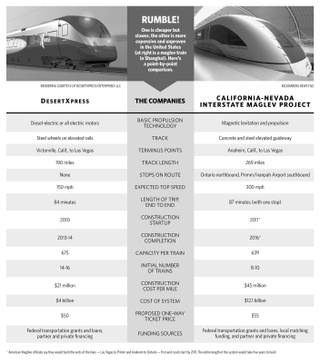
Enlargeable graphics: Maglev and DesertXpress

You need to upgrade your Flash Player

Reader poll

Would you consider using a high-speed train to get from Las Vegas to Southern California?

View results

— Dreamers have long envisioned a fast train to whisk riders between Las Vegas and Southern California.

But probably no one expected that, with $8 billion in federal money available for the smartest proposals across the country, two starkly different proposals for fast trains between Las Vegas and Southern California would compete for the business.

And neither proposal is perfect.

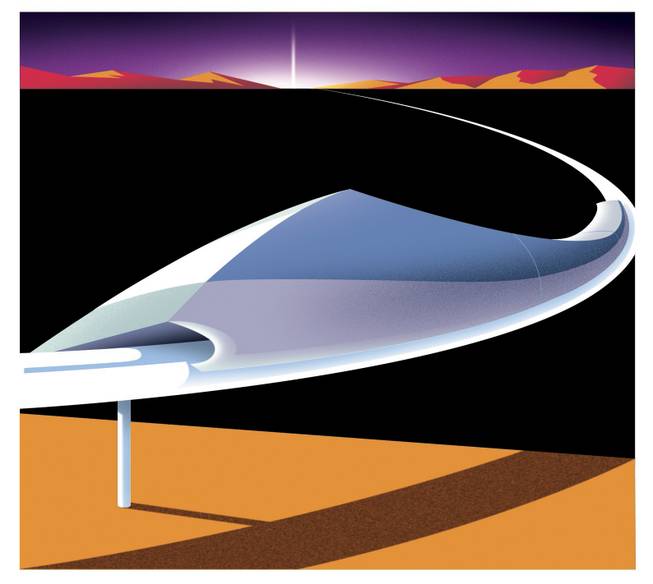
One offers a stunning view of the future: A publicly-funded maglev train, smoothly propelled at speeds up to 300 mph by magnetic levitation, a technology untried in this country because it is so expensive to build. The price tag is $12 billion.

The other, the upstart DesertXpress, would use traditional steel wheels on steel tracks, driven at speeds up to 150 mph with electric or diesel-electric power. Its oddity is its southern terminus — the high-desert outpost of Victorville, more than an hour’s drive above the Southern California basin. The $4 billion project was pitched as a privately funded venture but its backers say now they may seek government loans.

Both of the proposed lines would transport passengers between Las Vegas and Southern California in the time it takes to watch a movie, for about $50 — with one going at half the speed and covering two-thirds the distance of the other.

The choices raise pivotal questions as the nation weighs its appetite for risk and considers whether such a system should be in public versus private hands.

As President Barack Obama offers this bold investment in train travel — the most dramatic since the transcontinental rail line was laid a century ago — is it time to take a grand leap with a futuristic technology? Or is the public averse these days to financial risk?

This week, the federal Transportation Department will unveil guidelines for those seeking to apply for a portion of the $8 billion passed by Congress as part of the economic recovery package. Decisions will be made this year.

The maglev project desperately needs public dollars and has appealed to Obama’s transportation secretary, Ray LaHood, for $1.8 billion to develop the first segment — from Las Vegas to the state line at Primm — and to continue planning the rest.

DesertXpress Enterprises LLC has shunned federal aid, promising to be privately financed and turn a profit, a feat no other modern rail line has been able to accomplish in this country. But it is in the market for federal loans.

If the maglev project gets a federal boost of stimulus dollars, it could make it difficult for DesertXpress backers to raise private equity. If DesertXpress can leverage its newfound support from Senate Majority Leader Harry Reid, it could knock maglev out of the picture.

Maglev’s boosters say that even if DesertXpress is constructed, it will still pursue its own project. But skeptics doubt there is sufficient appetite, financial or otherwise, for the Federal Railroad Administration to permit both trains.

Sen. Reid’s turnabout

Reid, knowing that one-third of Las Vegas visitors come from Southern California, has been in frequent contact with the Obama administration about the importance of a high-speed rail between the two regions.

He tilted the game board last week.

Reid had long championed the maglev project and had helped steer more than $50 million toward its development.

After three decades of talk by maglev boosters but little to show for it, Reid turned his back on it in favor of the swift enterprise of DesertXpress.

“He’s been waiting on a high-speed train from L.A. to Las Vegas for 30 years,” said Reid’s spokesman, Jon Summers. “He wants to see something done.”

The senator’s change of heart surprised maglev developers, with some suggesting that Reid switched sides because DesertXpress could be tangible when he runs for office in 2010.

DesertXpress is backed by power broker Sig Rogich, a former official in the first Bush administration who is co-chairman of the group Republicans for Reid.

Yet Reid’s move could have been foreseen by anyone who has watched and waited for the visionary maglev train to be more than designs on paper.

Rogich has backed Reid since 2004.

“I would suspect the senator’s decision is based on practicality,” said former Democratic Gov. Bob Miller, who recently wrote a commentary in the Las Vegas Sun with former Republican Gov. Kenny Guinn in support of the maglev project.

“Certainly anything that has taken as long a period of time as this has taken creates frustration,” Miller said.

For his part, Miller is ambivalent. “I can’t pick between one or the other,” he said. “Whatever can help, more power to it.”

Maglev’s proponents vow to soldier on, undeterred by the loss of their powerful patron, and relying on supporters in the White House. They say two lines can coexist across the desert.

“We’re going to do it,” said Neil Cummings, president of the American Magline Group, the consortium of engineering and construction companies that would build the maglev project.

Because this country has never had a strategy for rail planning in the modern age, unlike its master plan for interstate highways, the nation now faces the prospect of designing a rail system from bottom up, rather than from the top down.

The General Accountability Office said as much in a report this year: “No federal vision or national plan for determining the role of high-speed rail in the U.S. transportation system exists.”

Robert Puentes, a senior fellow at the Brookings Institution’s Metropolitan Policy Program, said the result has been what he calls the peanut butter method of allocating transportation dollars. The government just spreads it around.

“It’s done in an ad hoc way,” Puentes said. “The criticism is the federal government has been absent and adrift for too long.”

Train projects are popular among the engineering, construction and rail firms that would profit from their construction. The maglev project is among dozens of rail projects from across the country that could be vying for the $8 billion in federal recovery money for high-speed rail.

Most employ traditional technologies, but one in Pittsburgh and another that would link Baltimore and Washington, D.C., involve 10-year-old maglev proposals.

Maglev’s 20-year history

This maglev project is the brainchild of the California-Nevada Super Speed Train Commission, a highfalutin name for a nonprofit entity formed in 1988 with the sole purpose of developing a fast train between Las Vegas and Southern California.

The commission, made up of private citizens and public officials, entertained several technologies before choosing magnetic levitation in 1991 and choosing American Magline Group as its developer in 1993.

The maglev train proposes to zoom passengers between Vegas and the Disneyland area, enabling tourists in either city to experience the other, just 80 minutes away, without need of automobile. The northbound maglev would stop in Ontario to connect with the airport, and would stop southbound stop at Ivanpah, to connect with an airport planned for there.

With California separately building a north-south high-speed train line between San Francisco and Orange County, the maglev team envisions passengers being able to connect to the California train at its stop in Anaheim station to continue to Los Angeles’ Union Station.

(Groundbreaking for the California network could happen in the next few years. It is funded by an $11 billion bond issue approved by California voters last year, and is considered a front-runner in being awarded federal stimulus money.)

Bruce Aguilera, chairman of the California-Nevada Super Speed Train Commission and an executive at Bellagio, said his organization offered a prime selling point when the group met with LaHood in April: They promised to have the first 40-mile segment to Primm running “in time for President Obama, the secretary and Sen. Reid to show the American people before the next election what this money could be used for.”

Maglev critics deride the technology as wishful futurism, but transportation experts say it is maglev’s price tag, not science, that has left it undeveloped in this country.

“It’s not to say maglev couldn’t be successful or the technology isn’t feasible, it probably is,” said Martin Wachs, one of the nation’s leading transportation experts, who taught for 25 years at UCLA and is now director of the Rand Corp.’s Transportation, Space and Technology Program.

“It’s a question of rationality,” he said. “Those who have to actually plunk the dollars down on the table see the increased benefits of maglev as not worth the risk.”

The world’s only operating commercial maglev line links Shanghai and Pudong International Airport — a 19-mile-long run completed in 7 1/2 minutes.

That system, now in its ninth upgrade, is what American Magline wants to build between Anaheim and Las Vegas.

At one point, reminds Miller, the former governor, maglev was the only game in town.

Not only Reid, but much of Nevada’s political class has at times supported the maglev train.

And then DesertXpress plans emerged, relatively suddenly, to pose a competitive challenge.

That has left lawmakers to rework their support. Democratic Rep. Dina Titus, a former commission member as an appointee of three governors, thinks maglev is the “technology of the future,” but is now giving some thought to DesertXpress, her spokesman said.

Democratic Rep. Shelley Berkley is among those who support “whichever one is successful.”

Over the years, the commission has raised $10 million for maglev — more than $7 million in federal allocations championed mainly by Reid and more than $2 million in state and local funding.

Internal Revenue Service filings from recent years show that most of the commission’s annual expenditures go to the American Magline Group, the consortium of private companies that is developing the project.

Rail lines are an expensive undertaking. Before a single track is laid, millions are spent drafting the inches-thick environmental review required by the federal government.

After two decades, the commission’s maglev project is suddenly losing the paper war.

In just a few short years, the DesertXpress backers have spent $25 million producing an environmental report.

DesertXpress is the nation’s only privately financed train proposal before the Transportation Department’s Federal Railroad Administration.

If their plan is approved this year, DesertXpress backers say, they can raise private funding and break ground in 2010. Earlier groundbreakings have been postponed.

Although Reid secured another $45 million last year for maglev, the money has not been spent because the commission had been unable to raise the required matching funds until American Magline Group contributed the $11 million two months ago.

Cummings, the Los Angeles attorney who is president of American Magline Group, said, “We’ve admittedly been stalled, delayed, because of a shortage of funding.”

DesertXpress’ 7-year history

Plans for DesertXpress were launched in 2002. Its backers have been slowly but methodically spending money to plan the rail line between Las Vegas and Victorville.

The company is run by two alumni of the Metro Gold Line, the light rail train between Pasadena and downtown L.A., who saw the potential of a line between the two states.

But for all the attention it is getting for trying to create a private, profitable passenger rail line, DesertXpress is also raising eyebrows for a different reason: Why Victorville?

The answer: Unlike maglev, which can handle steep grades, the steel-wheel train can’t accommodate the Cajon Pass, which funnels entry into the Southern California basin, and blasting a tunnel to flatten the route is too costly.

Backers think that for the promise of a fast, on-time train across the desert, passengers will get themselves at least to Victorville, where the Vegas experience could begin. At the station, passengers would check into their hotels, turn over their luggage and board a train car with food, drink and entertainment (but no gambling).

“It’s not so much why Victorville,” Vice President Andrew Mack said. “Victorville is what makes the project work.”

Skeptics abound. The high-desert city is 85 miles northeast of Los Angeles — more than an hour’s drive in the best of traffic. Why not just fly?

The Government Accountability Office acknowledged concern, that with the terminus outside of Los Angeles, “whether travelers will use the (DesertXpress) line at the level being forecast.”

But its backers cite marketing studies showing a sufficient number of passengers will brave urban traffic to get at least as far as the high-desert community, where they’ll transfer to the train rather than drive the rest of the way across the Mojave.

And for those coming from Nevada to California, would it be worth it to rent a car in Victorville for the drive into the basin?

But just for back-up, the company is planning the next phase.

Like the maglev, DesertXpress would connect with California’s north-south line by adding a spur to the California train’s stop in Palmdale, another high-desert outpost, about 50 miles west of Victorville.

Passengers could then continue south to Los Angeles, where the California train has a planned stop at Union Station and another in Anaheim, in Orange County.

Realities of the recession

Wachs, who taught engineering at UCLA and was chairman of the Department of Urban Planning before moving to Rand, said a privately-run train company is a model unlike almost any working today.

“In the entire world there are maybe one or two passenger rail projects that are actually profitable without public financing,” he said.

But recently, stung by recessionary realities of the credit markets, the company has indicated it could be interested in low-interest government loans to supplement its private backing.

The company is counting on raising 30 percent in private equity and 70 percent debt to finance the project. Though the company counts casino construction magnate Tony Marnell among its backers, Strip casinos have largely declined to get into the transportation business.

“Would we love to see greater access between Las Vegas and Southern California? Absolutely,” said Alan Feldman, spokesman for MGM Mirage. “Are any of us able to participate in that financially? The answer is probably not.”

DesertXpress officials said interest from potential global investors remains strong, but with the tightened credit market, government loans could be helpful. The Federal Railroad Administration can provide loans for 100 percent financing for 35 years.

“In view of the credit crunch, that might be attractive,” DesertXpress President Tom Stone said.

Reid has been pressing the White House to name the Nevada-California line as a priority corridor, a designation that, depending on how the route is drawn, could help his now-preferred line, DesertXpress, get access to government grants in the stimulus project.

If that happens, Reid is likely to be targeted, as he has in the past, by critics deriding a big-money train project as pork for the Sin City Express.

Politics are likely to continue playing a sizable role in deciding which Nevada line, if any, gets built.

Wachs, at Rand, shrugged off the political infighting or the lack of a master-planned vision.

“It’s up to a political system to sort all those out and make a decision,” Wachs said.

“Invariably we end up with systems that look to no one to be ideal,” Wachs said. Only in the lock-step world of Mussolini did the trains run on time.

In a democracy, he said, “it’s always kind of a messy, multifaceted process.”

Sun reporter Brian Eckhouse contributed to this story.

Discussion: 38 comments so far…

  1. No money should ever be wasted on a train to nowhere (Victorville). Whoever thought up that idea is an idiot, no matter how many degrees he has.

  2. Amen Lenny. Build the Mag-Lev. It will be a big boom to our economy.

  3. Who wants to go to Victorville? I want LA baby.

  4. DesertXpress = Las Vegas Monorail

    Poorly designed, out-of-the-way routes...destined to choke-off ridership.

    High speed rail will probably ultimately cost half the cost of a Maglev line. High speed rail should definitely be built between Las Vegas and LA.

    The worst part of the drive between LA and Las Vegas is going through the El Cajon Pass to and from Victorville - sometimes takes 5-6 hours with all the Friday-Sunday night traffic. That is the portion which needs high speed rail the most.

    Sorry, but the person at DesertXpress who created this dead-end route to Victorville, is simply an idiot.

  5. "8 Billion"? Watch it triple! We NEVER seem to learn do we?

  6. I would not pay a nickel to go to Victorville and by the time they start the second leg deeper into california thay will be bankrupt.

  7. Did Harry recently get a super deal on some land in or around Victorville?

    Mmmmmm...I wonder....so should you!

    Let's not even consider the Mormon contractor angle to this scam.

  8. The MAGLEV train is a train that will have had a successful ridership. The MAGLEV train will relieve traffic congestion at McCarran Airport,on the I-15 and in Clark County especially in the strip corridor.

    People who live in Aniheim, Los Angeles, Oceanside and the San Diego areas are not going to drive to Victorville, park their car and ride a slow train to Las Vegas.

    Every attempt at a Mass Transportation system that fails causes a seed of doubt in peoples minds that sets Mass Transportation back for years. The DesertXpress is an excellent example of a Mass Transit failure waiting to happen.

    Senator Reid's back peddling on the MAGLEV train is politically motivated. In the next election ask yourself; Does Nevada want a back peddling Senator or someone that can do a good job for Nevada ?

    "Democratic Rep. Shelley Berkley is another titter totter politician."whichever one is successful."

    Lets just build a steam train. Building the DesertXpress is like Ford selling us the Model T in 2020.

  9. Funny that they don't mention the tunnel they will have to blast through Clark Mountain on 15 west of Primm. (which is now in a national park). Hey what's another 20 billion dollars. The feds love to flush money down the toilet! Harry Reid seems to think the federalmoney is his to flush!

  10. I support the maglev system over the steel rail system. There are no surface rail systems that do not require a public subsidy to continue in operation. That is more tax dollars from you so that others can ride. The L.V. Monorail revenue supports its operation and maintenance costs and nets about 30% more.

    I would prefer less than one hour from L.A., Ontario, or Anaheim. I would not drive to Victerville and then pay for a train ticket.

    If Maglev is not an option, monorails can be developed that match the 150 mph speed and they can continue throughout the L.A. area. I have studied the potential routes and L.A. County has confirmed that they are viable.

    Monorail MAY pay for its own operation, surface or steel rail will require your tax money for as long as it operates.

    At your Service,
    Brian C. Brooks

  11. So which fast talking sales pitch will the people of Nevada buy? Don't be fooled this is about helping the rich get rich. These plans require government money because they can't convince enough people to use the service - that means they'd fail on their own.

    They want taxpayers to take the risk of losses while they keep all the profit. High speed rail, anyway you slice it, is a scam.

    Las Vegas does not have to be better than Shelbyville...

    http://www.writeonnevada.com/2009/06/las...

  12. California is going to spend its maglev money connecting its own major cites. Period.

    Wake up people. This is a Reid/Rogich Ponzi scheme.

  13. Quid Pro Quo

  14. Victorville, the town that PG&E made famous. If built, Erin Brokovich or Julia Roberts can be the first passenger.

  15. There are better things to spend the money on...
    1) Solve the water problem in the western US
    2) Diversify the NV economy - we should be the world leader in alternate energy
    3) For a fraction of the cost, we could be leaders in R&D in our university system.
    My point is, any stimulus money which is spent should have some sort of ROI in terms of national exports

  16. or let the people spend their own money as they see fit. All your examples above, while well intentioned, are the same thing: Taking from the less wealthy to give to the rich.

  17. or let the people spend their own money as they see fit. All your examples above, while well intentioned, are the same thing: Taking from the less wealthy to give to the rich.

    I agree, but it looks like we are stuck with the stimulus, so if it is a done deal, we should ensure that the spending has a real long term return.

  18. numbersman - you stole my thunder.

    Senator Reid - we have millions of square miles of open desert, lots of sun, lots of wind, and thermal underground.

    Money is better spent on that.

    -----------------------------

    Also - why take a train when you can fly southwest airlines from LAX, John Wayne, or San Diego, or Ontario to get to Las Vegas???

  19. Please, Please, Please, Let many of us who have left So Cal and Nevada have a way to return frequently from the SW regions of this country...over 600 miles of nothing but desert...no trains or planes are available! If you did this it would bring your economies way up. I'm speaking of Las Cruces NM [by ElPaso TX to all parts East} TO Needles CA which is the 3 state area that connects to AZ.CA.NV. There are already tracks from here to these places available for freight trains only. Here they are building the Spaceport plus Fort Bliss and Hood are here. We have plenty of money to spend and nowhere to go. Talk to whomever you can about this PLEASE

  20. Let's see-the Big Dig government project in Boston, assisted by Tip O'Neill, was budgeted at 2.7 Billion in 1987. Once the Bechtel engineering buffoons and the Union loafers got done with it, it cost nearly 15 Billion smackers. So now we want to go to Cali with a train? Why do you think that Cali has water shortages and yet no desalinization plants? It's because the idiots at the Cali Coastal Commission are worried about hurting the little fishies at the intakes. This is a typical example of why there is no way that a decent new train line can be built to LA. They're broke drooling liberals, and they would screw up any attempt to build a train line to LA. What about the poor little desert tortoises?

  21. WHY DO WE NEED THIS???????

    And it goes just to Victorville???? THen you have to DRIVE to either Anaheim or LA??? Why bother?

    That money could be used for something that we actually need.....like maybe the CAT system so more can actually take public transportation to work and not spend 2 hrs each way doing it?

    And really...how many people travel between So Cal and Vegas on a weekly basis??? And like someone said - ever hear of Southwest Airlines? Oh yeah, let's not forget our own cars (Or rent one if you don't want the wear and tear on your's!)

    Hey Adrien - Good point about the unused rail tracks that are all over the southwest, including between Vegas and California. Utilize those routes before spending millions on something that will end up like the LV Monorail.

  22. .
    ..
    ...Once I worked on the Pennsylvania Railroad. Every generation there is an upgrade to the rail-beds due to a new fleet of larger freight cars.

    ...So it's a matter of time for a new upgrade for roadbeds. A new rail line for high speed passenger service is not rocket science and could be designed and built a lot quicker and less expensive than the prototype mag-lev train on the drawing boards.

    ...The existing right of ways for rail tracks were given to the Union Pacific and many other train companies during this nations first giveaways to Corporate entities a century and a half ago and I'm sure there is room for another pair of tracks within these property lines as most railroads have given up on passenger service decades ago.

    ...Once the track issue is settled, new bullet train locomotives and streamlined cars could be built here in America or leased from European or Asian manufacturers for a three or five year period to see if they are excepted..

    ... Spain's citizens didn't think they wanted them from Madrid to an isolated state but they proved to be popular and they have now built many more branches connecting Madrid as the hub to many outlaying areas of the Iberian peninsular.

    ...The Mag-lev would probably require many hours in courtrooms over eminent domain and real estate seizures delaying the launch of passenger service and adding unseen costs to an already ballooned estimate in the billions.

  23. Well now, looky here, I love trains. Some day the meglev might get built someplace. It is a pie in the sky. If someone came in to the FDA to test an unknown drug it would take years to establish the safety and the efficacy of a new drug. Trains and other things are somewhat like that. We know about the high speed trains (not meglev) because they are already being used and they are not decades in the future. If we can get 150 mile per hour trains it will make the ride quicker than flying when you consider the ride and expense of leaving your automobile at an air port or otherwise getting there. Look, the reason to do those things is that in the realm of things causing our country to approach crash and burn, the importation of oil ranks at the top. Our oil consumption causes our money to leave the country more quickly than water flowing out of Lake Mead. One of these days both your checks and government issued checks will stop being honored because the Chinese and the Arabs will no longer be willing to buy our worthless paper. We need to do everything we can so that the whole country may use energy as efficiently as residents of the Big Big Apple who are at something like 70% of the energy usage of the rest of the country on a per capita basis. If we could reduce our energy consumption by 30% and increase our production from renewable sources, we might survive as a civilization and be civil in the meantime. We need desperately to act intelligently and quit ranting and raving like we are knowledgeable while lacking understanding. We need to do things so we may have a reasonable expectation of being taken seriously. May peace reign on earth and may we all move forward in a rational manner.

  24. Building the most expensive solutions possible while cramming everyone into little cramped spaces while taxing away the freedom of the automobile is not rational - most people have chosen to NOT live like New Yorkers....

  25. It's all about money. When the government fills a big pot with bucks it attracts a crowd. It's not about doing the right thing - it's about getting some of the money.

  26. These projects are boondoggles!

    Las Vegas needs better highway connections to LA - not this white elephant!

  27. This debate is so simple. Maglev is the way to go.

    300 mph to a drop off point in southern Calif. is ideal. This would be an hour and half trip, and would be a little greater than the plane ride.

    150 miles an hour on desert xpress, come on, as many of you know that drive that route... it isnt uncommon to have your car going 150 mph ...

    Get us there as fast a plane, and without the check in hassle of the airport, and you will have a WINNER...

    The concept is so simple! I am amazed that there is a debate on it. I would never ride a train going 150mph to Calif, NEVER !

    Gol

  28. $8,000,000,000,000.00 of our money wasted on kickbacks, skimming, graft and greed. Then add in another 50% for cost overruns.

    I've got an idea, turn I-15 into a toll road to pay for the train because that's the only way some people will even consider leaving their car home. Start with a $20 toll.

  29. So worthless projects like this are what we leveraged our children finical futures for? Harry Reid is a disgrace to the office, and the state of Nevada.

  30. I would ride the magna train. the other is a waste of time by the time I get to victorville i will just drive through so i can have transpo in vegas....dumb..do it ride spend the money what you guys dont get is the money wil get spent anyway mostly on stuff the public gets nothing out of at least as with the big dig..the public gets to use it

  31. I don't think people get it - the meglev is a dream - it has never been done. It will take decades to get it into action.

  32. "but its backers say now they may seek government loans."

    HAHAHAHAHAHA idiots

    save the money and just give the taxpayers a free tax credit! it'll do the economy more good

  33. MagLev has never been proven reliable over 40 miles. WHY in the world would anyone commit $12B+ to construction of a 200+ mile line? It's a total insider's boondoogle as has already been mentioned here by several people.

    (BTW - where did the $50M already "steered toward development of the MagLev" go?!!)

    Use a fraction of the money to connect the Vegas monorail to the airport to make it economically viable (and reduce traffic on the Strip).

    THEN and only then talk about building a high speed train to L.A.

  34. I'd love to see a high speed train to Southern California and I'd ride it. Victorville is not the destination I had in mind, and I don't think anyone else did either. The Roy Rogers Museum isn't even there any longer to go to.
    Barring Dingy Harry owning all the land around the train terminal, or his friends owning the railroad line, if Nevada's really serious about high speed rail to bring tourists up and locals down, it needs a buy in on the California High Speed Rail project that was approved by the voters last November. This project links San Diego, Los Angeles, the Bay Area, and Sacramento. The Las Vegas line could either tie into that rail line at Mojave for both L.A. and S.F. bound trains, or the Victorville could be extended down Cajon Pass to Ontario Airport and meet the line connecting San Diego and Los Angeles, or tie in at both places. Ideally if Nevada joined that existing project it could have a representative or two on the High Speed Rail Authority.
    That makes more sense to me than this rail turkey. I'm surprised the Desert Xpress doesn't drop us off at Baker at the Mad Greek or the tallest thermometer or at Peggy Sue's Diner at Yermo, or even one of the vintage rail coaches at the McDonald's at Barstow Station! At least the old steam choo choos could get us where we were going. These days getting you to your destination in the 21st century is....rocket science!

  35. The maglev will never happen. Mega-projects such as a long range maglev on top of being largely experimental technology would result in massive cost overruns guaranteed. Regular rail however would not only be vastly cheaper, but has been practically applied in many countries. Plus there is a lot of potential for upgrades as is the example of Frances TGV trains which often reach speeds clsoer to 200mph. Ideally they would use all electric.

    I envision a train depot that links into the Las Vegas Monorail, downtown Vegas and the future Ivanpah airport. A train would look especially attractive when gas prices inevitably surge yet again.

  36. The MAGLEV magnetic levitation train system is the only feasible solution for such a high-speed train.
    The DesertXpress proposal is flawed starting with stepping back into the past by utilizing old technology and then the gross mistake of only leading to Victorville. Who in the world would ride this train from/to Victorville, ... that's about as stupid as it gets. The DesertXpress train/rail system will lose money hand over fist and taxpayers will foot the bill.

    But the MAGLEV has a real shot of success, even though it costs more to build, it's the future of efficient public mass transportation. The MAGLEV would be fun to take from/to Las Vegas and Anaheim and it makes sense, ... there's no comparison and the Maglev is a far superior proposal.
    The $8 billion the communist Obama regime has set aside for high-speed rail/train systems in the U.S. won't even be a drop in the bucket, and Washington better allocate at least $500 billion (half a trillion $$$) to get a basic high-speed train system ready throughout the U.S. And that's the only way to do it: do it right or forget about it. And most likely, due to the enormous initial investment, no high-speed train system will ever pay for itself, ... not even over decades. But the benefit will be to the environment as it will take more people off the road and out of their cars as they may utilize quality public transportation instead. Of course, only comfortable high-quality trains such as the Maglev system will be appealing and are the only solution that will work.

  37. A high speed train is needed, we are so far behind other countries in the area of high speed mass transit, its amazing. But while we're waiting, how about just re-establishing AMTRAK service? We're a city of almost 2 million, and if I want to take the train (which I love doing) I have to have someone drive me to Kingman or Barstow for crying out loud! It's absurd.

  38. THATS GOT TO BE THE MOST STUPID IDEA EVER. YEAH LETS HELP PEOPLE FROM CALI GET TO LAS VEGAS FASTER TO IMPROVE THEIR ECONOMY.CALI PEOPLE SPEN BILLIONS OF DOLLARS EACH YEAR THERE.WE SHOULD LEGALIZE GAMBLING HERE, IF WE HAD ANY BRAINS. I HAVE TRIED TO GET MEG WHITMAN TO RUN ON THIS ISSUE,BUT SHES TO DUMB TO LISTEN.

Post a comment

Commenting requires registration.

Comments are moderated by Las Vegas Sun editors. Our goal is not to limit the discussion, but rather to elevate it. Comments should be relevant and contain no abusive language. Full comments policy.

Username:
Password: (Forgotten your password?)

OR Create an account (It's free)

  • Most Read
  • Discussed
  • Most E-mailed

Calendar »

  • 29 Sun
  • 30 Mon
  • 1 Tue
  • 2 Wed
  • 3 Thu