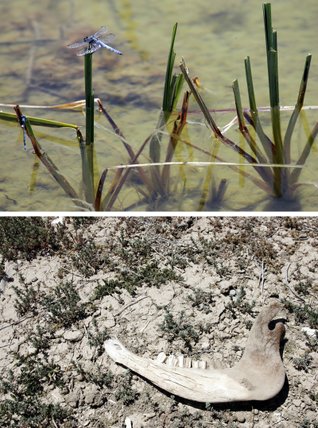
At top, a dragonfly rests on a plant in a rural Nevada spring near Wheeler Peak in White Pine County. Above, the jawbone of a horse lies near the dried-up Needle Point Spring in Snake Valley. The valley’s water is coveted by the Southern Nevada Water Authority, which has a request for pumping rights pending with the state engineer.
Tuesday, July 15, 2008 | 2 a.m.
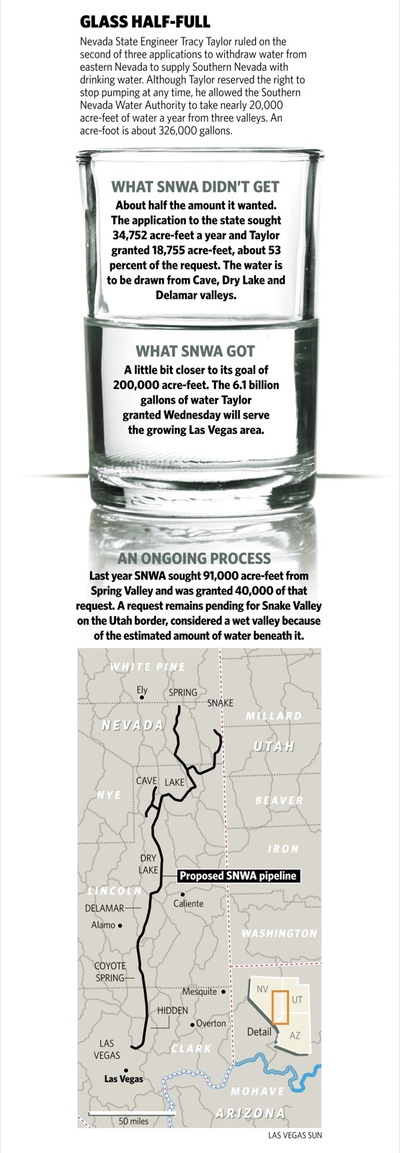
Enlargeable graphic
Reader poll
Sun Topic
Sun Series: Quenching Las Vegas' Thirst
- Part 1: Satiating a booming city (6-1-2008)
- Part 2. The Chosen One (6-8-2008)
- Part 3: The Equation: No water, no growth (6-15-2008)
- Part 4: Not this water (6-22-2008)
- Part 5: 'Owens Valley is the model of what to expect' (6-29-2008)
State engineer Tracy Taylor has played it down the middle so far, giving the Southern Nevada Water Authority about half the water it wanted from rural Nevada.
His two rulings — on Spring Valley and Cave, Dry Lake and Delamar valleys — were called cautious by some on both sides.
Final arrangements are to be considered today for the biggest showdown to date over rural Nevada’s water — hearings to determine whether the Water Authority can take water from Snake Valley. The hearings will provide another opportunity for Taylor to split the difference between the authority’s request and the contention of ranchers, environmentalists and others who argue that not a drop of water should leave rural Nevada for Las Vegas.
But those opponents say that other than sitting atop an aquifer coveted by the Water Authority, Snake Valley has little in common with the valleys that have come before it.
“This is not like Cave, Dry Lake and Delamar valleys, where you would be lucky if you could find a couple human beings,” said Simeon Herskovits, an attorney for many of the opponents of the pumping plan. “Snake is dramatically different.”
Snake Valley has a much larger population than Cave, Dry Lake and Delamar valleys combined and has many more existing water rights than Spring Valley.
In Snake Valley, the ears of mule deer peep above the vegetation on fields kept green by pivot irrigation. It’s that irrigation — and many long-standing water rights — that supports a ranching and tourist economy.
Because there are existing water rights and a history of pumping in the area, Herskovits said, it’s no mystery what will happen when pumping begins. There are cases “where ground water pumping on a very modest level — really a totally different scale of magnitude than what SNWA is proposing — ... have already caused springs to dry up ... and lowered the water table,” he said.
And the existing water rights give Taylor, the state engineer, a legal basis upon which to limit pumping from the valley. Although plants, animals and the environment have limited legal rights under Nevada water law, there are stronger protections for senior water rights.
“The law requires that (Taylor) protect existing water rights,” said Tom Meyers, hydrologist for the Great Basin Water Network, which opposes the pipeline plan. “The environment does not have an existing water right.”
More people and water rights mean more opponents arguing against the pumping during hearings that could be delayed by as much as a year if some opponents get their way.
Another thing that distinguishes Snake Valley from the others the Southern Nevada Water Authority has targeted for its water supply pipeline project is Great Basin National Park, the only national park in Nevada and one of the area’s major tourist attractions.
“You have a whole different level of environmental sensitivity and concern there,” Herskovits said.
And the national park, combined with the objections of several local Indian tribes, might be enough to keep federal agencies such as the Interior Department and its Bureau of Indian Affairs and National Park Service in the fight, too, Herskovits said. Although federal agencies agreed to withdraw their opposition to the Water Authority’s applications in Spring, Cave, Dry Lake and Delamar valleys in exchange for a seat at the monitoring table once pumping begins, they have not yet made such an agreement for the Snake Valley hearings.
Federal agencies did not reveal until the day hearings over the Spring Valley applications began that they had withdrawn their protests. They announced similar agreements more than a month before the Cave, Dry Lake and Delamar hearings, Herskovits said.
And while the population, existing water rights and the national park in Snake Valley may give the state engineer more reasons to deny SNWA’s application there, they also make the stakes much higher.
Pumping “could make agriculture ... very difficult because of lowering water tables and the effects it will have on existing water rights,” Meyers said. “The ranchers depend on those rights.”
Another factor that may weigh on Taylor’s ruling for Snake Valley, which might not come until eight months or more after hearings conclude, is that the valley spills over into Utah.
Herskovits said it’s impossible to tell how much water is available to be exported without taking into account how much is already promised to Utah users and what the environmental impacts might be in a state that has staunchly opposed the Water Authority’s pipeline plan.
“It’s implausible to pretend that the two-state aspect of this ... is not a very important distinction,” he said.
Water Authority Deputy General Manager Kay Brothers does not disagree.
She said last week it’s likely Taylor will grant the authority less than the 50,000 acre-feet it has asked for from Snake Valley.
Brothers said there’s a lot of unclaimed water there and that 80 percent of the water that flows into the aquifer under Snake Valley comes from Nevada. But she said Taylor may be cautious because the basin is shared.
And Utah must agree to the pumping plan before any water is exported from Snake Valley — thanks to a clause tucked into the 2004 Lincoln County Conservation, Recreation and Development Act.
Taylor’s boss, Allen Biaggi, director of the Nevada Conservation and Natural Resources Department, said negotiations with Utah are confidential. He said last week they are ongoing, despite persistent rumors that they have broken down completely.
The Interior Department has asked Taylor’s office not to hold hearings before July 2009, in part to allow time for an agreement to be reached with Utah.
But even if ranchers and environmentalists get their way and the state doesn’t grant the Southern Nevada Water Authority another drop of water from eastern Nevada, that will not keep the authority from pumping from the four rural valleys where it has already won water rights.
Last spring Taylor ruled that Spring Valley could stand to lose 40,000 acre-feet of water a year, increasing to 60,000 acre-feet after a decade of monitoring. Last week he awarded SNWA almost 19,000 acre-feet from Cave, Dry Lake and Delamar valleys.
Brothers said that even if Taylor doesn’t grant the authority any water from Snake Valley, it will build its pipeline to Las Vegas anyway, filling it with that water.
Because drought on the Colorado River, which provides
90 percent of Las Vegas’ water, is so severe, Brother said, with “the numbers we have now ... the project is feasible.”

Join the Discussion:
Check this out for a full explanation of our conversion to the LiveFyre commenting system and instructions on how to sign up for an account.
Full comments policy