Las Vegas Sun

November 21, 2009

Currently: 61° | Complete forecast | Log in

Southern Nevada Water Authority’s Challenge:

Prove it won’t pump Snake Valley dry

Image

Chris Morris

Friday, Aug. 1, 2008 | 2 a.m.

Sun Topics
Reader poll

Should the Las Vegas Valley pump water from the Snake Valley area even if it puts ranchers out of business?

View results

MORE THAN ONE MODEL

What’s next: The Southern Nevada Water Authority has expert Frank D’Agnese building a model to help predict the environmental effects of pumping ground water out of Snake Valley. Opponents of the Las Vegas pipeline plan also are building a model, as are at least one federal agency and experts testifying for Utah, which also opposes Snake Valley pumping.

Why is Nevada requiring the model now? Deputy State Engineer Jason King said modeling’s role in the debate has changed. His office has hired hydrologists who can make use of new and better technology in creating models. Previous studies also have been done in Snake Valley, meaning data exist about water resources in the valley, King said.

How much water has Las Vegas been granted from other areas? State Engineer Tracy Taylor’s ruling in July granted the Water Authority 19,000 acre-feet of water a year from three rural valleys — Cave, Dry Lake and Delamar. An acre-foot is about 326,000 gallons of water, enough to serve two single-family homes for a year.

Since the big hearings on Southern Nevada’s plan to take water from eastern Nevada’s Great Basin aquifer began, water officials have been able to avoid presenting scientific predictions about how pumping will affect the lifeblood of that region’s ranchers, plants and animals.

But in July, the state official who is deciding how much of that water will be allocated to the Las Vegas Valley ordered the Southern Nevada Water Authority to run complex, computer-based modeling to develop those predictions about Snake Valley.

The results may determine the future of not just urban Clark County, where officials are desperate for more water to sustain unprecedented growth, but also whether the ranching way of life in rural eastern Nevada will continue.

“It has very important implications for all of us” throughout the state, said Launce Rake, a Las Vegas-based spokesman for the Progressive Leadership Alliance of Nevada, a group opposing the pipeline.

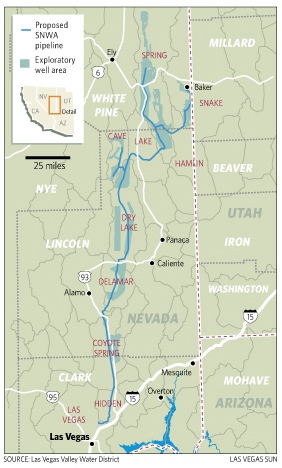
The Southern Nevada Water Authority has cast a large net across the Great Basin in search of unclaimed water. It has won water rights from Spring, Cave, Dry Lake and Delamar valleys, and it envisions filling a $3 billion, 250-mile pipeline from the high desert to Las Vegas.

But still up for grabs is the water beneath Snake Valley, a rich agricultural region that straddles the Nevada-Utah state line. Because of the location, Utah has a say in the matter.

On the Nevada side, State Engineer Tracy Taylor decides who gets water and how much. In the case of Snake Valley, Taylor is saying — for the first time — that before he makes a ruling, the Southern Nevada Water Authority must present a model of the basin and make predictions of what will happen over the next 200 years of pumping the valley.

The demand caught Las Vegas water attorneys by surprise at a preliminary hearing in July. During a morning briefing over Snake Valley, attorneys for the Water Authority had argued that the final showdown over its plans to import billions of gallons of water each year from rural parts of the state should begin in January. They had been through it all before and wanted to move forward as quickly as possible.

But their momentum evaporated with the demand for modeling. They promptly changed their tune about the timeline. They said the Water Authority couldn’t prepare a model by summer. With that, the state engineer’s staff members said they would likely postpone hearings until fall 2009.

Longtime observers say Taylor’s decision to require a model probably comes from the increasing comfort with, and expertise at, modeling among his own staff.

“He has now brought on his staff people that are very competent modelers,” said John Bredehoeft, a retired hydrologist who long lobbied Taylor to use modeling. “Without that (expertise) on his own staff, the state engineer was limited with respect to what the models were telling him.”

Without hydrologists on staff, Taylor could only listen to quarreling experts and weigh their testimony.

With the Water Authority’s experts arguing that modeling wasn’t particularly useful as a predictive tool, Taylor seemingly gave little weight to the models done by the protesters, Bredehoeft said.

“He didn’t listen to what we said,” he recalled. “The first time I have really seen him take cognizance of the model was in the Cave, Dry Lake and Delamar decision.”

Still, Taylor’s ruling granted the authority 19,000 acre-feet of water a year from the three rural valleys. An acre-foot is about 326,000 gallons of water, enough to serve two single-family homes for a year.

Jason King, deputy state engineer, agreed the role of modeling has changed.

“Decades ago we didn’t have the expertise,” he said. “We have the staffing; software programs are better. Time has passed so there is more data on water levels and spring flows ... It’s definitely changed the way we can look at those issues.”

King said there is enough data about Snake Valley — enough studies have been done and enough pumping has been performed — that modeling should be reliable there, where it might not be in other valleys.

And although Bredehoeft said he wasn’t sure whether requiring a model would change the course of the Snake Valley hearings next year, he said he thinks it is important for Taylor to have all the information this time around.

Still, experts on both sides admit modeling isn’t absolute.

“No model is perfect,” said Susan Lynn of the Great Basin Water Network, which opposes the pumping plan.

As hearing officer Susan Joseph-Taylor said in July, the state engineer’s office has spent countless hours on “Modeling 101,” which she hopes to skip over in the Snake Valley hearings to get right to the pertinent predictions.

During hearings on Spring Valley’s water in September 2006, an expert witness for the Water Authority discounted the usefulness of modeling altogether. Today that expert — Frank D’Agnese — is building the authority’s new model.

Opponents of the pipeline presented their own models predicting dramatic lowering of the water table. That translates into certain environmental harm, they said.

The Water Authority attempted to punch holes in a model created by Tom Myers, a hydrologist consultant for opponents of the pipeline.

The authority had its own model — a computer program that calculates what will happen to ground water under certain conditions, such as pumping. But the authority didn’t present any predictions gleaned from the model.

It said there weren’t enough data to make reliable predictions with its model.

And Myers didn’t have time to develop predictions from his model.

Simeon Herskovits, an attorney for the opponents, said he has no doubt the Water Authority suppressed what its model showed, which was drawing down the water table over time, during the Spring Valley hearings.

The National Park Service had run the authority’s model — and found that it predicted a drop in the water table with prolonged pumping. But because the federal agency had signed an agreement to not oppose the authority’s water rights applications in Spring Valley in exchange for a role in overseeing pumping, predictions it made from the model weren’t allowed as evidence.

But in hearings in February, the Water Authority was unable to sweep that under the rug, because the scientist and former authority consultant who had prepared it, Tim Durbin, was testifying for the opposition instead — about the grave effects pumping could have.

Durbin could not be reached for this story.

Still, after both sets of hearings, the state engineer granted the authority about half the water it had requested and mandated monitoring programs to report any effects.

Kay Brothers, the authority’s deputy general manager, said last month that the agency has never suppressed evidence.

She also said models are only one tool, and not the most useful one, in determining how much water is available in a valley.

“It concerns me that everyone starts to think that the model is going to tell you exactly what is going to happen,” she said. Modeling, she said, is “not exactly a science.”

The model the authority is required to prepare for federal environmental review, she said, will be useful for providing ranges of pumping’s effects.

But Myers said the new model, which the authority is developing in cooperation with federal agencies, is imperfect for the same reason most models are — the scientists building them just don’t have enough information.

With plenty of pumping and plenty of data, however, a model gets more reliable. And, models are the only predictive tool available to hydrologists.

“Here we are trying to decide whether to allow that pumping, and so you have to make a best guess,” Myers said.

So he’ll present a model next fall. So will at least one federal agency and experts testifying for Utah, which opposes the authority’s plan for Snake Valley.

One thing all the models presented during hearings on the authority’s applications have in common — and something they’re likely to have in common with the models that will be presented next fall — is that they show significant drawdown of the water table, Bredehoeft and Myers said.

What isn’t certain is just how low it will go, and how long it will take to get there.

But to the plants, animals and farmers who depend on that water, Myers said, it’s immaterial whether its level drops 120 feet or 200 feet.

“If you’re looking at a spring on the surface, that’s an academic difference,” said Myers. “It’s still a dry spring.”

And if you water your livestock from that spring, as so many ranchers do in Snake Valley, it could be the only thing standing between you and financial ruin.

Discussion: 17 comments so far…

  1. It's criminal to take these rural users livelihood.

    Simple solution: raise Las Vegas residential water rates = curb residential water use (50% of draw on Lake Mead water)

  2. vegas has one of the lowest costs of water in the west. raise the cost and less people will use it. i wonder why this is never mentioned.

  3. Ride SINWA outta town on a rail! Their scheme will cost rate payers billions. It won't create significantly more water for LV. It will be the ruin of rural NV.

  4. In the article it states 1 acre foot = 326000 galls enough for 2 homes /year, that equals 426 galls a day, and in an area of the USA that there is a drastic shortage of water. When the lakes run dry, and the deep ground water is no longer there, what will you all do then. Here in Sweden, we have an abundance of water, beyond your wildest dreams, but are we wasteful, no, not at all. I am an average water user, and get through about 10% of what the article states, and still I am careful with water. Water is life, and without it, life will not survive

  5. I don't know where all of the other commenters live besides the one in Sweden but the rates have gone up annually in Henderson for about 10 years and Las Vegas has had their rates increase by larger margins just in the past few months. If rates were increased you would all be complaining that the water district was lining their pockets and there would be outcry to lower them (just like what is happening with gas prices). And I'm going to take a guess and say that the climate of Southern Nevada is a bit drier and warmer than Sweden which may account for some of the additional water used here.

  6. Kay Brothers, Pat Mulroy and their SNWA cronies try to have it both ways. Brothers is quoted as saying that "modeling is not exactly a science", yet heretofore when their own bogus models were getting them by, the opposite was being said. And, SNWA was telling the ranchers, eastern NV residents and those who care about the land and the species of plants and animals living on it, that it would not dry up local communities and native ecosystems - all based on the predictions of their models. Funny how actually really introducing science and the scientific method into a contorversy can change things...

  7. Ban construction of new private swimming pools and charge existing private pool owners a $100 monthly waste fee. To those thinking vegas is draining lake mead, do you know we only receive 2% of the annual colorado river flow, the other 98% is used by Arizona and California. (see http://www.usbr.gov/lc/region/pao/lawofr... )

    Being southern Nevada supports northern Nevada (Northerners receive more than $1 in government services for every $1 paid in taxes, southerners receive less than $1 for every $1 paid), you would think that northern Nevadans would support the ecenomic growth of southern Nevada.

  8. Gordon makes two very important points not covered by the Sun's series yet. At the center of the debate over water in Southern Nevada is the dated Colorado River Compact of 1922, which allocates a measly 300,000 acre feet to Nevada. In comparison Wyoming, a state with a population of a little over half a million people receives 1.05 million acre feet. The problem is that the compact does not reflect the reality of contemporary need, and must be rewritten. Of course all of the other states involved in the compact, including Utah which gets 1.73 million acre feet of Colorado River Water, and has a population of 2.6 million people, refuse to even think about such a possibility until the SNWA exhausts all of its instate possibilities, forcing the agency's pursuit of northern water right. Ironically, Utah is now protesting the Snake Valley project when all they have to do to solve the problem is give up some of their Colorado River water.

    The second point is economics. Rural sections of the West do not, and cannot, compete with urban areas economically. This is a growing reality in Nevada and has done a lot to shape the current budget crisis and lackluster governance by both parties. Vegas is the economic motor of Nevada, and it is understandable that it should receive more of the pie. Something that will not happen as long as the North retains its choke hold over power and water in the state.

  9. The first part of our water series (http://www.lasvegassun.com/news/2008/jun...) covered the Colorado compact and has graphics that explain the partitioning of the river water. A look back at what Nevada was when the compact was signed should also be considered. Yes, Clark County and Las Vegas in particular is a much different place than was the small rail stop in the valley meadow of 1922. And Fred is correct — the compact as written offers Nevada the short straw and the other states will do little to change it. Chris Morris.

  10. "Kay Brothers, the authority’s deputy general manager, said last month that the agency has never suppressed evidence."

    Oh Really ? For the last 5 years, the SNWA has been offered a truly new fresh water Source that will yield a million acre feet a year. That is 3 times NV's allocation from the Colorado River.
    Not once has this alternative Source been mentioned by the SNWA ! For those of you who pay fees to the SNWA, the SNWA has also been assured that development of the new Source will save the SNWA hundreds of millions of dollars. If you don't know about that, maybe the savings too has been "supressed".

    Let's also clear up another matter,..."An acre-foot is about 326,000 gallons of water, enough to serve two single-family homes for a year." That is also a suppression of the evidence ! For planning purposes, the in-house domestic use in a one single family dwelling is conservatively estimated to be 350 gallons per day which equates to 0.39 AF per year. But the SNWA suppresses the fact that only 5-10% of that amount is consumptively used ! Therefore, an acre foot (AF) of water can be utilized for the domestic in-house use of 25-50 homes because of return flow credits back to the Colorado River or stream source receiving the effluent ! This is done directly or by exchange.

    The new Source of fresh water would at least double the existing water resources of Nevada. The SNWA and the Bureau of Reclamation REFUSE to investigate to verify the validity of the Source because they claim they cannot enter into confidentiality agreements. What the SNWA and the Bureau can do is request an outside attorney to review the facts and the evidence and report as to the validity of the new Source. Both the SNWA and the Bureau REFUSE to consult an outside attorney for an opinion regarding the claimed aspects of the new Source.

    The reason for mentioning the Bureau of Reclamation is because the return flows to the Colorado River after the initial domestic use from the Source could be utilized to keep Lake Mead reasonably full and assuring the 1800 megawatts of annual power generation ! The Bureau is responsible for the operation of Lake Mead's power.

    Fighting over computer models, monitoring wells and producing mountains of paper in hearings and Court cases will not produce a single drop of new water for Nevada. A million acre feet of new fresh water is 325,900,000,000 gallons a year !

    Ray Walker (Retired Water Rights Analyst) waterrdw@yahoo.com

  11. Hey Ray. Talk about supressing information. This isn't the first time you mentioned the "SOURCE" and yet you continue to withold what the source is. Put up or shut up.

  12. What these water managers are doing is criminal. Anyone who has been up to Lincoln County knows that the drought is killing the watersheds. In a short ten years I've seen springs dry up in the area, and they want to PUMP?

    These people should be ashamed of themselves...

  13. The concept of having the State Engineer rely on a water model is great. However, the Nevada environmental community, the State of Utah, and SNWA simply cause confusion in the hearing process by creating their own separate water availability models for the Snake Valley. Instead of creating their own models, they should be providing information to the State Engineer, and critiquing what the State Engineer's hydrologists create. One well thought out water model is far better, in terms of accurate decision making, than four or more "dueling" models.

    And, once again folks, remember that the ground water in Central Nevada is owned by the State of Nevada, not by the farmers and ranchers. Those who constantly repeat the fraudulent statement that the water is owned by the farmers and ranchers are just as reprehensible as the people at SNWA and LVVWD who make misrepresentations.

    Then there is the second half of the coin. The State Engineer is obligated, by Nevada law, to allow use of state owned ground water for the benefit of the citizenry of Nevada. Last time I checked, the state's boundaries did not end at the south county line of Lincoln County.

  14. That is the trouble with these so called politicians, and they think they can do just what they like, without any thought for the consequences. When the water sheds have gone, the snowfields gone, less rainfall, only then will they wake up, and then its not certain, they will most likely blame G Warming, not their fault.

  15. Trying to move this groundwater is criminal and small-minded. It is time for some visionary action.

    Communities 1000 miles to the east of us and 1000 miles to the north of us are flooding with excess water and would love our help to solve this problem. Pumping excess flow out of these communities, then into the Columbia and Mississippi rivers, then into other rivers, open channels and some new pipeline and then into the Colorado River would solve 2 problems simultaneously. Sure it needs some political savy and some dough, but it is certainly doable. Just need visionary leadership to get it done and that seems to be in short supply.

  16. Control the growth of Vegas. Outlaw lawns. Get serious about water conservation. Destroying the Snake Valley so the developers can continue to make money is a crime. Oh yeah-and put Mulroy in prison for being such an Owens Valley style crook.

  17. "And, once again folks, remember that the ground water in Central Nevada is owned by the State of Nevada, not by the farmers and ranchers. Those who constantly repeat the fraudulent statement that the water is owned by the farmers and ranchers are just as reprehensible as the people at SNWA and LVVWD who make misrepresentations."

    This is legal mumbo-jumbo. The state has a responsibility to take care of its resources-and those resources were not put there to patronize the irresponsible growth and water waste of one community. There are priorities that are much larger than a legal loophole that gives all the water to one wasteful community. Gimme a break! Vegas has a responsibility to stand up to developers and limit growth.

Post a comment

Commenting requires registration.

Comments are moderated by Las Vegas Sun editors. Our goal is not to limit the discussion, but rather to elevate it. Comments should be relevant and contain no abusive language. Full comments policy.

Username:
Password: (Forgotten your password?)

OR Create an account (It's free)

  • Most Read
  • Discussed
  • Most E-mailed
Live chat
Tuesday, noon PST
Chat with Krista Creelman
Problem Gambling Center executive director Krista Creelman will answer questions about gambling addiction from Las Vegas Sun readers from noon to 1 p.m. Tuesday, Nov. ... Submit question

Calendar »

  • 21 Sat
  • 22 Sun
  • 23 Mon
  • 24 Tue
  • 25 Wed