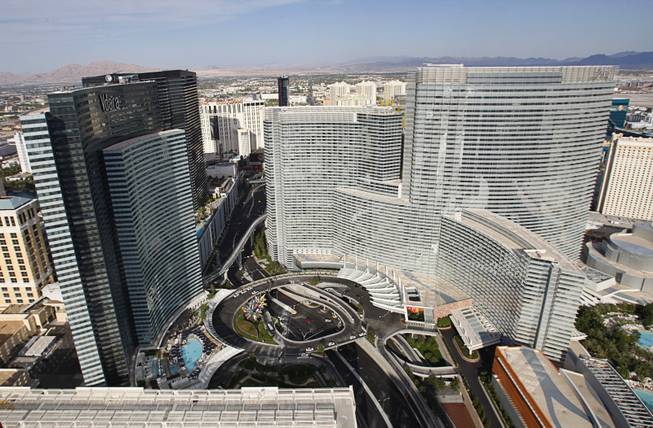
A view of MGM’s CityCenter taken from a helicopter Monday, May 21, 2012. Vdara is at left, and Aria is at right.
Wednesday, Oct. 17, 2012 | 12:35 p.m.
Related content
The $8.5 billion CityCenter — built in Las Vegas’ heyday but opened after the recession had set in — continues to struggle, though it is benefiting from growing numbers of visitors to the area.
One of the largest privately financed developments in the United States, the 67-acre project on the Strip took five years to design and build, and opened in late 2009 to much fanfare. But the towers at CityCenter brought about 5,900 hotel rooms to Las Vegas, expanding its hotel inventory by almost 5 percent at a time when the number of visitors had fallen by about 2.85 million since 2007.
At the same time, CityCenter also loaded the ravaged Las Vegas market with nearly 2,400 high-end condos, including condo-hotel units, and an upscale shopping center with potentially half a million square feet of luxury shops.
Nearly three years since it opened, CityCenter is seen as, at best, a qualified success. A majority of the hotel rooms have been filled, but at much lower room rates than originally planned. Condominium sales have not taken off, though, and the units that have sold have gone at big discounts. Many luxury retailers have moved into the shopping center, but about 12 percent of the mall is still vacant.
As sales trickled in, CityCenter eventually turned about 1,350 units at its condo-hotel Vdara into regular hotel rooms, while it leases out to vacationers about 70 percent of the approximately 150 units that it sold, said Bill McBeath, president and chief operating officer of CityCenter.
At CityCenter’s sixth tower, the Harmon, which was intended to be a 49-story condo-hotel, construction was stopped by Clark County because of construction defects in mid-2008. At the time, CityCenter’s owners -- MGM Resorts International, the publicly held casino operator, and Dubai World, an investment arm of the Dubai government -- announced they would cap the structure at the 26th floor and kill plans for the approximately 200 condos. The Harmon never opened.
Since then, the Harmon has been embroiled in a lawsuit over contractor payment, and MGM Resorts has announced plans to demolish the building altogether -- plans which have been held up by the lawsuit. Residents and businesses on the Strip have been watching the building’s continuing plight, debating whether it will end with a potentially colorful trial, scheduled for mid-2013.
Many have also been trying to assess CityCenter’s full impact on the local economy.
CityCenter “opened at a bad moment,” said John Stater, a research and GIS manager at Colliers International-Las Vegas. “It was something that MGM really wanted to do, but in terms of the local economy, I think it’s debatable whether it was pulling a lot of new visitors into Las Vegas.”
Stater said he believed CityCenter was obviously “cannibalizing other businesses in Las Vegas” and may have contributed to the closing of the Sahara in 2011. But Stater said he also believed that CityCenter had finally been fully absorbed by the local economy.
According to the Las Vegas Convention and Visitors Authority, the gambling city has nearly recovered the visitors lost because of the recession. Michael Mixer, a managing partner of Colliers International-Las Vegas, said that by dropping hotel rates drastically, CityCenter has kept its occupancy up, and Las Vegas has been able to absorb the new hotel rooms.
“When CityCenter opened, Las Vegas was at the depth of the recession,” he said. “The initial forecast room rates were unachievable at that time, and a lower-than-market average occupancy was experienced.” But as they discounted their hotel rates, he added, “they achieved a higher occupancy at the expense of lower-tiered properties, within the MGM family and others. This was a flight to a higher quality when given similar price points.”
At Aria, CityCenter’s 4,000-room hotel and casino, results announced by MGM in the second quarter of 2012 showed occupancy at 93 percent and an average daily rate of $201. At Vdara, occupancy was 89 percent and the average daily rate was $161. In May 2009, Aria initially was booking rooms ranging from $179 to $799 a night, and suites ranging from $500 to $7,500 a night.
CityCenter’s condos tell a similar tale of slashed prices, but in their case, prices may not yet be low enough. Tony Dennis, an executive vice president for the residential division at CityCenter, said CityCenter will soon introduce a new marketing effort, aimed largely at international buyers. This effort will most likely occur in the new year and will offer condos at even lower prices. At the same time, CityCenter has taken on the role of financier, assisting about a third of its buyers with loans, he said.
Currently, at CityCenter’s Mandarin Oriental, 65 units of 225 have sold; at the two-tower Veer, 272 units of 669 have sold; and at Vdara, about 156 of the 1,495 units sold before becoming a hotel.
“Back in the day, at Mandarin, we were priced at about $1,600 a square foot on average, and today we’re priced at $840 a foot,” Dennis said. “And I think that still is a little high for the market. At Veer, in 2007, we were priced at $1,000 a foot, and we’re now at just over $600 a foot.”
Total residential revenue to date from condos and condo-hotel units is about $393 million, Dennis said.
Given the adverse conditions of the Las Vegas real estate and tourism market in 2008 and 2009, CityCenter’s condo sales and hotel bookings stand out in comparison to some other Las Vegas businesses. There are plenty of examples of half-finished or never-started hotels and commercial projects in Las Vegas, both on the Strip and off.
At Crystals, CityCenter’s 500,000-square-foot luxury mall, upscale retailers have been slowly leasing storefronts, from Gucci and Prada to Hermes and Tiffany & Co. The center still has to lease its 30,000-square-foot third floor and is close to leasing the last three spaces on the lower floors, McBeath said.
“As the retailers have enjoyed the success, and the growth in same-store sales,” he said. “Demand for the remaining spaces has gone up.” CityCenter doesn’t release its leasing rates or revenue-per-square-foot figures.
CityCenter officials said the development had created about 11,000 jobs for Las Vegas, and added a significant $40 million public art program on its campus, with work by artists like Henry Moore, Maya Lin, Claes Oldenburg and Frank Stella.
While Las Vegas is a city of novelty and reinvention, real estate experts said the city cannot support much new development. Construction has started on two giant observation wheels modeled after the London Eye, and a third one is rumored. Some smaller hotels and shopping centers have also started construction, but there is almost no new hotel casino development anywhere on the Strip, Mixer said.
“The rising occupancy and rate numbers we are beginning to see in our market still won’t support new development,” he said.

Join the Discussion:
Check this out for a full explanation of our conversion to the LiveFyre commenting system and instructions on how to sign up for an account.
Full comments policy