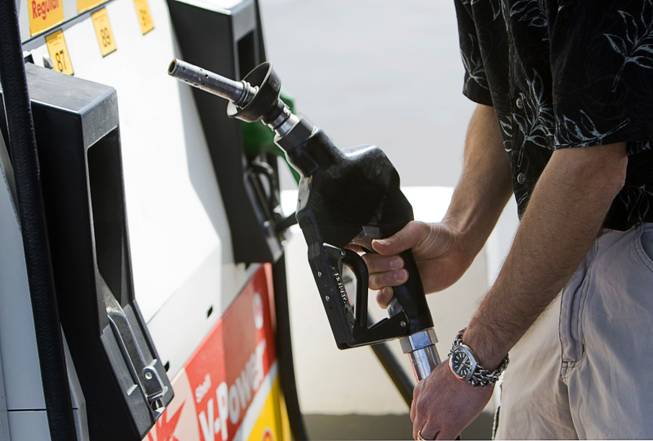
Kurtis Keeler of Jamestown, New York, replaces a pump after filling up at a gas station on Blue Diamond Road Thursday, April 14, 2011.
Friday, July 29, 2011 | 1:55 a.m.
Travel Tax
Viewing video requires the latest version of Adobe's Flash Player
KSNV coverage of proposed alternative to gasoline tax, July 27, 2011.
Sun archives
Reader poll
Sun Coverage
The Nevada Transportation Department doesn’t want to know where you’ve been, just how many miles it took to get there.
As cars become more fuel efficient and more cars run without gas at all, states have seen a decrease in gas tax receipts.
The shortfall, expected to be about $39 million a year by 2016 in Nevada alone, has transportation departments across the country looking for alternatives.
At least 16 states and the federal government have begun studying the possibility of setting up a vehicle miles-traveled fee, a system where people would pay taxes based on how many miles they travel instead of how much gas they buy.
The idea is to set up a system where motorists in hybrids and electric cars pay their fair share for road construction and maintenance.
But the first phase of a Silver State study came to one clear conclusion: Nevadans don’t want the government knowing where they have been driving.
“The biggest thing that came up was the privacy (issue),” said Scott Rawlins, the department’s deputy director. “No one wanted a big brother or a black box in their car.”
Most of the proposed mileage fee systems are based on using GPS devices in cars to track how much — and where and when — people drive. Governments like the idea because it would allow the revenue to go different jurisdictions based on where people drive the most, plus motorists could potentially be taxed more if they drive at peak congestion times.
But the privacy concerns of such a system may prove to be insurmountable, Nevada officials learned.
When the GPS idea was presented to Nevadans last year, more than 80 percent opposed it, said Eric Herzik, a UNR political science professor who is part of the study.
“The GPS system was just a disaster,” he said. “It wasn’t just no, it was hell no.”
When Herzik told some students about the GPS units that would be installed in cars, one student said he would get a shotgun and “blow it up.”
While many states are considering or studying the concept, Nevada is one of the few states that have actively sought public feedback on the idea, Herzik said. “We came in with a first model and it got slapped. It has changed the conversation,” he said.
So for the second phase of the fee study, the Transportation Department ditched the GPS idea and is focusing on two other possible fee-collection methods.
One would require drivers to report their odometer readings to the DMV, likely annually, and then pay the tax, either annually or spread out over the year.
The other possibility is setting up a system where gas pumps would automatically record a car’s odometer reading and add the tax to the fuel price, much like the current gas tax.
While that option doesn’t solve the problem of how to tax electric vehicles, it does provide a solution that is the most simple and most familiar to most drivers, said UNLV professor Pushkin Kachroo, the director of the Transportation Research Center, which is conducting a small field test of the system.
UNLV has recruited 25 volunteer drivers to have the small transponder attached to their car and then fill up with gas at a participating station. When the motorist gets gas, the receipt shows how much they paid under the current gas tax and how much they would have paid under a mileage system.
The system is “seamless; you do exactly the same thing,” Kachroo said.
And while there will always be conspiracy theorists who say the government is tracking people, Kachroo promises the devices are not capable of doing so.
“We’ve seen the system. We designed it. We built it. We installed it,” he said. “There’s no tracking, no GPS...no privacy concerns.”
The Transportation Department hopes the small UNLV study this summer will pave the way for a larger, statewide study in the future.
“This study is going to give us a platform; here’s what works in Nevada or what doesn’t work,” Rawlins said.
Even if the study is a success, there are still a lot of legal and policy issues to be worked out, and implementation would be a decade or more away, likely coming through federal action, officials said.
But this study will give Nevada a voice in the national discussion, Rawlins said.
The department is accepting public comment on the tax idea. Comments can be sent by email to vmtfeestudy@vmtfeenv.com or by regular mail to Alauddin Khan, 1263 S. Stewart Street, Carson City, NV, 89712.



Dennis those of us that drive gas guzzlers already pay gas tax. It is collecting from vehicles that do not need gas that they are after .Why have a complicated solution ? Just put a meter on the car to see how much electricity it has consumed and tax that . Problem solved with no privacy issues.
richard,
As a gas guzzler you are not paying for the externality cost of burning all that gas. Stop being a freeloader.
The privacy issue is more than just a 'concern'.
I hope they're not planning on using MY obdII port for their mileage tracking --- I've got other devices plugged into mine and I won't give those up so the government can figure out how far I've driven.
the state knows how far I've driven every year when I get my car inspected. use that number.
I also hope there's a different rate for various cars since this is largely over electrics / hybrids. they should pay more since they're not getting dinged every time they fill up.
This is a ridiculous notion to have people pay road taxes bases on usage. It's a dangerous president. The roads are there for all of us to use, even if some don't. This is the same concept that is applied to fire departments, police and schools. Should only the people that use those services pay for them? Of course not.
Those services are there to benefit the whole community. Even if I don't ever drive a vehicle, the roads are still used to give emergency services access to my home as well as those on bicycles, etc.
To mandate a tracking device in all vehicles in Nevada in order to justify increased fees will most likely lead to even fewer people keeping their vehicles registered in other states.
That is right, buy and drive a hybrid to save money and they want to find a way to tax you more so there goes your savings. Good idea.
Save on Electric power at your home, they raise the rates because they are not bringing in enough money.
Why is anyone going to try to save when they just keep finding another way to take your money?
Enviromentalists with their hybrid cars using less gas which generates less gas tax revenue.
I suggest higher taxes on fuel economic cars because it's obvious they are not paying their "fair share".
if the only purpose of the tax is to build more roads to accommodate more cars then it's a self-defeating effort. the only way to alleviate the problem is to get cars off the road and get people into public transportation--not really a feasible endeavor here, i know. taxing people on miles driven won't work any better than a gasoline tax. eventually people will drive less then tax receipts will go down again and we'll be right back where we started.
and unless the state of nv is going to build an adequate public transit system (think train network that services major metro areas and connects north-south) with the gas/miles driven tax there's no point to raising taxes at all.
People are encouraged to 'conserve, conserve, conserve' and so we do - and then when revenues go down the very same people who made sacrifices all in the name of conservation are penalized in one or another (does NV Energy rate increase ring a bell?) in the form of higher prices, more taxes etc etc etc. In conclusion all I know is that if you keep penalizing THIS person for trying to conserve resources THIS person will just go back to the 'old ways' and to hell with conserving ANYTHING beyond my sanity.
I don't think that auto/fuel taxes should be based on mileage. Keeping track of everyone's mileage does not seem practical, and would probably end up costing more trying to maintain and police such a system. It might be better to obtain funding for road maintenance and construction from fees that could be collected during the annual automobile registration. The fees could be based on the weight of the vehicle and the number of axles. The heavier your vehicle is and the more axles it has, the more you pay.
One problem that is not addressed by either GPS or odometer readings is the problem of out-of-state drivers, i.e. tourists from SoCal. At least when they buy gas here they are being charged our fuel tax. The other ideas would require a national system to ensure that.
And, yes, the privacy issue is a major concern. It's bad enough that cell phones are back-doors.
You see some insurance companies now trying to plug devices into your car so they can monitor your driving habits. I say Hell NO to this as well. We all need to speak up loud and clear in order to protect ourselves from the spying eyes of corporations and the government.
The best way to tax is on consumption.
FYI: there is a "gas guzzler " tax on some new cars , I know because I paid $1300 for it recently. Unfortunately like a lot of things green, the more we try to conserve (or try to drive less, or more efficient cars, or use less electricity) and save the more it ends up costing us - in privacy and $.
What if a person travels the country as a salesperson and drives 95% of the time outside Nevada? Why should that person pay taxes when they are driving outside the state and do not use our roads?
Why is government's answer ALWAYS how to get MORE money out of taxpayers?
In the past few years Flamingo, Eastern, Tropicana, Horizon Ridge to name a few local roads have been ripped up, repaved, ripped up again, repaved, etc... How much did that cost over assessing the total needs of the roads and doing it once?
There is no new technology to create road surfaces that last longer and need less repair?
Lets not invest in better mass transit, instead lets discontinue routes and serve less people encouraging more of the public to put more cars on the road.
As far as the "We've seen the system. We designed it. We built it. We installed it," he said. "There's no tracking, no GPS...no privacy concerns." quote. Yeah ok because 'We wouldn't lie to sell a product 'we' hope will become mandatory putting millions into our pockets and by the way 'we' will then make even more money but building our product in China.
No system is perfect and Anthony Lale's comment made me realize that no matter where you drive you are using someones road and should pay for that use wherever it occurs. The current system does this to some extent and the idea of GPS I surmise was to know if you were using Nevada's roads or some other states roads. So what kind of unfairness do you want? The kind that allows freeloaders on the system?
Richard,
Very straight forward and fair solution. It addresses the problem without creating additional ones.
Same thing as with Nevada Power. We are encouraged to conserve, then when we do we are gouged because revenues are down.
The GOVERNMENT has NO business knowing where you drive. Is this part of the "smaller government" ideology?
Det,
Which government? There are many levels and you are already issued a state driver's license that gives some information. What about paying taxes on housing? The county government knows where you live. There are plenty of legal reasons to have information on people and even, in some cases, where they drive.
It doesn't keep track of personal information? Assuming for the moment I believe that, which I certainly don't, how do "they" know where to go to collect "their" taxes if someone decides they can't afford to pay. What if someone wants to challenge the assessed tax in court. Or are we just supposed to take the government's word for it?
Just like they said the airport body scanners didn't store personal pictures and the operators couldn't save or print any body scans. How did that work out?
Seems we've heard it all before. Fool me once shame on you; fool me twice and . . .
I think the gas tax is the most efficient way, people pay "a little" at each fill-up. The more you drive, the more you pay. I'm not for tax increases, but the obvious answer is to add a nickel or whatever to the per gallon tax. (not suggesting that they should, but it would be easier and way less costly than to add a tracking device to every car). There are so few electrics on the road that their revenue would be insignificant. Hybrids DO use gas and pay the gas tax, just not as much (maybe a battery tax?).
The biggest problem I see is that too much of the gas taxes we pay gets thrown into the inefficient mass transit rathole which is very heavily subsidized and used by very few people.
Maybe charge a high tax on all of those pointless trucks clogging up the strip advertising "hot babes" or some cirque show. Talk about wasteful. The cabs all have the same ads, and they are carrying passengers.
So who will have to pay the cost to retrofit every car with a gps? Would my old 1974 VW that gets driven very little (a couple hundred miles a year) have to get one?
"Read your odometer and pay your share"? I imagine suddenly half of the cars will get reported as gatting 2,000 miles a year. Unless it's reported at an annual state inspection (Smog checks in CA are every 2 years) it would be wide open to abuse.
First, the government wants folks to go green with the hybrids, which are extremely expensive to purchase, to reduce our "carbon footprint". Why penalize those who have paid for such an investment?
If the government wants REVENUE, then just maybe, they need to change what they have been doing for nearly the last century, and restructure the WAY we pay TAXES, for example, get rid of the IRS, and have ALL consumers in the USA pay a FLAT TAX. That means everyone! If you consume a product or service, then you pay a flat tax at the time of purchase.
After this past month of political bickering on the Federal level, and half year with the Nevada State level, it is really time to look at doing the way government is done DIFFERENTLY!