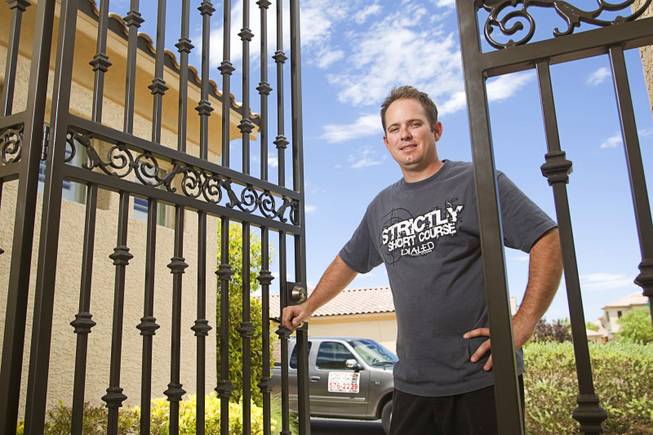
Steve Antill opens a security gate he built for a homeowner in Southern Highlands Monday, July 18, 2011. Antill, owner of Strictly Iron, started his business about a year ago after being laid off from the ornamental ironwork company where he was an employee.
Wednesday, July 20, 2011 | 2 a.m.
VEGAS INC Coverage
Steve Antill cashed out his IRA of about $7,000 to start his Strictly Iron fence-building business. The 34-year-old married father of two lost his job of 13 years and figured he would need to make it on his own. He estimates that he grossed $40,000 over the past year building security and decorative fencing at 30 job sites.
It’s mainly a one-man operation with the occasional buddy brought on to help. Antill has also stretched himself, adopting the role of marketer, bookkeeper, parts supplier and website operator. “For years I wanted to start my own business. When you’re getting that steady pay at a job, it’s hard to leave,” Antill said. “I could see why other people would be starting businesses in times like this.”
In this recession, banks have been hesitant to write small-business loans to help entrepreneurs get started. Potential borrowers have watched prospects decline as they failed to make regular payments on past debts, and their credit ratings tumbled. They are unable to qualify for traditional small-business loans. Many creative businesspeople have been forced to tap retirement and personal savings to build some form of economic security.
Bankers argue that the money is there, but tighter, post-crash lending practices have made it difficult to lend because of an explosion in the number of high-risk borrowers. A growing percentage of small-business operators are using credit cards to purchase supplies and borrow money at interest rates that can exceed 30 percent. “It’s nice to do it without any credit card debt,” said Antill, who refuses to tap credit cards to run his business.
Like many trying to navigate the financial, regulatory and personal challenges of starting a small business, Antill has never talked to a banker in hopes of raising money for his venture. He’s simply not familiar with the process. “I figured I wouldn’t even qualify for a loan,” he said. “I wouldn’t even know how that works.”
At the height of the economic boom, 70 to 80 percent of all small-business loans in Southern Nevada tapped the collateral offered by the grossly inflated value of the residential real estate market, according to UNLV’s Small Business Development Center. Much of the startup money came from home-equity lines of credit. The dollars flowed freely in the days housing prices exploded and those become the piggy bank for new-business owners.
“The first thing they would go to five years ago was equity in the home,” Wells Fargo Nevada President Kirk Clausen said.
But that entrepreneurial option no longer exists in a region where an estimated 75 percent of all homeowners owe more on their homes than they are worth.
The U.S. Small Business Administration spurred record levels of startups in the middle part of the decade, backing bank loans to as much as 85 percent of their principal, with banks issuing seed capital based on a borrower’s available collateral, credit scores, the quality of a business plan, experience and the amount of cash, stocks, bonds and money-market funds a borrower possessed. Lenders believed they could recover their losses by foreclosing on borrowers’ homes if they failed to make payments in those days.
Few were worried. After all, the value of that collateral rapidly escalated. So SBA loans flowed. More than 1,200 SBA-backed loans worth $277 million were issued in Nevada during the 2007 budget year ended Sept. 30. That was up from about 370 loans worth $117 million in 2001.
The money sparked the introduction of small landscaping companies, construction contractors, auto repair shops, professional offices, a multitude of ventures that seemingly sprung up overnight in strip malls and office parks. Then the economy collapsed. SBA-backed lending saw its number of Nevada loans fall last year to about 300 worth $102 million.
“It was easy to get loans in Vegas. It was easy money, but that day has come and gone,” says Ed Cardena, SBA district director. “If you have good credit and a good business plan you can still get loans. The key to getting a loan is that you have to have good credit. The biggest problem is personal wealth has lost so much value that the collateral you can use for a small-business loan has decreased.”
Regional bankers are particularly sensitive to arguments that they took federal bailout money in 2008 as the financial markets began to melt down but failed to show thanks by lending to small- and midsized business operators. In fact, the numbers show that SBA-backed lending has somewhat rebounded in the region. Three hundred twenty SBA loans worth $121.6 million were written during the first nine months of the current budget year ending Sept. 30, but the numbers remain below the 2007 high.
“The money is there, but the profile of the borrower has changed to a certain extent because of the economic downturn,” said Jim Valley, SBA regional sales manager for Wells Fargo Bank. “We’re actively considering and actively pursuing loans in support of small-business owners in Nevada and throughout the country. Our appetite to make loans is there.”
The average cost to start a business is about $30,000, according to a 2009 study by the Kauffman Foundation of Entrepreneurship. Many require much less money, just a few thousand dollars, with some Internet-based operations requiring little overhead or labor. At the start of the recession, which began in 2008, 92 percent of small-business loans in the United States were each valued at less than $100,000, with the bulk coming from business credit cards, according to the Kauffman study.
Small businesses with one or two employees are the most likely to tap credit card debt, with the average startup cost being $31,150, according to Kauffman’s figures. Credit cards are easier to get for small-business operators than traditional bank loans or government grants. They don’t require business plans or a lengthy approval phase.
“The main problem with credit cards is that they are an expensive way to finance a business,” the study says. “Interest rates on personal and business credit cards average around 15 percent and can be above 30 percent in extreme cases.”
Businesses that rely on credit cards are more likely to fail than those that tap other lines of credit, the study says. The implication: Credit card borrowing is a final option for fledgling entrepreneurs who lack other potential sources of financing.
A recent Thursday evening found 500 potential entrepreneurs gathered in a section of the Orleans for seminars on how to write a business plan, market a company and rebuild personal credit. Outside, lenders from Nevada State Bank, U.S. Bank and Wells Fargo touted their small-business lending programs. “SBA 7A Loan Program, Up to $5 million/$250,000 minimum,” one brochure says. “Because businesses needed space to grow,” read another with a picture of what appears to be a young banker shaking hands with a pair of equally young and attractive entrepreneurs. Representatives of state government touted a recently created $13 million investment fund that will be used to leverage $130 million in bank financing to spark business creation.
Eager business operators wound their way around the hall in search of opportunity. Most possessed a great deal of hope. A decidedly smaller number carried actual business plans. It was unclear how many were credit worthy. “It’s tough, very tough,” said Mary Anderson, a former casino worker who was seeking to start a business. She had some ideas — elder care, home cleaning, possibly a bakery. Anderson wasn’t certain, but she knew this much: She had lost her job and wanted to take charge of her life. “I don’t want to leave it to other people. No one else will look out for you.”
Antill, the iron fence builder, wasn’t at the Orleans. He was busy working at one job site and preparing for another. He sounded tired. The days can be long, and he has the pressure of raising a family while nurturing a business in the midst of the worst economy in 70 years.
Yet in that exhaustion you hear the optimist of the entrepreneur, someone who is attempting to make a go of it with the help of his wife, children and occasional friend who is brought on for day work. “There’s honestly a lot of work out there,” he said. “Almost 90 to 95 percent of this iron work is for security reasons. Times like this, people are seeming to want to secure their house, their gates. They’re putting up window bars to protect themselves.”
Antill acknowledges that demand for such work can be a stark reminder of modern-day reality, but he recognizes that amid his job loss has come opportunity. He only hopes that the workload and the capital are out there to help him achieve his goals.

Join the Discussion:
Check this out for a full explanation of our conversion to the LiveFyre commenting system and instructions on how to sign up for an account.
Full comments policy