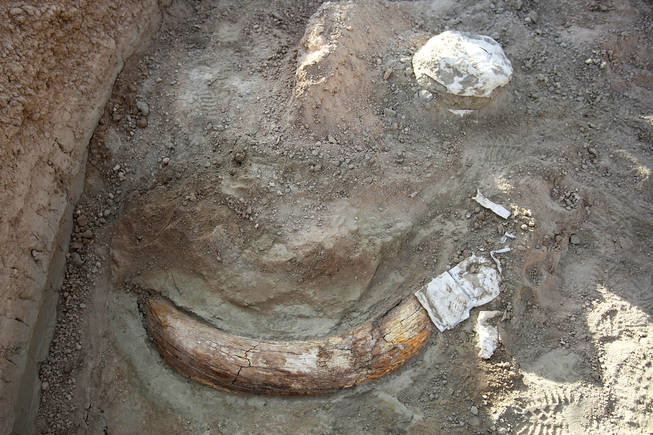
A look at a partially unearthed Columbian Mammoth tusk Thursday in the proposed Tule Springs National Monument area located in the northern part of the Las Vegas Valley.
Friday, Dec. 3, 2010 | 2:05 a.m.
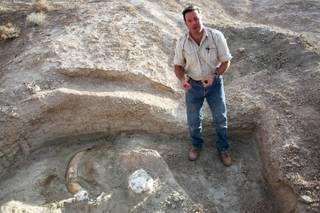
Sun Archives
- Advocates hoping for fossil bed national monument in Las Vegas Valley (8-6-2010)
- Advocates hoping for fossil bed national monument in Las Vegas Valley (2-2-2010)
- Tule Springs preservation prospects take off (8-16-2009)
- Tule Springs tours offer vistas into the past (5-11-2005)
- Valley residents get chance to protect Las Vegas Wash (4-29-2005)
- Researchers hoping to protect fossil sites (12-8-2004)
- More ancient treasures found (10-1-2003)
- Revisiting Tule Springs' 'Big Dig' (11-1-2002)
A paleontologist revealed Thursday the discovery of a seven-foot-long Columbian Mammoth tusk in an area near North Las Vegas rich with fossils.
Thousands of fossils have been found in the area of the proposed Tule Springs National Monument, including many Columbian Mammoths — 14-foot-tall creatures that roamed the Nevada desert thousands of years ago.
The process of unearthing the tusk began earlier this year after the Bureau of Land Management approved the excavation, said Eric Scott, a paleontologist with the San Bernardino County Museum. The tusk was found, Scott said, because part of it was sticking out of the desert dirt.
What makes Tule Springs special, Scott said, is the variety of herbivores found in the area — including mammoths and camels.
His crew is still looking for smaller mammals, such as rodents, to study, which would give the group a better idea of what the region was like thousands of years ago. The reason? Rodents didn’t migrate; larger creatures did.
“There are no other sites that duplicate this site,” Scott said. “It’s a paleontology and biology laboratory.”
When NV Energy began digging in recent years to put in power lines along the south edge of Tule Springs, crews found hundreds of fossils, spurring subsequent excavations, said Lynn Davis, a Nevada Field Office program manager with the National Parks Conservation Association.
“All of a sudden, people were reminded that there was this amazing amount of fossils here,” she said. “They were forgotten until a few years ago.”
Stephen M. Rowland, a professor of geology at UNLV, said one reason studying these fossils is important is because when the mammoths died, the Earth was undergoing severe climate changes during the last Ice Age. “That’s something we’re dealing with today,” he said.
He added, “These animals became extinct — the mammoths, the camels, the lions and the ground sloths — 11,000 to 12,000 years ago. We don’t know why they became extinct.”
North Las Vegas City Councilman Richard Cherchio took a tour of the excavation site Thursday afternoon. The site, he said, will be part of the future of tourism and attracting residents to the area.
“It’s not always about development,” Cherchio said. “Where else could you go where you have gaming and a national monument?”
Jill DeStefano, founder of the Protectors of Tule Springs, said her group hopes the area will become a national monument “as soon as possible.”
“We need to do it now,” she said.

Join the Discussion:
Check this out for a full explanation of our conversion to the LiveFyre commenting system and instructions on how to sign up for an account.
Full comments policy