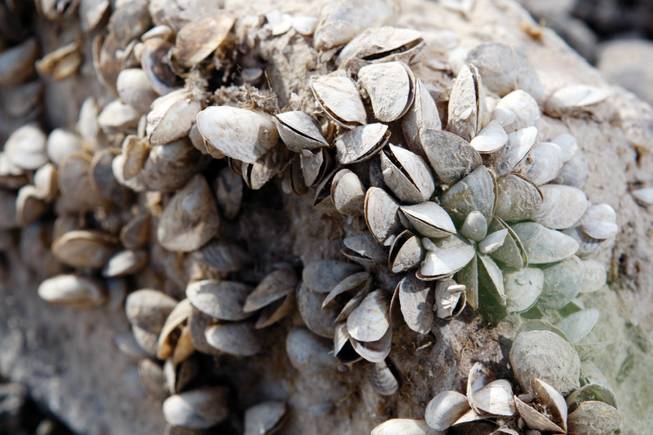
Dead quagga mussels are clustered on a rock at Lake Mead last year. The mollusks release toxins that can move up the food chain.
Monday, Nov. 9, 2009 | 2 a.m.
In Today's Sun
Sun Archives
- Wary of invasive species, hatchery suspends operations (1-20-2009)
- Mussels’ last meal (6-20-2008)
- Get rid of pest? Not if it turns tap water pink (7-21-2007)
- Mussels now contained but need monitoring (1-18-2007)
- Lake Mead mussels identified as quagga, not zebra (1-13-2007)
Sun Topics
Beyond the Sun
- U.S. Geological Survey: Species Factsheet
Anyone who doubts that the quagga mussels in Lake Mead are a critical issue should consider this warning from the experts: If the quaggas are not stopped, they could poison the lake.
Years before they showed up in Southern Nevada, the little mollusks colonized the Great Lakes, and researchers there have found that the rise in their quagga populations correlates with increases in dangerous toxins. There are two reasons for this: poop and algae. Quaggas can poop poison pellets and can turn swaths of open lake into algae-filled dead zones.
The scoop on the poop is this: Each mussel works like a tiny liver, absorbing toxins and heavy metals such as mercury, selenium, polychlorinated biphenyls (known as PCBs), and polycyclic aromatic hydrocarbons (or PAHs) from the lake water in a process called bioaccumulation.
But quaggas are not content to do a good deed. They later expel those chemicals and metals — in the form of a highly concentrated pellet. Those toxic pellets sink to the lake floor.
Some of the pellets are eaten by bottom feeders. As the bottom feeders eat more and more of the pellets, the toxins concentrate in their tissues. When a whole bunch of those bottom feeders are eaten by larger fish or birds, higher concentrations of those toxins build up in those predators, in a process called biomagnification. The toxins amplify in each predator as they make their way up the food chain — all the way to fishermen and bird hunters.
What scientists know
For years, even before the arrival of the invasive quaggas, UNLV’s school of public health has been studying the levels of contamination in Lake Mead. But with the introduction of quaggas it has become more important to monitor toxins in the wildlife in and around Lake Mead, says Shawn Gerstenberger, the school’s executive associate dean.
One UNLV study this year on popularly fished species at Lake Mead looked specifically for mercury contamination and found the levels low. But now those researchers are involved in a wider project to test different kinds of fish for various toxins. So far, they don’t have enough data to reach any conclusions about the quaggas’ effects.
“We want to watch these levels in fish and birds to see how things change,” Gerstenberger said. “What we’ve seen in the Great Lakes shows the contaminants (levels) here will likely go up.”
And whatever the quaggas have been able to do in the Great Lakes, they are expected to be able to do in spades in Lake Mead because Lake Mead is the perfect breeding habitat for bothersome bivalves. Much of the lake bed is the hard rocky surfaces quagga mussels love. The lake is chock-full of the algae and nutrients the mollusks need to thrive. And the lake’s temperature is ideal for quagga whoopie. They won’t mate if the water temperature drops below about 50 degrees. The water in Lake Mead is about 65 degrees much of the year, so it’s a year-round quagga honeymoon spot. They get especially frisky in early summer and fall, researchers have found.
Now, about the dining that leads up to the quagga dating.
Quaggas munch through algae as if each lake current were a moving buffet. That would be fine if the mussels ate some of everything. But like any experienced buffet customer, they eat only the good stuff, and lots of it. Quaggas, it turns out, don’t like a dangerous type of algae called cyanobacteria.
Why the danger?
Cyanobacteria make news from time to time in the form of massive algae blooms that create dead zones in lakes and ponds across the country. Cyanobacteria produce cyanotoxins (such as neurotoxin and heptatoxin) that have killed animals and made humans ill. Humans can get sick from swallowing water contaminated with cyanobacteria or even from inhaling aerosol-like droplets of the contaminated water while swimming.
Lake Mead had small levels of cyanobacteria algae even before the quagga invasion. But the quaggas, by eating up all the other algae, are making space for the cyanobacteria.
To compound matters, the quaggas lower the nitrogen-to-phosphorus ratio of lakes, creating ideal conditions for cyanobacteria growth.
Cyanobacteria are already abundant in some parts of the lake. They make up about 20 percent of the phytoplankton (microscopic plant-like organisms) over all of Lake Mead. That’s not bad, but the numbers are higher in the open water of places such as Boulder Basin, where cyanobacteria make up about 95 percent of the phytoplankton.
That’s where most of the Las Vegas Valley’s drinking water comes from.
Like the quaggas, there’s really no way to get rid of the cyanobacteria once you’ve got an outbreak. So the water authority monitors the nitrogen-to-phosphorus ratio of water going into the lake once a month to see how it might affect overall lake ecology and tests cyanobacteria levels weekly in the Boulder Basin, says Peggy Roefer, the water authority’s regional water quality program manager.
Since 2003, the levels of phosphorus and nitrogen coming into the lake haven’t changed much, according to water authority data. And the amount of cyanobacteria in Boulder Basin has decreased in that time, Roefer said. So if the nitrogen-to-phosphorus ratio or cyanobacteria level in the lake begins to increase, the quaggas would be a likely culprit.
As with the quaggas, there’s really no good way to get rid of cyanobacteria yet. But the water authority thinks it knows how to manage the algae’s impact on drinking water quality. Water managers use ozone in the water treatment plants to kill the cyanobacteria and break them down, and the water treatment plant uses filtration to keep the valley’s tap water from being harmful to humans.
But there’s no way to get rid of the cyanobacteria in the lake without releasing the toxins into the water to be absorbed by fish, birds and swimmers. Keeping the cyanobacteria levels low in Lake Mead is necessary to save recreational activities such as fishing, swimming and water skiing.
How researcher sees it
Biolgist David Wong, a researcher at UNLV’s School of Community Health, has been analyzing data from the Southern Nevada Water Authority, Las Vegas and the Bureau of Reclamation water testing programs for two years and he hasn’t yet seen a significant quagga effect on water quality. But that, he cautions, is only because it’s too soon. The quagga nation is still maturing. By 2012 it will be an underwater empire vast enough to begin to diminish the water quality, and at that time, Wong said, he can begin to correlate the water quality effects with the rate of quagga population growth. Once he figures that pattern out, he can try to formulate a rough prediction of the quaggas’ future effect on water quality and lake ecology.
“For now we need to monitor them and then figure out how to manage them,” he says.
He says he already knows this much, however: “In terms of potential ecological impact and economic loss, the quaggas are the worst threat facing Las Vegas.”

Join the Discussion:
Check this out for a full explanation of our conversion to the LiveFyre commenting system and instructions on how to sign up for an account.
Full comments policy