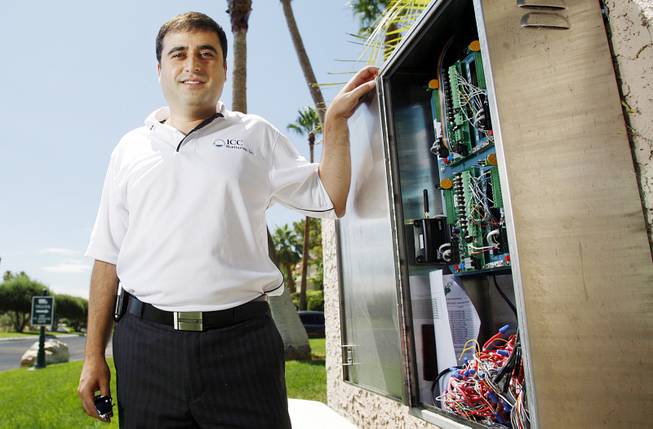
David Drake, CEO of ICC Monitoring, says the control boxes at Canyon Gate save water and give notice of leaks in the irrigation system and of broken sprinkler heads.
Monday, July 27, 2009 | 2 a.m.
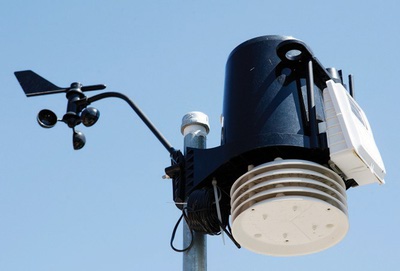
TECH IS ONLY PART OF THE PICTURE: ICC Monitoring uses sophisticated monitoring devices to help communities such as Canyon Gate save water, but the key part of its service is countering the incentives organizations and their employees might have not to make conserving water a priority. There's no upfront cost for the company's service and its fees come out of customers' savings.
Sun Archives
- Study: Colorado River water supply safe through 2026 (7-22-2009)
- Lake Mead marinas buy time to move to deeper water (6-26-2009)
- Lake Mead braces for lowest level since 1965 (4-24-2009)
- Report: Rivers serving most people, like Colorado, drop as climate changes (4-21-2009)
- Delay sought for hearings on pumping water to Las Vegas (3-30-2009)
- Using less water — but why? (2-13-2009)
- The Equation: No water, no growth (6-15-2008)
- Satiating a booming city (6-1-2008)
- Water: The more you use, the more you’ll have to pay (4-8-2008)
Beyond the Sun
Canyon Gate
If someday Las Vegas should die, not burned like Troy or buried like Pompeii, but abandoned like Angkor, just left like an old Plymouth by the side of the road, well, if that should happen, someday some archaeology grad students are going to wind up in the gutters of Canyon Gate.
They’ll describe how the gutters are pocked and channeled by erosion. Stains will hint and laboratory tests will confirm that algae once grew in the gutters. People will marvel at their findings, appalled. In a baking desert that receives 4 to 5 inches of water a year, they built a city of 2 million people and then watered their lawns so much that scum grew in the gutters? No wonder it went bust.
But that’s history as it might not have to be written. Right now, Las Vegas is alive, surviving if not thriving, and Canyon Gate is an inhabited upscale gated neighborhood with a waterfall out front and green lawns inside. And though its gutters are indeed eroded and algae stained, what’s really interesting is what you don’t find in the gutters:
Water. For the past seven months, though the grass, trees and shrubs are all still alive and well, Canyon Gate’s gutters have been mostly dry. To find out why, lift your eyes from the gutter. Look atop the western gate house and you’ll see a white box topped with a wind speed meter, one of the twirling ones that looks like it’s made from pingpong ball hemispheres.
This is part of a watering control package designed by David Drake, whose company, ICC Monitoring, is doing something that no one else does in Las Vegas. It is — and this is all ICC does — monitoring water use.
But let’s back up for a minute.
Here’s how commercial landscaping in the valley generally works, as explained by J.C. Davis, spokesman for the Southern Nevada Water Authority.
You have, on the one side, a customer such as an HOA or a business and then on the other side, you have a landscaping company. The customer pays the water bill and pays a landscaper to keep the plants alive. And so you have a system in which, subtly and without any nefarious intent, the landscaper is encouraged to overwater. After all, if customers are happy with green plants, the easiest way to avoid angry phone calls and multiple trips to the property is to overwater.
Is it a waste? Sure, but it’s not the landscaper’s water bill.
Not every landscaper does this, Davis says, but it’s common. The water authority is trying to stop the overwatering with the only tools at its disposal: It can hit the HOAs or businesses with water waste fines and raise water rates, it can send letters to landscapers telling them they are risking the business by putting their clients in danger of said fines, and it can offer landscapers classes and certificates in water management in the hope that customers will select the certified landscapers.
The water authority is trying all of these approaches, but it is not easy to be sure they’re talking to the right people, Davis says.
For instance, the guy who owns the landscaping company might not be managing the company and the guy managing the company might not be the gardener setting the watering timers — but to make the guy setting the timers care, you have to make his boss care, and to make him care you have to make the owner care.
On the other side, the person who negotiates landscaping contracts might not be the person who pays the water bill and the person who pays the water bill might not be paying with his own money.
It is “a tough little communication nut to crack,” Davis says.
Now David Drake found out about this from another direction. He spent 11 years designing sophisticated watering controllers for Motorola — adding sensors, automating the controllers’ responses, adding new parameters to adjust — and then one day he left the corporate office to go on a field call with a landscaping company. He had an epiphany: He had been designing increasingly complex machines to be used by people who are, to put it gently, not themselves engineers.
Actually, Drake had a second epiphany: He hated working in a cubicle.
He thought: Why not start my own business, managing water by getting in between clients and landscaping companies? I wouldn’t be pushing anyone out, it’s just an empty space, and I would get outdoors.
To overcome skepticism — the sentiment of: I already have a landscaper, what do I need to pay another guy for? — he would have clients pay for the sensor installation with their water authority rebate checks and then pay a monthly fee that’s a percentage of the savings from their old water bill. In other words, he can tell them, “It won’t cost you any money. It will save you money.”
Canyon Gate is ICC’s pilot project and from February through June, it has saved 7.3 million gallons and cut the water bill by more than $20,000, compared with the same period last year. Percentage-wise, that’s savings of 37 percent and 45 percent, respectively.
We asked the community manager for Canyon Gate, Scott Jaegel, how the pilot program is working out from his perspective.
“If this is any indication of what’s to come, well, then we’re very pleased,” Jaegel said.

Join the Discussion:
Check this out for a full explanation of our conversion to the LiveFyre commenting system and instructions on how to sign up for an account.
Full comments policy