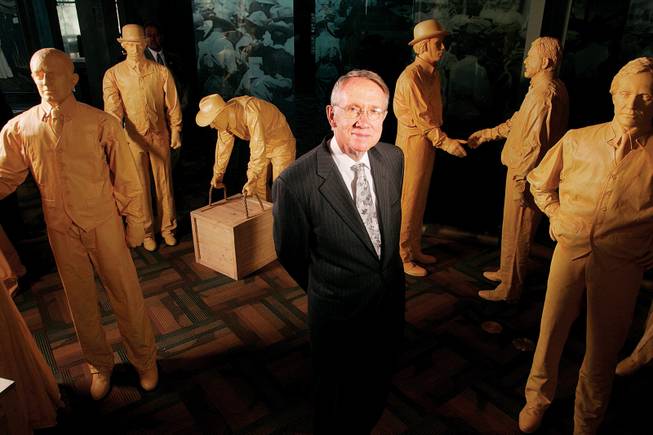
At Las Vegas Springs Preserve, Senator Harry Reid stands amid a re-creation of the land auction that created Las Vegas. For years, Reid pressed legislation that freed up acres for development in Southern Nevada and slowly but surely laid the groundwork for a ground water pipeline.
Sunday, June 15, 2008 | 2 a.m.
Special Sun Series: Quenching Las Vegas' Thirst
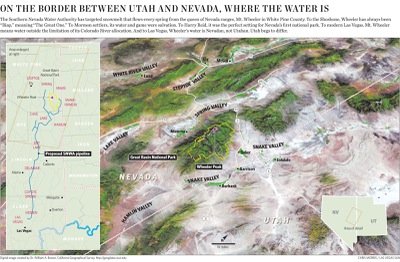
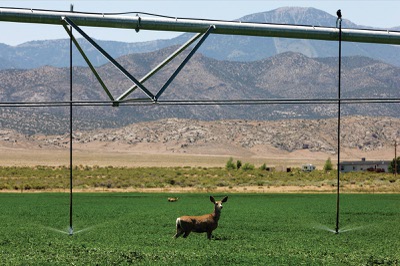
A mule deer strolls through an alfalfa field near Wheeler Peak in White Pine County. In 1985, Sen. Harry Reid began working to establish Nevada's first national park with the mountain at its center.
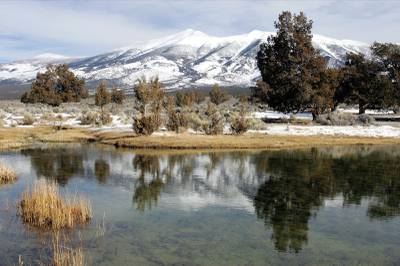
Snowmelt from Wheeler Peak has sustained generations of Northern Nevada cattle ranchers. The creation of Great Basin National Park in 1986 protected grazing rights and farming claims on the water to grow lush alfalfa crops.
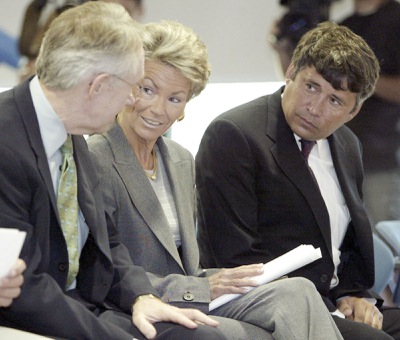
When Pat Mulroy, center, got involved in the land act, she demanded that it contain a clause diverting 10 percent from land sales to her Southern Nevada Water Authority. Mulroy is seen with Reid, left, and Interior official Bennett Raley in 2004.
Beyond the Sun
The congressman from American Samoa was confused. Could Senator Reid clarify for him again who owned the land around Las Vegas?
Nevada?
The U.S. government?
Bugsy Siegel?
“My sense of curiosity is raised in the fact that Las Vegas was developed by — I think it was an entrepreneur,” he said. “It was out in the desert ...”
“Well,” Harry Reid replied, “the entrepreneur was Brigham Young.”
“Oh, I thought it was a Jewish fellow that started the first casino ...” The congressman pressed on, struggling to understand the Nevada lands bill that Reid was asking the House to adopt. “I am trying to develop a sense of why we didn’t just give half of what is owned by the federal government to the state of Nevada and let them take care of it?”
It seemed incomprehensible to the House Resources Committee in 1997 that Reid and the other members of the Nevada delegation felt they needed to justify the release of tens of thousands of acres of federal land around Las Vegas.
Not one member of the House Resources Committee seemed to appreciate how the federal government had come to own much of Nevada in the first place.
The answer was water, more specifically the lack of it.
Nevada was so dry that ever since statehood, its government had laid claim only to areas around its rivers and springs, and left management of its vast, dry reaches to the Interior Department.
But the bill that Senator Reid and then-Congressman John Ensign presented to the House of Representatives had a formula to change that.
Embedded in it was a shadow plan to get more water.
• • •
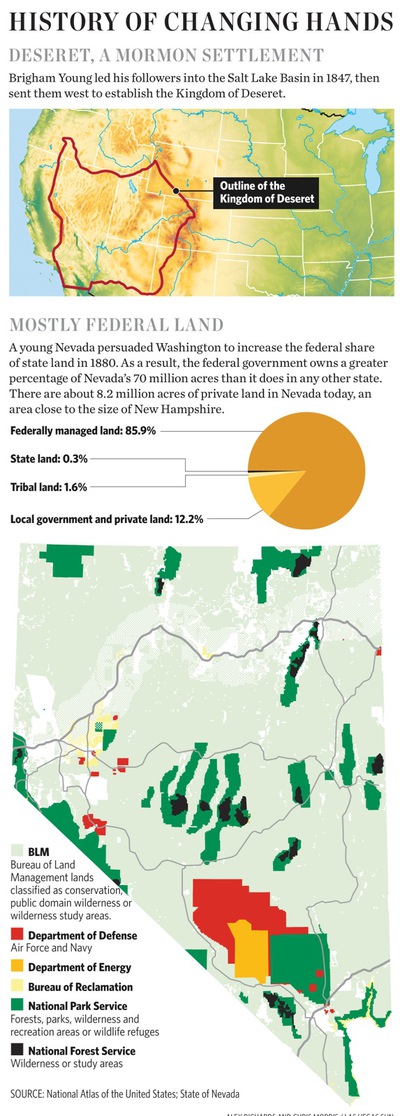
Reid was right. Brigham Young was Las Vegas’ first entrepreneur. After leading his faithful into the Great Salt Lake Basin in 1847, the man whom George Bernard Shaw dubbed the “American Moses” saw most of the American West as the makings of a theocratic nation state, the Kingdom of Deseret.
He promptly dispatched his followers to colonize it. Deseret will go down as a place of many ifs. Young might even have held onto the Utah Territory if he hadn’t tried to defy U.S. law over polygamy.
When the ultimate borders were drawn, Nevada emerged as a mining state whose backup business plan proved to be prostitution, gambling and quick divorce.
Utah became the country’s national symbol of temperance and industry with a pointedly Mormon emblem, a beehive, embedded in its state seal.
Binding this new yin and yang was water, or lack of it. No railroad promotions, no federal farm act could change the fact that both Nevada and Utah sat in the rain shadow of the Sierra Nevada. On the new map, Nevada officially became the driest state in the nation, Utah the second driest.
Water was so short that in 1880, fledgling Nevada persuaded Washington to downsize state-held land from 3.9 million acres to its choice of 2 million so it could concentrate development around existing settlements and lakes, rivers and springs. As far as Nevada was concerned, the federal government could control the other roughly 68 million acres.
More than a century later, Nevada was every bit as dry except for the fast-diminishing 300,000 acre-feet of Colorado River water delivered to Las Vegas every year compliments of Uncle Sam.
The beauty of this water was that, when asked its cost, a Southern Nevada Water Authority information officer shrugged and said, “Basically free.”
And so as Reid put before Congress a bill that proposed “orderly disposition” of federal land for yet more growth in what was the fastest-growing city in America, land released for development would need more water.
The bill envisioned a way to get that, too.
Advising the Nevada delegation on the bill was Marcus Faust, the Utah-born wizard of K Street natural resources lobbyists, son of a prominent Utah Democrat and a man then regarded as one of the living prophets, seers and revelators of the Church of Jesus Christ of Latter-day Saints.
Back in Nevada, the team was completed by Pat Mulroy, general manager of the Southern Nevada Water Authority, and her mentor, Richard Bunker, gaming lobbyist, civic leader, Mormon bishop and head of the Colorado River Commission.
Their plan: Persuade the federal government to sell land and use 10 percent of the proceeds for new pipes and such.
To fill the new pipes, the group was lobbying hard elsewhere to get Southern Nevada more of that federally subsidized, “basically free” water from the Colorado River.
If that failed, the group was also sitting on an incendiary scheme to pump the Great Basin’s ground water.
That water would not be free.
It would require a multibillion-dollar pipeline running hundreds of miles north, through Clark, Nye, Lincoln and White Pine counties.
Moreover, the danger of that plan was that it would drain the life out of Brigham Young’s old empire.
• • •
Few men understand old Deseret and new Nevada better than Harry Reid.
The Senate majority leader was born in 1939 to an alcoholic hard rock miner, also named Harry Reid, in a Mojave mining camp roughly 60 miles south of Las Vegas. His mother worked as a laundress for the brothels serving Reclamation men working south of Hoover Dam. Reid was not yet a Mormon. There were no churches in Searchlight, Nev.
Once Reid began hitchhiking to high school in Henderson, an aunt introduced him to Mormonism. He began attending seminary before school. After high school teacher and boxing coach Mike O’Callaghan passed the hat to raise scholarship money, Reid set off for Southern Utah State College.
After he transferred to Utah State University, Reid returned to Henderson to claim the hand of his high school sweetheart, Landra Gould, according to O’Callaghan the prettiest girl in the class.
Few passages in Reid’s new biography, “The Good Fight,” are as touching as those recounting their elopement.
As she worked to put him through college and they started a family, the couple were baptized into the Church of Jesus Christ of Latter-day Saints.
When Reid got into law school in Washington, D.C., O’Callaghan twisted the arm of a Nevada congressman to help Reid get a job to support his family.
And when Reid returned to Nevada to take the bar exam, his old high school coach — now head of Nevada’s Department of Human Services — met him at the Reno airport and pressed a crisp $50 bill into his hand to help with food and lodging. In 1970, O’Callaghan ran for governor and Reid, just 30, ran for lieutenant governor.
Both men won, but as O’Callaghan went on to become one of the most beloved governors in Nevada history, Reid was about to enter a wilderness.
After watching Muhammad Ali train at Caesars Palace, it was close to noon on June 22, 1972, when Reid the avid amateur boxer, euphoric after meeting a hero, more or less floated back to his office.
His mother was on the phone.
“Your pop shot himself,” she said.
A bid for the Senate failed, as did another for mayor of Las Vegas. Reid’s political career might have ended in 1977 had the paternal arm of O’Callaghan not reached out again, tapping him to head the Nevada Gaming Commission.
O’Callaghan later described it as the most important appointment of his governorship, saying, “Harry led the commission through its most challenging time.”
Reid describes himself as having “wandered into some terrible fun house.”
Modern profilers of Reid invariably stop at star-struck mentions that he was the model for “Mr. Cleanface,” Dick Smothers’ character in the film “Casino,” Martin Scorsese’s comic opera about the last gasp of mob Vegas.
Reid claims to not have seen the film, though he proudly takes credit for having signed in 1978 the exclusion order banning the real-life model for the movie’s rapturous killer, Tony “the Ant” Spilotro, from entering a Nevada casino.
Bomb threats became so commonplace, Reid says he lost count. But in 1979, the unsealing of FBI tapes in which a mobster claimed to have a “Mr. Cleanface” in his pocket put the Mormon gaming commissioner under suspicion.
Reid wanted to quit.
“Listen and listen close,” O’Callaghan told him. “You quit this job and you’ll regret it the rest of your life.”
When another prominent Mormon, former Clark County Manager Richard Bunker, was appointed head of the Gaming Control Board that same year, one of his first jobs was to investigate and clear Reid.
Then, in 1980, it fell to both Mormon crime-busters to rehabilitate Frank Sinatra, and Las Vegas with it.
Back in 1963, Sinatra had lost his Nevada gaming license over alleged association with mobster Sam Giancana. In February 1981, he wanted the license back, this time to operate out of Caesars Palace. As the world’s press poured in to see Sinatra go before the commission, Las Vegas was scruffy. There had been a series of tragic hotel fires. Gas prices were discouraging the weekend motorcades from Los Angeles. Atlantic City was waylaying Easterners.
The Strip needed Frank back. Harry Reid and Richard Bunker saw that it got him.
The stint revived Reid’s political fortunes and he was elected to the House of Representatives in 1982. By the time he’d risen to the Senate in 1987, there was a new political reality to go with the at-least-notionally new, clean Vegas. As historian Michael Green puts it, whatever Reid’s faith might dictate about gambling (Mormonism eschews it), “representing gaming is as basic to being a senator from Nevada as it would be for a senator from California to champion Disney.”
Reid and Bunker had Nevada’s back as the rest of the country woke up to the potential of gaming in the 1990s. By then Bunker was president of the Nevada Resort Association, the casino industry’s lobbying arm.
In Washington in 1992, when 46 states tried to get in on the proceeds of sports betting in Las Vegas, Reid blocked it.
Two years later, as President Clinton considered a 4 percent tax on gross gambling receipts to fund a child welfare program, Reid stood on the White House lawn and proclaimed that if Clinton went forward with it, “I will become the most negative, the most irresponsible, the most obnoxious person of anyone in the Senate.”
• • •
No state, not even Alaska, holds more federal land than Nevada, where more than 60 million of the state’s roughly 70 million acres are federally owned or managed.
As Reid gained leadership of the Nevada delegation and then the Senate itself, the Nevada delegation finally had the cohesion and Reid the clout to begin to wrest Nevada from the Interior Department.
A placeholder of a state was about to become a real state.
But nothing about the push would have been possible without Washington’s natural resource lobbyist Marcus Faust.
A large, slightly palsied and professionally discreet man, Faust ended his on-the-record interviews with the media shortly after Reid’s bill passed in 1998. But as Faust’s visibility decreased, his influence intensified.
If you want water, or land, or to keep conservation development-friendly in the West, you become his client.
“He’s a genius,” says client George Caan of Nevada’s Colorado River Commission.
He drafts bills, teaches clients how to testify at hearings, shows up and bolsters them as they do it. He generally knows their political representatives better than the clients themselves, and although those politicians come and go in Washington, Faust remains a constant.
Almost two decades earlier, when Reid was still holding gaming license hearings, Faust had drafted the blueprint for the Southern Nevada Public Management Land Act.
It was the Santini-Burton Act of 1980 and it provided a prototype in which proceeds from sales of marginal federal land around Las Vegas were directed to rehabilitate the Lake Tahoe Basin.
The bill’s originator, Representative James Santini, recalls it was a win-win for Nevada. Marginal land in the Las Vegas Valley used largely as “spontaneous dumping grounds” could be sold to create housing, and the cash generated could be used for fire control and habitat restoration in Lake Tahoe.
Although cash from the sales went north and to both Nevada and California Tahoe restoration projects, according to Reno-born Santini, the value to Las Vegas was a boost in the tax base.
By 1997, Santini was long gone from office (defeated by Reid). A new, proud and politically connected Las Vegas wanted more than land releases, it wanted more of the proceeds to go back into projects that benefited Southern Nevada.
Again Faust was on hand to assist with the drafting.
The new bill had survived its first, largely unpopular year in Congress under the stewardship of John Ensign. In 1997, Reid assumed political custody and began shaking the problems out of it.
As it evolved under Reid, it mandated that recipients of funding include habitat restoration on the Colorado River, the Department of Aviation, public education and a host of other environmental and civic projects.
To see the Southern Nevada Public Land Management Act heralded as a source of parks, trails and shooting ranges for the people of Las Vegas and the prototype for lasting wilderness protection, go to Reid’s Web site or talk to his most ardent ally, the Wilderness Society
For the version in which it’s the first of a series of federal giveaways to Reid cronies and Faust clients, go to the Western Lands Project, The Los Angeles Times or The New York Times.
To hear how it checkerboards wilderness with development in a way that will strand and destroy wildlife, go to Defenders of Wildlife.
No bill divides Nevada environmentalists quite so thoroughly.
“At first, Interior hated it,” says the water authority’s Mulroy.
As it happened, Mulroy hated early drafts, too. Before she would support the bill, she had a condition. If Nevada delegates wanted to expand the city, they would have to expand the water authority, too.
“Look,” she’d say to the Nevada congressional delegation, “developers don’t buy land to watch cactus grow.”
Mulroy was also a Faust client.
A clause was inserted into the bill. Ten percent of proceeds of the land sales would go to Mulroy’s water authority.
To see what difference a clause can make after 10 years and the sales of 47,000 acres of land, go to the Bureau of Land Management’s bookkeepers. According to their tables, as of March 31, at $285 million and counting, the Southern Nevada Water Authority has received a cool $135 million more than the next-best-funded recipient, the State Education Fund.
Because Reid, Faust and Bunker are prominent members of the Church of Jesus Christ of Latter-day Saints, when the Southern Nevada Public Land Management Act became law in 1998 — and in 2002, 2004 and 2006 led to a series of bills targeting land in Clark, Lincoln and White Pine counties — jokes started circulating around Washington.
The team that banned the mob from Vegas had replaced it with the “Mormon mafia.”
Except its crucible of power now lay as strongly in Nevada as in Utah.
• • •
Cash from sales of marginal scrubland could buy new pipes. There remained the question of getting the water to put in them.
The obvious choice was more of the “basically free” water from the Colorado River. For years, Bunker, Mulroy and their counterparts in Arizona had been pushing the Interior Department to force California to quit hogging the surpluses that relatively undeveloped states upriver let flow south every year.
By 2004, they’d succeeded and Nevada was about to claim some of the surplus.
When the first bad year on the Colorado came in 1999, there was no panic. Sixty-five percent of the water used in Southwestern suburbs is used outdoors, most of it on lawns and car washing. Mulroy was hard at conservation work and leading the nation in “cash for grass” programs paying Las Vegas homeowners to rip out their lawns.
The next year, 2000, was also bad on the Colorado River, as was 2001.
“We’d had cyclical high- or low-flow years before,” Mulroy says. “Those three years were nothing out of the ordinary.”
In 2002, the Colorado experienced its worst year since record keeping began.
Still, Mulroy didn’t panic.
By 2003, with total water storage on the Colorado River down by half, Mulroy went back to her board for another $5 million to pay Las Vegans to pull up their lawns.
They could ride out another bad year.
But in August 2003, an oceanographer at the California Institute of Technology issued a white paper commissioned by the Metropolitan Water District of Southern California.
The “El Niño” storms that had flushed the Colorado River in the 1980s and ’90s, he said, “will have more of a tendency to be El No Show or El Wimpo.”
Judging from ocean currents, he predicted there would be drought in the Colorado River watershed the next year.
And the year after that.
And the year after that.
The Colorado, he said, had entered an epochal drought.
The upshot for Nevada was that it had finally gotten its fair share of Colorado River surpluses just as those surpluses were drying up.
Mulroy today may regret the news release calling the Metropolitan Water District a “rogue agency” and, shortly afterward, accusing the Caltech scientist of having accepted a bribe, but as experts began seconding his predictions, there was no time to wallow.
By February 2004, Mulroy was back before her board asking for more millions to murder more lawn.
It was a stopgap at best. That September, Mulroy was in Washington. The Nevada delegation had the third land bill going through Congress, this time releasing land in Lincoln County.
She rolled out her dilemma before Congress: She had killed more than 33 million square feet of ornamental turf, so much that she had driven down total water consumption in Las Vegas while the population kept ballooning at a rate of 6,000 or so a month.
There were now 1.6 million people living in greater Las Vegas.
Plan A on the Colorado River was a bust. Its reservoirs were half-empty.
Plan B — to take ground water from rural Nevada — was now an urgent Plan A.
Mulroy needed another clause dropped into another land bill, this one aimed at federal land releases and protections in Lincoln County.
This time she needed Congress to instruct the Interior Department to clear passage for Las Vegas to run a pipeline across Lincoln County into the heart of rural Nevada.
• • •
Before Reid became a senator, Nevada had every class of federal land except a national park. In 1986, in his next to last year as a congressman, Reid changed that.
Others had tried during the previous 60 years, none harder than passionate park advocate Senator Alan Bible. “Alan Bible represented Nevada for 20 years in the Senate and couldn’t get it done!” historian Michael Green says.
The most logical setting for a park was Wheeler Peak, Nevada’s second-highest mountain. Its outline could have jumped off the state seal. It had sweeping vistas of Utah to the east and Nevada to the west. Moreover, it had the kinds of attractions it takes to achieve park status: Lehman Caves, a Tiffany’s of stalagmites and stalactites, and bristlecone pines, gnarly trees older than the pyramids.
In good years, Wheeler’s snowmelt is so generous that a hardworking cattle rancher can get in four crops of alfalfa before frost. During summer, cattle herds could forage across hundreds upon hundreds of miles of Interior-owned land.
In 1985, Reid took up the cause for a park. The Sierra Club backed it. So did urban romantics. But as Reid got to Mount Wheeler, he soon learned that the last thing the pioneer-stock ranchers of White Pine County wanted was park rangers telling them where they could and could not graze their cattle.
“I didn’t know the intensity that people had,” Reid recalls. “It was like it was some kind of a plot, you know, like putting fluoride in water.”
Local support grew for the idea after the closure of Kennecott Copper Mine drained White Pine County of hundreds of families. As Reid and others steadily pressed his case, an infestation of park rangers and a plague of tourists began to look like a business plan.
Moreover, Green notes admiringly, Reid negotiated the kind of park that allowed grazing.
With the formation of the Great Basin National Park in 1986, as Harry Reid ascended from the House to the Senate, “Mr. Cleanface” became “Sierra Harry.”
• • •
After the passage of the Southern Nevada Public Land Management Act in 1998, a succession of land bills introduced by Reid and the Nevada delegation churned through Congress every two years or so. With the passage of each, land deemed marginal or necessary for development was released while choice parcels of wilderness were selected for protected status: 440,000 acres in Clark County, 768,000 acres in Lincoln, 559,000 in White Pine. The Sloan Canyon National Conservation Area was created, Red Rock Canyon extended.
The bills also cleared the way for a Las Vegas pipeline to take water from many millions more wild acres.
As hope of new Colorado River water for Las Vegas evaporated in 2004 and Mulroy’s hydrologists began dusting down the ground water maps of rural Nevada, it was clear that the sweetest reserves were in the two valleys fed by Wheeler Peak in Great Basin National Park.
The people who stood to lose their livelihoods were the very ranchers whom Reid had persuaded many years before to back him in creating the park.
Reid’s early mentor, Mike O’Callaghan, who was now editor of the Las Vegas Sun, sided with the ranchers.
Six days before he died in March 2004, one of his last “Where I Stand” columns noted with disgust that the pipeline “isn’t a new idea ... Big bucks and the drought have dragged it out of hiding again.”
O’Callaghan then reprised his original stinging condemnation from 1990. “We shouldn’t allow our greed ... to destroy the families who are descendants of men and women who made this a great state. People who have carved out a living in this dry climate deserve better treatment.”
• • •
Reid choked back tears at O’Callaghan’s funeral as he said, “If you were right and fighting for it, Mike was by your side.”
Seven months later, the senator born in a Mojave shack with no running water backed Mulroy, not the ranchers championed by O’Callaghan.
Mulroy got her pipeline clause inserted into Reid’s land bill that year.
But just before the vote, Utah Senator Bob Bennett saw the need for another clause.
The valley east of Wheeler Peak, a key pipeline target, is shared with Utah. Ranchers there were up in arms at the idea of their water being siphoned to Las Vegas. Bennett phoned the Utah state engineer asking that urgent language be placed in the bill.
When the Lincoln County Conservation, Recreation and Development Act of 2004 passed, Mulroy got congressional clearance for her pipeline.
But thanks to Bennett’s clause, the act also stipulated that before Las Vegas could draw water from the valley shared with Utah, Utah would have to sign off on it.
The Mormon mafia — the Nevada Mormons — had just heard from the fatherland.

Join the Discussion:
Check this out for a full explanation of our conversion to the LiveFyre commenting system and instructions on how to sign up for an account.
Full comments policy