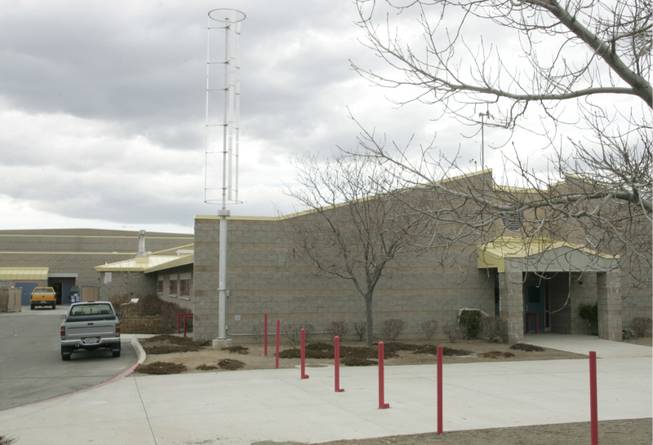
Lou Mendive Middle School in Sparks sports a Windspire, a wind turbine manufactured by Mariah Power in Reno.
Sunday, Feb. 8, 2009 | 2 a.m.
Sun Archives
- Environmental concerns roadblock to renewable energy (2-6-2009)
- We can lead on energy (1-18-2009)
- Green mantle sought in Nevada has other suitors (1-13-2009)
- The great potential and risk in Reid’s big, bold, green push (12-3-2008)
- Solar takes no shine in Nevada (10-26-2008)
As state leaders tell it, companies like Mariah Power should be the future of Nevada’s “green jobs” economy.
The Reno-based wind turbine maker will this year ship $9 million worth of its innovative wind turbines, which quietly power homes and businesses.
The company has 15 employees, eight in Reno. But when it came time to expand and mass-produce the company’s technology, Mariah Power went elsewhere.
After evaluating eight states, the company selected Michigan as the home of its manufacturing facility and 140 green jobs.
Nevada is locked in what participants say is a cutthroat competition for renewable energy jobs. Debate over how to best attract an industry many see as the forefront of an economic shift will occupy lawmakers and other state leaders this legislative session.
“Everybody’s in a race to do it now,” said Ian Rogoff, chairman of Nevada Institute for Renewable Energy Commercialization, a nonprofit company that brings technology to market.
And by some measures, it’s a race that Nevada, with its climate, geology and proximity to California’s massive energy demand, could win.
But right now, experts say, Nevada is trailing. Although geothermal power has a respectable presence in Northern Nevada, there are only a few solar plants in Southern Nevada, no wind farms and one manufacturing plant for a solar thermal technology that employs 20 people.
Gov. Jim Gibbons, a Republican, and Assembly Speaker Barbara Buckley and Senate Majority Leader Steven Horsford, both Democrats, agree a renewable energy economy is integral to the state’s future. And legislators have vowed to take up policies this session that will help the state grow the industry.
“This is akin to the other big things in this state,” said Mike Skaggs, executive director of the Nevada Economic Development Commission. “Think mining, and then in the 1950s gambling. This is of the same magnitude.”
•••
When most people think of green jobs, they imagine fields of solar panels and workers weatherizing homes. But once the solar panels are erected and the turbines are built, those jobs are gone. As one lobbyist put it, it doesn’t take many people to wash solar panels.
So the real prize that Nevada and states such as New Mexico, Arizona and Utah are pursuing are jobs building the wind turbines and photovoltaic systems, Skaggs said.
“Manufacturing equipment that these projects need to use, that’s where the high-wage jobs are,” he said. “With unemployment approaching 10 percent, our emphasis should be on how do we get the most high-wage jobs the quickest.”
Nevada has, so far, attracted only one manufacturer of solar equipment.
One reason Nevada trails other states, particularly Arizona and New Mexico, is because it doesn’t offer competitive incentives, Skaggs said.
New Mexico has a long list of tax incentives, some specifically tailored to the renewable energy industry. It recently announced an agreement to bring in a Signet Solar manufacturing plant that will create 600 jobs. In return, the state economic development agency agreed to provide $6 million in infrastructure improvements and credits against corporate income tax and sales tax.
“Even though you have a decent incentive program here in Nevada, most states we compete with have giveaways,” said Somer Hollingsworth, president of the Nevada Development Authority, a private entity that works with the Economic Development Commission to attract companies to Nevada. “They give land. They give buildings. They write checks for training dollars. All of this is worth millions and millions of dollars.”
Nevada was working with another solar panel manufacturer to bring hundreds of jobs to the state, when New Mexico swept in with a suite of incentives, Hollingsworth said.
That’s not to say Nevada has no incentives. Manufacturers that pay above-average wages and export a majority of their goods out of state can get a large break on the sales tax they pay on equipment.
Ausra opened a Las Vegas manufacturing facility for solar thermal equipment in July. It guaranteed 20 jobs that will pay an average of $24.50 an hour and in return the state offered incentives worth $650,000, according to the Economic Development Commission.
The state also offers property and sales tax rebates for renewable energy projects that generate 10 kilowatts of power or more.
All those tax rebates and incentives are set to expire in June.
There will be a broad push to renew the tax credits during the legislative session. Some in the renewable energy industry will also push for more incentives to compete with other states.
But lawmakers are still seething over a tax incentive they approved in 2005 to encourage companies to build “green.” Casino companies and connected developers got tax credits worth hundreds of millions of dollars before lawmakers could rewrite the law.
“We will look at incentives, and find what works and what doesn’t,” said Assemblywoman Marilyn Kirkpatrick, D-North Las Vegas. Kirkpatrick said she would consider making it a requirement that all panels used in Nevada solar fields be built here.
“Any incentive has to be good for Nevadans,” she said.
•••
Signet Solar, which chose New Mexico over other Western states, downplays the importance of incentives.
“It’s not the only way companies make decisions,” said Keshav Prasad, the company’s vice president of business development.
More important is good existing infrastructure and a high-tech manufacturing base, he said.
Indeed, if you ask experts in the field what prevents Nevada from becoming a leader in green jobs, the reasons go well beyond incentives. They include:
• The Bureau of Land Management controls most of the land in Nevada and has yet to approve a single solar project.
• The state lacks transmission lines to transport energy from the rural areas, where much of the energy would be produced.
• Capital markets are frozen, meaning companies lack cash to buy equipment.
There is also a broad consensus that funding education is key.
UNLV and UNR both have renewable energy programs. The Desert Research Institute also wins praise for its work.
Gibbons, however, has proposed a 36 percent cut in higher education in his budget.
“We haven’t spent the money on higher education that we’ve needed to,” said Hess, the chief executive of Mariah Power. “When you cut the UNR budget, when you cut the UNLV budget, that’s my talent. That hurts me.”
Hess said he decided to move his company’s manufacturing jobs to Michigan because of its infrastructure and workers’ experience working with steel.
In Nevada, he said, he hasn’t seen great leadership in the public or private sector for renewable energy or developing a “knowledge economy.”
“I don’t see cities taking a leadership role. I don’t see counties taking a leadership role,” he said. “Gambling has been in the lead so long, we’ve let casinos dominate where we go and what we do. That’s not a knowledge economy.”
But some say the will and factors to broaden the economy are in place.
When Nevada was the fastest-growing state in the nation, with home prices skyrocketing and casinos posting record profits, there was little incentive to try something else. But growth has slowed, and state officials say unemployment could rise as high as 11.4 percent.
When asked why the state would now get serious about diversifying the economy when efforts have failed in the past, state Sen. Mike Schneider, D-Las Vegas, who heads the newly created Senate Energy, Infrastructure and Transportation Committee, said: “We’re dead. We’ve been exposed.”



Solar and wind farms most likely will not bring that many permanment jobs in the long run.
Also missing from the article is that solar and wind farms have very marginal profitability prospects to investors because of the capital cost and the low efficiency of a solar or wind plant as compared to other energy sources. For example a 600 mega-watt coal plant can run nearly 24/7 at near full capacity, but a solar or wind plant 600 mega-watt farm does not even come close to being in the same ballbark. Therefore the captial cost is speard out over fewer watts generated making the power more expensive to sell.
That is why investors need a ton in cash and other incentives from state, local and federal taxpayers to make it more profitable and worth the risk.
Lastly, solar and wind can't provide 24/7 energy and therefore they can't be a primary source for energy needs of the consumers. They can only supplement the grid and not replace 24/7 energy sources like coal, nuclear and natural gas.
RE: "24/7 energy"
human people still sleep for 6-8 hours per day
so the energy demand would be more like 18/7
and there are things called batteries
and composite approaches
Don't bother David, he can't hear you. Or wont.
There are lots of places where the theme of Not In My Backyard dominates the process of installing the necessary infrastructure. I'm not certain how pouring more money into higher education is going to solve the problems of not being wired to move power to where it's needed or persuade the federal agencies who manage the land to allow wind farms or solar collection.
Gee....'Ya think there's a link between higher education (or even a quality basic education) and attracting industry to NevaDUH? Or keeping industry here?
Stupid, stupid Mariah.... Don't they realize we have a monopoly on wind and sun in the West? Some day they will come back abegging for our exclusive renewable assets. And NevaDUH will do something else equally stupid to run 'em off.
After all....we have two industries that serve us very, very well all the time so why try and develop more?
JFinance,
You post frequently. You do your homework and write better than the average commenter and I respect you for that. Unfortunately you and I always seem to be on the other side of every issue you comment on. Please come to a meeting of the Solar NV organization. www.solarnv.org. We meet once a month at the Nevada Power building on West Sahara. I'd like to have a chance to talk alternative energy with you. I believe it is the engine that can drive our country for the next 100 years.
CronkyVoddy,
I agree that alternative energy is the way of the future.
Who's future? If you have stayed current on the issues (I assume you have) you would know that NOBODY wants this anywhere near them.
I have posted some pretty snarky rebuffs about the NIMBYism that pervades the discussion.
I am all for saving and enhancing the environment as I am an avid sportman but last time I checked Nevada has some of the most wide open spaces in the country, why can't we use it.
There has to be an environmental sea change or all this talk about renewables is just that, talk.
Current battery and other storage technology is expensive and limited. The longest I have seen is 4 to 6 hours. There are theories of storage systems that last longer but the price tag of them is out of this universe.
Perhaps, you guys can point out something that is not expensive and can last weeks at a time.
Sometimes the sun does not shine enough or the wind does not blow enough for days at a time.
What are you going to do them? Sit in your house with no power?
That is funny about the guy who says that he only needs power for 18 hours a day. So are the casinos, hospitals, police, jails, etc going to shut down at night. What about heat or A/C at night? I imagine many of the greenies want electric cars. Are they not going to put a load at night on the grid to re-charge?
Even Obama understands this. Most nations target renewables to be around 20% of the grid. Some go for 30%. The bulk of renewables goal in the USA is hydro....you know dams. That is 20% or 30% the delievered power and not the stand-by peak capacity. Renewables of solar and wind are not reliable sources of power. Currently they produce power that is at a much higher rate than coal and natural gas.
Once again, the Sun injects their own biased opinion about sacrificing public lands for this mythical green economy.
We are NIMBY's and proud of it. All the NIMBY name callers are the same people who don't want to put solar on their own roof! There are many more armchair NIMBY's with big mouths living in the city than rural nimbys. Batteries actualy last longer than 4 hours. If you did the research, you would find that batteries from solar will run all night. People have been doing it in their homes for years.
We are hopeful that not one acre of BLM land will be lost-not until some of these name callers start making sacrifices with their own property.
Perhaps the Sun will someday learn how to keep their opinions confined to editorials. I know it's hard, but growing up has to come sometime...
"The longest I have seen is 4 to 6 hours."
Batteries can store power for only 4 to 6 hours? Wow! Did you know the Beatles broke up?
"Perhaps, you guys can point out something that is not expensive and can last weeks at a time."
Me.
"That is funny about the guy who says that he only needs power for 18 hours a day."
So if it isn't unlimited, then it's no good? Okay, then stop using all that oil and coal because they are both utterly limited!!!
Johnevegas....can you link one source that says a Solar or Wind plant is storing energy to batteries on a large commerical level more than 8 hours?
No you can not because none exist.
I guess you are going to on an bicycle producing energy for all Las Vegas citizens....LOL.
Perhaps you should put your money where your mouth is.
Get a wind will and solar panels for your house and your business.
Only use power from those two sources.....oh...you can you the power from your bike too.
"No you can not because none exist."
Right. But you said batteries were limited to 4 to 6 hours. That is nonsense.
Frankly, associating batteries with solar power plants is nonsense too. I imagine that's why you keep doing it, because it makes it look worse than it is.
Anyone can see the sun doesn't shine 24 hours or every day. But to assume that it's inability to deliver a 24/7 solution means we should use it is silly. It can do what it can do, which is more all the time, which will help offset non-renewable sources, and help make us more independent. That is all that matters.
I was clearly talking about renewables solar and wind farms and their ability to store energy.
You are putting words in my mouth. I never said batteries could not last longer than 4 to 6 hours.
I said that I have not seen any batteries or other storage technologies store more than 4 to 6 hours of power. It is obvious to a truthful person that I was continuing my previous comments on the ability to store power in commerical solar and wind farms. I said that there are theories to store power longer but the cost is out of this world.
As for batteries....it was one of your allies that tossed out that subject first.
I am glad that you agree with me that solar and wind can't not be a primary source for power and can only be used to supplement the power grid.
Thank you for that was my main point.
All the lip flapping done here is enough to drive at least one turbine. See and you though it wasn't possible.
Ahh, jfnance32, there you go again, making stuff up and reacting to it.
Studies show that wind and solar power plants produce more construction jobs, operation jobs, and tax revenues than fossil fired plants of the same capacity -- especially for a state like Nevada which has no in-state fossil fuels to speak of.
Instead of shipping (untaxed) money out of state every year for fuel, money is spent (in state) on construction and maintenance of capital equipment.
The advantage is biggest in solar thermal power plants, which provide roughly 4x the construction jobs and 4x the in-state revenues of conventional power plants of the same capacity. One of the world's biggest builders of coal-fired power plants did a 2006 study for California which found this result; you can find the study here: http://www.nrel.gov/csp/pdfs/39291.pdf
One of the segments of the green economy that does need development is battery tech. There are a number of industrial solutions being vetted including a type called a Vanadium Battery.
http://www.triplepundit.com/pages/vanadi...
The nice thing about this tech is it is highly scalable. Yes certainly *right now* they are not ready for prime time and very expensive. But like all tech as they are produced and the production is streamlined they will come down in price and likely size. Just look at the performance vrs price on computers in the last 20 years. As the need arises and the market develops the price and performance will follow.
This is really the case with all green tech and renewable energy. As a society we have not dumped the resources time and interest into the area. I have faith that the US will be capable of doing so despite the ney sayers.
As to NIMBY. Frankly folks need to get over it. A small turbine or solar panels on the roof as part of a diversified energy delivery system are not obtrusive. They can be kept small because the goal is to create small sufficient zones or neighborhoods. This for the moment can be tied to main grid tech but to move forward we need to look at reducing our reliance on olde skool concepts. Grid diversification is one way to do so.
Finally state action needs to be taken to overturn and illegalize the prohibition of alt energy additions by CCRs. Just as it is illegal to keep service animals out of areas so should it be illegal to keep alt energy out of a community.
JSin
The battery of the future will be the storage of sunlight energy in the form of heat/BTU's. This acomplished by running solar heated fluid through underground heat exchangers which pass heat from the sun through salt baths producing molten salt. Current technologies can produce molten salt in the 650-750 degree range. When the sun goes down the stored BTUs can be use to spin steam turbines that will create megawatts of electricity.
Battery storge in the sense of electron storage (ie lead acid/lithium ion) are suited well to distributed generation. Distributed generation is the oposite of centralized generation. ie coal/gas plant. This is where homes, businesses, and cars all have their own battery systems as well as generating systems (ie photovoltaics) which are connected to and interactive with the grid. Database systems will be able to account for the flow of electrons throughout the entire grid in real time. This is done by installing systems that will trace electrons coming out of their source, as they pass into a battery, as they pass back out, and where they are retired into sinks (ie homes/businesses). This is basically a system of meters with their own IP addresses. Grid and Net interactive! We'll be able to store excess power when it is available and put it to work when it's not. ie nighttime/or clouds.
The grid is unbelieveably inefficient right now. Society uses only a fraction of the actual power generated and put onto the grid at any time. It's maddening how much we generate and don't use. What we don't use goes up in smoke and heat. Also, massive amounts of energy is lost as heat in transmission lines. Once the infrastructure is built to accomdate distributed generation and storage, coal and gas will take a back seat. It's all about efficiency and finding the right mix of renewables and traditionals to meet our future demands. The bottom line is future demand should progressively drop as we learn how to get more bang for our buck. Coal and gas will be a part of our energy portfolio for a long time, but there will never be a need to expand it's development.
Our future energy economy....Yes, it will be costly. Is it worth it? YES