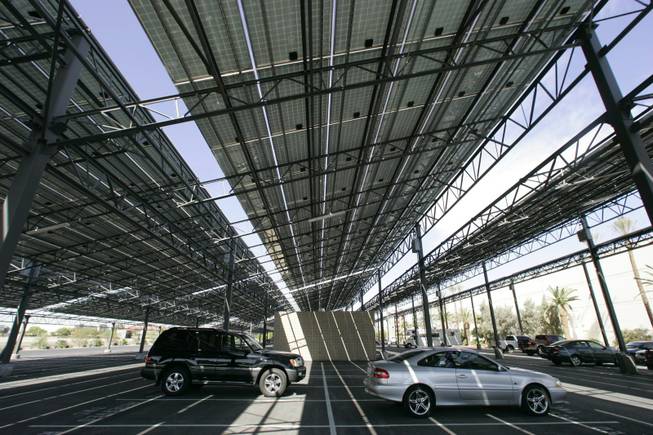
Steve Marcus / FILE
The shared parking lot of ProCaps Laboratories and TWC Construction in Henderson is shaded with an array of photovoltaic panels that also provides about 50 percent of the power used by the companies.
Sunday, Oct. 26, 2008 | 2 a.m.
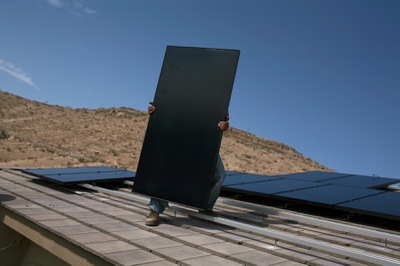
Electrician Frank Cudia of Bombard Electric carries a solar panel for installation this month on the roof of a home in Las Vegas. Developers of large solar arrays say Nevada doesn't offer kinds of the incentives or workforce other states do.
Why do solar installers, developers and financiers prefer states other than Nevada?
Solar companies building utility-scale projects have taken a beating on the international stock market in recent weeks, and large solar arrays Nevada prefers are huge financial risks, increasing the difficulty of securing financing. The solar energy industry also thinks Nevada is averse to smaller projects after the state Legislature passed a cap on incentives for smaller solar arrays.
Nevada has some of the best solar potential in the world — enough to power the entire nation, according to the Energy Department. But solar energy developers were far from singing the praises of the Silver State when they gathered for a conference in San Diego this month.
Solar installers, developers and financiers at the event said although Nevada’s solar potential is impressive, it’s not enough to lure them away from states with better financial incentives, stronger workforces and more progressive electric utilities.
They said the top states at attracting solar developers include some of the most obvious candidates: California, New Mexico and Arizona — but also states such as Oregon, Colorado, New Jersey and Texas.
In most conference presentations, Nevada never made the list.
Even companies that have a Nevada presence — Ausra (which owns a manufacturing plant in Las Vegas), Acciona (which owns Nevada Solar One) and Sun Power (which built the Nellis Air Force Base array) — are building their new projects in neighboring states.
There are myriad reasons why solar developers are passing Nevada over in favor of these other states.
For starters, the projects favored by Nevada’s utility — large utility-scale ones — are expected to have trouble getting the necessary financing to get off the ground.
Large solar companies building utility-scale projects most attractive to Nevada have taken a beating on the international stock market in recent weeks. And their projects — usually giant solar thermal arrays using technology similar to that at Nevada Solar One — carry a higher financial risk than other types of projects, meaning they would have a harder time getting loans in a tight credit market.
Financial experts say the lower risk, medium-sized urban solar photovoltaic projects built mostly by privately owned companies will be far more attractive to creditors.
“It used to be that large sized was your friend. I’m not sure that’s the case anymore,” Morgan Stanley Vice President Edward Levin said at the conference. “It might be easier to get smaller scale projects funded today ... The sweet spot of the market is 1 megawatt or less.”
That’s approximately the size of the arrays on the roof and parking lot of ProCaps Laboratories in Henderson and about one-third the size of the parking lot array at the Springs Preserve.
But companies that build 1 megawatt arrays said at the San Diego conference they have little interest in Nevada. Instead, they are going for the low hanging fruit in states with better incentives for small to mid-sized solar projects.
Most companies look not just for high solar capacity, but also high electricity prices (solar electricity is pricier than most other forms of electric and so is more attractive in states that have high fuel costs for generating electricity); the availability of rebates and tax incentives; generous net metering — credits on electric bills for people whose arrays put electricity back into the grid; and an educated, tech-savvy populace more likely to want their energy to come from renewable sources, said Brendan Neagle, vice president of business development for Borrego Solar Systems, a major photovoltaic company.
Nevada falls short of other states in all those areas, several solar developers said.
“We’ve never seriously considered Nevada because the market isn’t there yet,” said Hygenes Garcia, a lead engineer for solar engineering firm M&W Zander. There aren’t enough Nevadans putting in PV (photovoltaic) and not enough people interested in having PV.”
Some larger solar photovoltaic companies said they have also been put off by perceptions that Nevada won’t enforce laws requiring utilities to generate set amounts of electricity from renewable sources. It is well known in the industry that the state’s utility has yet to meet its annual renewable energy and solar energy mandates and yet has not been sanctioned by Nevada’s Public Utilities Commission.
The message that has been sent, many at the San Diego conference said, is that the state doesn’t really support renewables.
Several solar developers said they were even more discouraged by an impression that NV Energy (formerly Nevada Power) has little interest in growing the number of mid-sized solar projects considered more likely to get funding in the next three years.
“It’s bad right now. We feel like they’re blowing us off completely,” said a representative of a solar developer who asked that his name be withheld because he feared being blacklisted by NV Energy.
One reason the utility has a reputation as bristly or uncooperative is because the state Legislature has capped the incentives for smaller solar arrays.
Rebates for new solar installations in Nevada are available only for homes, small businesses, public buildings and schools. The rebate program for small businesses and residents is capped at 1 megawatt of new small solar projects per year statewide and fewer than 4 megawatts over all categories each year.
The program has filled up within hours of the application period opening each year and generally has a long waiting list.
And until this year, net metering — credits on the electric bill for extra solar energy generation — had been limited to arrays generating 150 kilowatts or less. Arrays up to 1 megawatt are now allowed to participate.
By setting limits on the rebates and other incentives, legislators can control the effect on state coffers and utility rates.
But it doesn’t attract solar companies and new jobs.
Our state budget crisis isn’t helping either. Solar developers said states with budget deficits are more risky, and they fear incentives will be decreased or dropped.
“The public’s appetite for new tax losses due to companies taking advantage of state incentives or the (federal tax credits) could dry up,” said Matthew Cheney, chief executive of MMA Renewables. “States with deficits are looking for opportunities to cut things and they’re going to cut things that don’t hurt.”
Nevada also lacks the educated workforce available in states with stronger higher education systems and more developed technology industries. Solar companies can more easily recruit homegrown engineers and accountants in states such as Arizona, California, New Mexico, Oregon and New Jersey.
And although Nevada has plenty of unemployed construction workers who could be retrained to install solar, some worry the state’s education system has created a workforce that can swing a hammer and not fall off a roof, but can’t do the math necessary to install solar.
“We need people with ‘real’ high school and ‘real’ college degrees,” people who have the knowledge, not just the diplomas, said Jeff Wolfe, chief executive of groSolar.
Also, the state’s strong unions have a reputation of being difficult to work with, some solar developers said.
It is also important to note: Nevada is not just competing with other states for solar companies and projects, said Stephen O’Rourke, managing director of Deutsche Bank. Solar developers of all sizes are eying emerging markets in Italy, South Africa and many other countries.
So, although Nevada’s politicians are touting the state as the next big solar market, “the Saudi Arabia of Solar,” some in the industry see us — at least right now — as something more like the Latvia of Solar.
A version of this story appeared in In Business Las Vegas, a sister publication of the Las Vegas Sun.

Join the Discussion:
Check this out for a full explanation of our conversion to the LiveFyre commenting system and instructions on how to sign up for an account.
Full comments policy