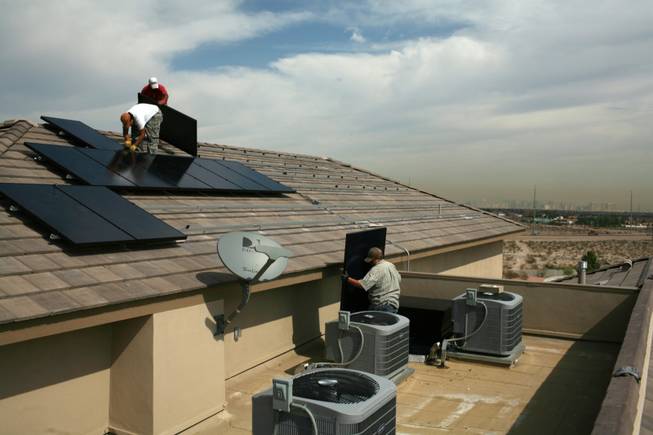
Bombard Electric electricians Frank Cudia and Tina Long, on the roof, and Debbie Long install solar panels on a home in Las Vegas.
Sunday, Oct. 19, 2008 | 2 a.m.
Any time environmentalists and renewable energy advocates gather, the question is bound to come up: Why doesn’t every Southern Nevada home have solar panels on its rooftop?
Well, as any homeowner who has looked into going solar can attest, it’s often the price tag that stands in the way. At $40,000 to $50,000 per system, the upfront cost of “free” electricity from the sun is just too high for many homeowners.
But with expanded federal tax credits starting in 2009, people may be able to more easily see how it will pay off in the long run, according to green living consultant Steve Rypka, owner of GreenDream Enterprises.
“The math absolutely works out overall. It’s a good return on investment, but the big problem is the upfront cost,” Rypka said. “People will go out and spend the same amount or more on a swimming pool and not expect any return. A lot of it has to do with perception.”
For those who are ready to make the investment, NV Energy, formerly Nevada Power, offers a solar rebate program that pays for a quarter to a third of the system. The federal tax rebates will soon pay for a third of the remaining cost. Until January federal incentives pay only $2,000 of a residential installation.
Without the substantial federal and utility company subsidies, a typical residential solar array would never pay for itself.
Even with new, larger federal tax rebates, only a few dozen homeowners can get into NV Energy’s rebate program each year because it is limited by state law. Since 2004, 200 to 250 customers have received the rebate, including Rypka. His monthly electric bill is now $8, the basic charge for connecting to the electrical grid.
Each year the program fills up within a half-hour or so, according to Renewable Energy Generations Program Manager John Hargrove.
This year’s program is full. The next round of sign-ups will likely be in August or September 2009.
Customers who don’t make the list initially are added to a waiting list. Hargrove said that because many customers are ultimately scared away by the high upfront cost of solar systems, the utility has been able to clear the waiting list every year.
Still, Deidre Radford, residential solar project manager for Bombard Renewable Energy, said the end result is that customers sometimes wait two years to get into the NV Energy program.
Since 2004, the ratepayer-funded Renewable Energy Generations Program has spent $25 million to help pay for small solar, wind and hydroelectric installations on residences, small businesses, public buildings and schools.
Each year the rebate gets smaller. In fiscal year 2008, the rebate is $2.80 per installed watt, typically from $11,200 to $14,000 depending on the size of the array. Next fiscal year the rebate will go down to $2.60 per watt.
So far the utility has given rebates for 1.8 megawatts of residential and small business solar. The program can now rebate up to 1 megawatt of new residential and small business solar each year.
Hargrove said he expects expanded federal tax credits will cause “attrition to go down in this program. I don’t think as many people will withdraw because of the economics.”
He also expects the number of contractors who install solar panels will grow because of the new rebate.
And Radford said the investment will only continue to look better to customers.
“If the (utility’s) rate increases continue at what they’ve been over the last 10 years ... soon it will be down to about an eight-year return on investment,” she said.
In the past 10 years, the average residential electric bill in Southern Nevada has risen to $139.96 from $77.56, according to the utility, an increase of about 81 percent.
If that trend continues, people may not even wait to get into NV Energy’s program, but instead rely solely on the federal incentives, Radford predicted.
For Denise Gavlak-Yemc and her husband Louis Yemc, the expanded tax credits weren’t even necessary to make the math work. They had a 5-kilowatt system installed in their home in the Southwest part of the valley on Sept. 9.
“It will eventually pay itself off,” Gavlak-Yemc said.
And although the time it took to get into NV Energy’s program “seemed like forever,” she said, she’s considering installing a second array.

Join the Discussion:
Check this out for a full explanation of our conversion to the LiveFyre commenting system and instructions on how to sign up for an account.
Full comments policy