Las Vegas Sun

November 23, 2009

Currently: 47° | Complete forecast | Log in

STIMULUS DEBATE:

Lessons of Depression up for fresh discussion

Economists, politicians still haven’t pinned down the actions that ended it

Image

ASSOCIATED PRESS FILE

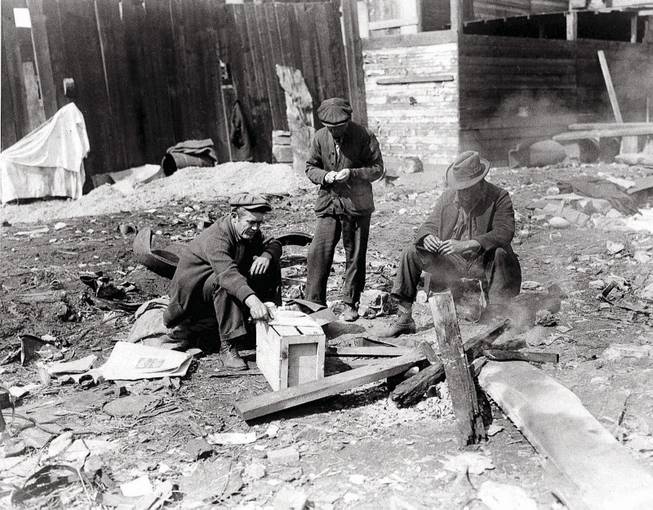
Three unemployed men start a fire for cooking in a vacant New York City lot, where they lived when they are not searching for work, during the Great Depression in 1932.

Thursday, Feb. 5, 2009 | 2 a.m.

As senators wrangle this week over Washington’s plan to stimulate the economy, the debate is laced with competing interpretations of something that happened seven decades ago: the Great Depression.

Click to enlarge photo

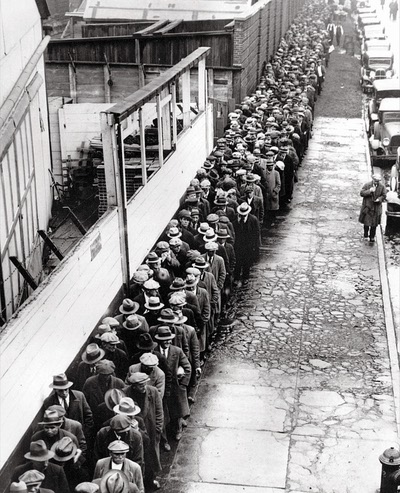
Jobless and homeless men line up to get a free dinner at New York's municipal lodging house in 1932, during the Great Depression.

Many Democrats believe government’s spending under Franklin Roosevelt helped the nation climb out of the Depression. They support President Barack Obama’s plan to inject $900 billion into the economy.

Other lawmakers, mainly Republicans and notably Nevada Sen. John Ensign, believe the opposite. “All the government spending did not take us out of the Depression,” Ensign said. They want to rein in Obama’s stimulus package and provide more tax breaks so the private sector can reverse the downturn.

So which view of the Depression is correct?

Let’s start with the president who occupied the White House when the Depression began, Herbert Hoover.

Did Hoover sit on his hands, predicting an imminent recovery, as liberal politicians and economists say?

Or, was he, as Ensign said, “very much an interventionist”?

Ensign argues he “raised taxes, he increased spending — very much tried to meddle in the economy,” without success.

Brian Balogh, a 20th-century historian at the University of Virginia’s Miller Center of Public Affairs, said Hoover often did assure the public that the Depression was in retreat, but he did so while trying a number of things to revive the economy.

Hoover created the Reconstruction Finance Corporation, which directed money to state and local governments to continue with large capital projects. He also raised tariffs on imports.

But the Depression continued.

William Gale, an economist at the Brookings Institution, said the judgment of Hoover’s actions doesn’t come down to a matter of “too much or too little; it was the wrong thing. It’s not a matter of do you intervene or not intervene. It’s whether you do something intelligent or not.”

Ultimately, Hoover was “unwilling to have the national government intervene directly in the economy,” Balogh said. He “drew the line at direct work relief, at creating federal jobs for people.”

Raising tariffs, in fact, turned out to be counterproductive. It kept countries that exported to the United States from earning enough dollars to pay their debts, which in turn led to big losses for the banking industry, said James Galbraith, economist at the University of Texas’ LBJ School of Public Affairs.

Historians and economists are less in agreement about the effects of the man who replaced Hoover, Franklin Roosevelt, and the effects of his New Deal.

Launched in Roosevelt’s first term, the New Deal included enormous deficit spending to pay for new agricultural programs and emergency relief and work relief programs, in addition to reforms to banking and industry.

Did it work? Here’s where things get murky.

Economists and historians agree that under Hoover, unemployment climbed to record levels, 25 percent, and then steadily declined after FDR took over in 1933.

By the end of the 1930s, unemployment was down to 10 percent or less. “In fact, Roosevelt did spend his way out of the Depression,” Galbraith said.

But other economists argue that unemployment actually stood much higher at the end of the decade — at 15 percent. And at 15 percent, they say, the country was still in a Depression even if far more Americans had jobs.

Two points are worth making here.

One, even if unemployment stood at 15 percent, the level was in fact down 10 percentage points from the beginning of FDR’s presidency. So does that mean FDRs policies succeeded or failed? That debate continues.

Two, the difference between 10 percent and 15 percent unemployment levels comes down to 3.5 million jobs. Those jobs were temporary, created and paid for by the federal government.

Liberal economists tend to count those jobs because the workers were, in fact, working.

Conservatives tend not to count them, arguing that government-funded temporary jobs are not a true reflection of the strength of the economy and should not be considered a measurement of the New Deal’s effectiveness.

Incidentally, the current national unemployment rate, as of December, was 7.2 percent.

Another point of contention about the Great Depression is something that occurred in FDR’s second term. Roosevelt campaigned in 1936 on ending deficit spending and returning to the policies of a balanced budget. After reining in spending by repealing many welfare programs, however, the economy slid in 1937. So was it a mistake to halt deficit spending?

Again, the debate continues.

As the 1930s drew to a close, FDR’s treasury secretary, Henry Morgenthau, told Congress that despite spending more money than ever before, the federal government had not solved the riddle of the Depression.

Some conservatives have seized on that comment today as evidence that Obama’s plan will fail to end the recession.

Most experts do agree that a lesson of the Depression is that the government must act aggressively to stop a downward spiral caused by an absence of liquidity.

“The lesson of the past is the government didn’t respond enough to avert the banking crisis. We can’t just stand by and let the financial system collapse,” Gale said. “If the economy is the engine, the financial system is the oil. If you lose the oil, then the engine dies — and a particularly nasty death. That lesson has been learned.”

The Depression ended in the first half of the 1940s as the government spent unprecedented sums to finance World War II. Suddenly jobs were more plentiful than workers. The war had provided economic stimulus far greater than anything under the New Deal.

Some economists say the lesson here could be that the New Deal had not rescued the economy because the government didn’t spend enough money in the previous decade — an argument in favor of massive and prompt federal spending by Washington today.

No one is talking about spending nearly as much of the current gross domestic product as was spent by the government during World War II, which could be seen as good thing or as a bad thing, depending on your view.

After the war, the nation enjoyed an economic boom caused in part by pent-up savings from the war years, Galbraith said. People working during the war earned money they couldn’t spend because purchases were limited by rationing, so “the war made it possible for American households to accumulate savings,” Galbraith said.

One final argument also makes the rounds these days, championed by Christina Romer, chairwoman of Obama’s Council of Economic Advisers.

She says the recovery was largely due to monetary policy. Romer has concluded that a doubling of the dollar-gold exchange rate had the major impact. Gold bought twice as many dollars, which led to an increase in the money supply, boosting bank deposits, investments and lending.

Pete Klenow, an economist at Stanford, said despite all the talk about lessons learned from the Depression, the nation still doesn’t understand enough of why recessions occur, and therefore both Republicans and Democrats might have the answer.

The economy would probably be well served by a wide range of solutions, including tax cuts and massive spending, he said.

“The Great Depression was a long time ago,” Gale said.

Discussion: 27 comments so far…

  1. This article was for the most excellent but there was a cop out at the end. If tax cuts were the solution or even a good portion of the solution then why did all the tax cuts thrown at the wealthy in the last several years not prevent the current crisis?

  2. The answers to the financial "crisis" that America is facing shouldn't be that difficult to solve ... The BIGGEST obsticle is that the two main political party's are more interested in scoring political "points" than seeking the needed remedies.

    Housing got us where we are today and addressing the problems created by overbuilding and speculation needs to be the priority if we are to get back on track.

    The answers are available ...but.. will congress listen to those answers?

  3. The investments made to infrastructure are probably good things that might come from the stimulus package, but those positive gains could easily be offset by the massive amounts of spending that can only be called what they are "Pork"

  4. Ironically, most economists agree that big government spending and heavy regulation caused the depression to last longer than it would have otherwise.

    Most economists also recognize that Hoover tried subsidies and bailouts before FDR did.

    They also recognize that Hoover tried the shovel ready jobs before FDR did as well.

  5. The most striking commonality between the current recession and the Great Depression is the poor condition of the large money-center banks. In the Great Depression, American banks had lent European governments large sums during the World War; these sums were to be repaid in part by reparations paid by Germany; Germany defaulted, and the default was exacerbated by trade barriers erected by the US which dramatically reduced the earnings by which European exports might have serviced their American debts. This provoked a liquidity crisis, which had much the same effect as today's "credit" crisis is having.
    This effect then was as it is today: Consumption shrank; prices fell; production fells; unemployment rose; fear and pessimism entered; and a downward spiral become established. If the above is largely true, then whatever else the stimulus package does, its focal point must be to reestablish liquidity and credit within the large banks; without credit, business expansion cannot occur.

  6. Everyone talks about spending, but nobody asks where the money is coming from. Government can only get money from two sources: by taxing the wealth we the people produce, or by borrowing the money from other governments. Simply printing more money only devalues the money, and if taken too far gives you a Weimar Republic scenario where a wheelbarrow of money won't buy you a loaf of bread. We're close to our borrowing limits already (soon other governments will lose confidence in our ability to pay them back, and stop lending), and socialist policy is killing incentives to produce wealth and taxing and regulating business to such an extent that it drives it offshore. Something's gotta give, but the Obama administration acts as if doing more of the same harder and faster will get us a different outcome. This is not the way to get us out of a recession. It's the way to ensure a depression.

  7. Since they Sun interviewed the most liberal economists it could find on the subject here is the other (more correct) side:

    http://www.mackinac.org/archives/1998/sp... (Great Myths of the Great Depression)

    http://www.thefreemanonline.org/featured...

    http://video.google.com/videosearch?q=Mi...

    http://mises.org/rothbard/agd/contents.a...

    http://newsroom.ucla.edu/portal/ucla/FDR... (UCLA economists estimate FDR's programs caused depression to last 7 years longer).

  8. THe problem with Rkellog statement and the federal bailouts in general is that everyone is trying to deleverage not increase debt. THe federal plan increases debt at a time when companies need profits to expand operations. More government spending does not create profits.

  9. The problem KDR is that most economists and a vast majority of historians agree that FDR helped during the depression. You sir are cherry picking your "consensus" numbers to make it sound different. The conservative republican method was tried with Hoover. The idea was to balance the budget lower taxes and spending. Those actually seemed to worsen the depression, especially as more and more people were in desperate need for governmental intervention in some form. The Kenysian method worked and helped to stabilize the country until World War II came along, which was just more government spending to help people out.

  10. "The nation still doesn't understand enough of why recessions occur"

    It's called the Austrian business cycle. The Fed makes credit artificially cheap - creating asset bubbles for commodities such as real estate - and, as a result, there appears a misallocation of resources across the economy. It further makes it difficult for financial institutions to accurately judge investment risk because they can't even trust in the value of the dollars being lent. Hence, they go under when the market corrects to adjust to the Fed's failings. It's happened before and it'll likely happen again.

    You seriously found someone willing to say that stagflation was a boon to the economy? That statement, more than any other discredits this entire article.

    The same force was at work in the 1920s prior to the crash. The government abandoned the gold standard and set the Fed free to print absurd amounts of money - leading to the same misallocation of resources and collapse of financial markets.

  11. Actually most economists do believe FDR's policies did not help the great depression. The difference is many economists feel that today's situation is not like the great depression which is why some recomend FDR like programs which they recognized didn't work in the great depression (because, repeating again) we are not in a great-depression like situation.

    Hoover's idea was most certainly NOT low taxes and a balanced budget. He increased spending, increased taxes, increased government regulation, bailed out businesses and states.

    All government spending did was use scarce resources in a less efficient way causing the depression to last much longer than it would have otherwise.

  12. http://video.google.com/videoplay?docid=...

    At about 31 minutes in, James Galbraith and Milton Friedman debate.

    A note on James, he believes income inequality is horrible, state central planning is absolutely necessary, and China has a modlel economy for the US to emulate. He's also really smug as you can see from the video.

  13. It's been my opinion for quite some time the fundamental problem with our national economy is its foundation -- half a century ago it was production, now it's debt. And the same kind of bookkeeping Enron went down for is far more the norm than the exception.

    Economy 101 starts with the classic primer Smith's "The Wealth of Nations." It's very thick even in paperback.

    The point -- nothing about this is going to be easy. The problem was a long time brewing, the solution will be long time fixing. And that's just not compatible with the usual desperate need to lull the populace with sound bites and this quarter's bottom line.

    By the way, excellent article!

  14. Yeah and Milton Friedman is the moron who honestly believes in unfettered capitalism. What's your point? There's people on both sides who feel very powerfully about the depression and how it was solved. Unfortunately the depression is now HISTORY. There's no way to test what could've worked better. And a moron stating it worsened the depression by 7 years is just spouting moronic numbers. Sorry, that's called spin/being an academic trying to sell your book.

  15. That and Friedman has some blood on his hands from Chile, so yeah he's the guy we should all follow... to a torture room.

  16. The answer to the first comment/question (mschaffer) is that the money is still in their pockets or lost but it is not spent. It is true that finance lubricates the engine of economy therefore cash needs to be kept moving. Just think for a moment what personally gives you confidence to spend and you will have one answer to the problem. Conversely think of the circumstances that would cause you to staunch your spending and you will have one cause.

    Finally the world economy will never find complete stability because countries are no longer backed by gold reserve, that is, what they print on paper does not equal what own in gold.

  17. Red,

    Yes there are ways to test this stuff. We've had multiple recessions and depressions in the country so its only a matter of locating them, understanding their depths and results, while looking at state policy to address them. After that the comparison is easy. Cause and Effect.

    As for Milton Friedman, your logic on him is Naomi Klienable at best (I've met her, she's cute, but as closed-minded as a brick). Let's start with Chile. Augusto took over that country from an elected socialist and proceeded to implement -- central planning in the economy. He was a military dictator not an economist.

    Milton Friedman was invited down to Chile by a local university to lecture on economics, not by the state. While there he gave a lecture that said free markets would give them a democracy and restore their freedom.

    He did meet with Augusto, briefly, and told him that central planning was dooming the state.

    Augusto didn't implement the Chicago School reforms until several YEARS after his takeover and several YEARS after the bloodshed.

    At best you can only lay blame on the bloodshed toward centrally planned government.

  18. I also think the out-sourcing of American jobs to other Countries is at issue as well as the fact that there's hardly anything "MADE IN AMERICA" anymore - so in addition to housing I think we need to address the issue of manufacturing and job out-sourcing as well. Ya, I know, the obvious response is gonna be how much more things will cost if made in America - that may be true but if Companies were more willing to pay a living wage maybe we could all afford some of the 'made in America' prices. I know I wouldn't mind paying a little for goods made here because I would know that jobs for Americans are at stake.

  19. Make a rule that you only pay taxes if you work for Obama, since that seems to be how it is anyway. And then spend, spend, spend!! Oink, oink, oink Harry and Nancy. I feel like squealing like a pig with those two in charge.

  20. If no outsourcing what-so-ever was good policy, Azsk8fan, then North Korea would be a very rich country today.

    And the whole "living wage" concept is complete crap. People are paid what they're able to produce. If the pay is too low people don't take the job they go to someone who will pay them what they're truly worth. There is no evidence what so ever that suggests any market economy has pay that is too low to live on. Period.

  21. The unemployment rate was 5% through the mid 20s, due to the lack of numerous laws, including bank protection rules, leading into the 1929 cash.

    Hoover and Roosevelt increased taxes, tighten monetary policy, new trade barriers, demonized business (FDR called them "the princes of property"), and implemented a 6% of GDP spending program.

    Hoover created the Reconstruction Finance Corporation to direct money to the state and local government and signed the Smoot-Hawley Tariff Act- June 17, 1930.

    Roosevelt, in 1935, sign a utility law restricted capital formation. In 1936 Roosevelt doubled the bank reserve requirement.

    Washington policy was spending and business retribution because it was selling. Roosevelt did inspire those in despair with his fireside chats.

    The unemployment peaked at 25% and remained in the 15-20% range throughout the thirties. The government employed about 5% of the population (3.5 million people) in temporary low end public works project. Many "New Deal" projects supplanted private job such as Tennessee Valley Authority and the Rural Electrification Administration. (Remember Commonwealth and Southern Company?)

    While many of the specific are being debated.

    What is clear and agreed to (on the right Amity Shlaes and the left Christina Romer) is the need to fix the broken process rules first, significantly increase liquidity, and provide the basics like food stamps and unemployment checks -

    then do not raise taxes, do not raise tariffs.

    So far the broken process rules have not been fixed, and a several billion dollar tax on cigarettes has been leveled.

    Until the process (including process assurance and oversight) for home loan origination, loan insurance, and loan securitization is fixed the monetary and spending stimulus (while it may boost the economy short term) it will long term do nothing to tip the jobs and economy trajectory positive (and may be made worse with the additional debt burden).

    You must fix the process (including process assurance and oversight) first or you are just pouring money into a broken system.

    Process change would include mark-to-market valuation, rebuilt credit rating agencies, reined in hedge fund arbitrage exchanges, and eliminate the system is set up so that fee-collecting middlemen churn re-structured financial instruments by reselling them. Brokers make money on every transaction.

    Eliminate dark pools of liquidity (or virtual trading arenas) which have created a two-tiered system where big speculators can move stocks and securities without the retail investors market knowing they were traded. Retail investors are left in the dark.

    Confidence by the public requires they see real changes, and believe that the housing process has been fixed.

    The stimulus can be a 50/50 mix of tax rate reductions and spending with the basic criteria that it must score "permenate" job creation in at less that $50k per job.

  22. future2012;
    A coherent,well thought out & presented commentary. Kudos. I wish some of the other regulars here would emulate that process when writing.

  23. Nothing comes from nothing. And there's no free lunch, guys. The credit and housing bubble has burst and now it's in everybody's mind. The recession will lead into depression. Crime rate will go up, and so will unemployment. After reading all these comments, as hard as it sounds, I try to see if somebody has a solution ready. But there isn't any. Stimulus packages will only kill the pain a bit but extend the problems. In fact, I'm afraid that this might lead into USA's state bancruptcy. And what's going to happen next?

  24. One thing people aren't talking about is the fact that everyone wants to "SPEND" our way out of this recession. But overspending and bad credit loans is what got us into this mess. What we have to do is encourage investment. By doing that, we sure up true bank funds and solidify the banking industry. By just creating more money/credit, we're just covering up the recession with more debt which gives us no real value in the world economy

    Raise interest rates, eliminate poor credit loans, and lower all taxes. We have the money. Allow us to invest. Allow us to start new businesses with new jobs. And allow us to jump start the economy. We need to look at the money/credit the government plans to spend as conterfeit funds. It has no true value

Post a comment

Commenting requires registration.

Comments are moderated by Las Vegas Sun editors. Our goal is not to limit the discussion, but rather to elevate it. Comments should be relevant and contain no abusive language. Full comments policy.

Username:
Password: (Forgotten your password?)

OR Create an account (It's free)

  • Most Read
  • Discussed
  • Most E-mailed

Calendar »

  • 23 Mon
  • 24 Tue
  • 25 Wed
  • 26 Thu
  • 27 Fri