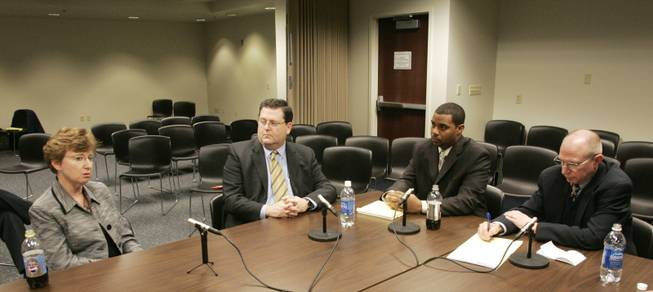
Assembly Speaker Barbara Buckley, from left, Sen. Warren Hardy, Senate Majority Leader Steven Horsford and Assemblyman Joe Hardy discuss the state budget and other issues the Legislature will take up starting Monday.
Sunday, Feb. 1, 2009 | 2 a.m.
Legislative Leadership Roundtable
Four state lawmakers discuss the looming budget crisis and other issues on the agenda ahead of the start of the next session of the Nevada Legislature.
Sun archives
Sun Blogs
Sun Archives
- Top Democrats’ wait-and-see on budget: Savvy or spineless? (1-30-2009)
- Dems mum on remedy for budget shortfall (1-29-2009)
- Gibbons defends cuts, says critics have no alternatives (1-27-2009)
- Gibbons’ staffers face barrage of budget questions (1-25-2009)
No Nevada Legislature in recent memory has confronted the dire financial situation that faces state lawmakers as they convene Monday: a $2.3 billion budget shortfall, an unprecedented foreclosure crisis and a state economy in freefall.
The Sun brought together four lawmakers — two Democrats and two Republicans — during a break from committee hearings last week to discuss the 75th session of the Legislature. (Gov. Jim Gibbons was invited to participate or send a representative. He declined.)
The panel was asked about the proposed 6 percent cuts to teacher and state worker salaries, how they plan to balance the budget and whether Nevada’s money troubles will leave time for them to deal with other important issues.
The participants:
• Assembly Speaker Barbara Buckley, a Democrat;
• Sen. Warren Hardy, a Republican;
• Senate Majority Leader Steven Horsford, a Democrat;
• Assemblyman Joe Hardy, a Republican
Sun reporter J. Patrick Coolican guided the discussion. Sun reporter Mary Manning transcribed it.
The conversation has been condensed and edited for clarity.
Do you favor the budget cuts proposed by the governor? If not, specify what you would do?
Assembly Speaker Barbara Buckley: We’ll do our best to stabilize the economy and look at issues — the foreclosure crisis, jobs, examining the federal stimulus package and figuring out a way to fix our financial problems. Also, we need to learn from these experiences and restructure our state for the long term.
Sen. Warren Hardy: A lot of what we are experiencing is beyond our control. It’s national and now international. We do have some control over how we deal with it, however.
We need to spend a lot of time focusing on the policy. We never seem to get around to the policy. We’re forever trying to fill holes in the budget. If you look at Nevada history, that’s the way things go, peaks and valleys.
That will be the challenge this session. Many of us have suggested a budget stabilization fund that’s a little different from the rainy day fund. It has triggers associated with it, both what you put in and how you take it out to help us deal with the peaks and valleys.
Senate Majority Leader Steven Horsford: These are extraordinary times and it’s going to take an extraordinary effort to change our approach to the budget process. Yes, we have a budget crisis, but we also need to discuss our education system. We have an enormous opportunity to position Nevada as a leader in renewable energy that is going to require a lot of collaboration and consensus building.
Most important we need to focus on economic recovery efforts. The people we represent are hurting and want to know that we have a plan.
Assemblyman Joe Hardy: We find ourselves in a hole and the first rule of holes is to stop digging.
We’re going to have to look at this as a two-pronged event. How do you save money and how do you spend money. The state needs to work with the entities with which it shares responsibility. I’m uncomfortable taking resources away from sister agencies or municipalities or counties.
Horsford: When it comes to teachers, if we try to save $300 million by cutting teacher salaries by 6 percent, that impacts our ability to recruit and retain quality teachers, many of whom are spending their own money to equip their classrooms with supplies. That is the governor’s approach — balance this budget on the backs of teachers.
The alternative is to figure out ways to support education, not dismantle it.
We have to determine what the priorities are. I believe one should be education, and one should be some critical health care services.
We can balance this budget. It will be difficult. It will require leveraging resources from the federal government, it will require us to be smarter with the dollars we have available. It will require stakeholders coming to the table to help.
It’s a bipartisan discussion.
Warren Hardy: We will talk about additional revenue, but before we do we’ve got to make cuts and they’re going to be painful.
The good news is that the political parties or houses of the Legislature don’t seem to disagree that education, mental health and public safety need proper funding.
I’m not going to participate in dismantling higher education, but that’s an individual priority. Again, we’ve got to make significant cuts before we can even talk about additional revenue.
Buckley: Education, higher education, K-12, health and human services and public safety constitute 93 percent of what we spend, so that is where the deepest cuts are being proposed by the governor. Those are the areas that we’re going to need to restore.
We cannot cut higher education by 36 percent, as the governor proposes. We cannot cut UNR and UNLV by almost 50 percent each. If that is the proposal, they might as well be shut down.
It’s a bad idea to balance the budget on the backs of teachers and state employees.
Warren Hardy: It’s a little unfair to criticize the governor for the budget he submitted because he has to fit that budget into that box. He is required to submit a budget that meets the Economic Forum numbers. That’s what he did.
If he’s susceptible to any criticism maybe it’s for his stance on not wanting to raise taxes. But a lot of us have said the same thing. I don’t think that’s unreasonable.
Buckley: But it’s interesting, Warren, that last night we were with a group of Republican and Democratic business leaders, public interest groups — at a round table with 30 folks to solicit their opinions. One conservative leader asked: Has anyone talked to one person who supports the governor’s budget? Not one person had.
Warren Hardy: My point is that we shouldn’t spend too much time wringing our hands over his budget. The governor went by the process. It’s not helpful to the process to criticize him. He presented it and now it’s our turn.
We’re not inconsequential in the process unless he makes us inconsequential by vetoing things we do. So we’re certainly not going to alienate him, and I think that needs to be recognized by everybody.
What about the Chamber of Commerce’s call to make certain reforms to public employee compensation before enacting a tax on business?
Buckley: Some of the proposals are problematic. Cutting current retirees? Teachers who have given us 40 years of service? Changing rules in the middle of the game, saying, “Hey, we told you we would provide health insurance, but surprise! We’re kicking you off your health insurance.”
I think we would end up being sued and I think they would prevail.
Now, can you examine the system and say, “Times are different”? Can you look at cost-saving reforms? Absolutely.
I think you can look at reforms without kicking people off health insurance. I’m more interested in reforms as we have an aging workforce.
Warren Hardy: We’ve got to start moving down that row toward health care subsidies to retirees.
Horsford: I think there’s a lot of middle ground. We’re going to have a good debate for people divided on the issues. We should expect results, more out of education, better graduation rates. It’s real easy to tear down. It’s real hard to build back up.
Warren Hardy: We tend to implement programs, then never go back to see if they work. Like President Obama says, we need to see results.
Joe Hardy: We take every program, literally, and dissect it. Did it work or did it not work? This is a good opportunity.
Warren Hardy: The margin of error is very, very slim. I’ve heard people suggest to solve the higher ed problem that we eliminate the state college. That would be the worst thing we could do for higher ed, but until you understand the role that the state college plays, it seems like an easy answer. We must look at where the cuts are — and whether we’re making things worse.
Horsford: I know we don’t want to talk about the governor’s budget, but, unfortunately, that’s the document we’re going to have to start from. My question is: If you cut so much out of a program that it doesn’t provide a needed service or you have kids on a waiting list who otherwise are entitled to health care, what’s the point?
The safety net we build needs to provide essential services for people until the economy rebounds and people are able to go back to work and have health insurance and all the other things people want for a good quality of life.
What about the state taking tax money that now goes to local governments? Can local governments do more with less?
Buckley: I think they can do more with less. We’re all going to have to do more with less. It’s legitimate to talk about funding sources for local governments and state government. It’s time to talk about whether the state takes a portion of the property tax from local governments.
We also should talk to the counties and cities about how they would make up the difference. You can’t just consider that without consulting them, planning with them.
Should counties and cities have home rule?
Buckley: It can always be discussed, but what does that mean? Does that mean that counties and cities can raise taxes anytime they want?
Could you have a situation where one county would raise taxes so much it could trigger a tax revolt statewide that could cause us to have to defund schools?
We have to be very thoughtful about what we’re doing and unintended consequences of what we may do.
Warren Hardy: I’ve always been an advocate of home rule. The problem is, it’s just not workable in Nevada because we have two large counties at either end of the state and the small counties depend on us, the state.
It’s time that local governments go through the kind of intense effort the Legislature has done over the last several sessions. Local government needs to look at their fundamental services. I don’t think they’re there yet.
Local governments are tight, they’re tough, but are they offering programs that are not core essential functions of government?
On my side of the table, Republicans talk a lot about the need for a spending cap. Well, the state has a cap and we’re far below it.
In 1978 the Legislature developed a spending cap that was very responsible and would guarantee that government wouldn’t grow out of control. We are $1.7 billion below that cap. So the notion that state government has spent out of control is inaccurate.
I do think there’s justifiable criticism of local governments. They need to take a look at the same thing we’ve done and distill it down to the core functions of government.
Horsford: Local government should be at the table in the discussion of revenue and distribution of revenue. It should not be a process whereby we dictate or they refuse to be at the table.
I don’t think we should shift our budget problem to local government. They’re our constituents, they’re the same people that county commissions and city council and school board members represent. Shifting that problem is going to create a kind of unintended consequence at a different level.
We need a robust discussion on consolidation, particularly here in Southern Nevada. We have duplication in areas that is inefficient.
For example, the public doesn’t understand the Las Vegas Housing Authority, North Las Vegas Housing Authority, Clark County Housing Authority. The question is: Is there affordable housing? That’s what we need to focus on — whatever structure works best to get us to the best policy.
Joe Hardy: The Southern Nevada Regional Planning Coalition, a group of elected officials from every local entity, has come together and tried to do that type of consolidation. It has worked in some ways.
On home rule, we do give a county or a city home rule up to the level we think they should have and we do that almost every session. But it’s not everything that the people in favor of home rule want.
So much of where you stand on issues depends on where you sit. We sit in legislative bodies and they sit in city councils and county commissions.
Local government is doing more with less, often without credit. They’ve gone through the same exercise as we have. In fact they’ve done it sooner than we have because we don’t go into session until February.
What are issues that will come up in the Legislature beyond the budget?
Buckley: Overhaul of our financial structure: the budget stabilization accounts, spending priorities.
There are also issues on workers’ safety, the hepatitis C outbreak. The interim committee has some very good recommendations to prevent that sort of tragedy from ever happening again.
Warren Hardy: Some issues will be driven by the debate. We need broad discussion and the budget crisis is going to allow us to have that debate.
We’re going to have to work together. I don’t think this will be a partisan session because as I’ve said many, many times, a failure of the Legislature is going to be seen as a failure of the Legislature, not of the Democrats, not of the Republicans, not of the Senate, not of the Assembly, but a failure of the Legislature, and the stakes are just too high for the people of Nevada for us not to get it right.
Horsford: Beyond what the speaker mentioned, renewable energy is huge. You will see innovative approaches to position Nevada to be at the forefront of a policy nationwide.
We can create 15,000 jobs in renewables just based on existing projects being talked about, and that’s everything from the manufacturing to the construction to the maintaining of the operations. The state needs to create an infrastructure to sustain this.
The federal stimulus is great. The president’s vision is the right move. But it’s a one-time stimulus and we have an obligation as a state that we’re building an infrastructure that works for us, in education, in health care.
We also need to make some better decisions in public safety and the investments that are being made there. We have a proposal from the governor to close one prison — the Nevada State Prison in Carson City — and open a new one. And yet the best practices are not building new prisons, but using intermediate facilities and improving reentry programs and mental health, alcohol and drug treatment facilities and services. Those things need to be at the forefront of our discussion at the Legislature and it will be.
I want people to feel that even though this is the worst economy we’ve ever been faced with, we have an opportunity to get it right, to get the government working again on their behalf and to make sure it’s meeting their needs.
Joe Hardy: When we walk out of the Capitol, we will have solved this problem.
To the teachers, I say: We will solve this. You will still be paid, you will still have benefits. People who want to go to college will still have a college, a community college and a state college to go to. They will still exist and they will have teachers to teach. That is the most important message today.
Also, there is more to the session than the budget. We have 900 some bills. We have to make sure we do it all.
The most important message to Nevadans is that we will get it done.

Join the Discussion:
Check this out for a full explanation of our conversion to the LiveFyre commenting system and instructions on how to sign up for an account.
Full comments policy