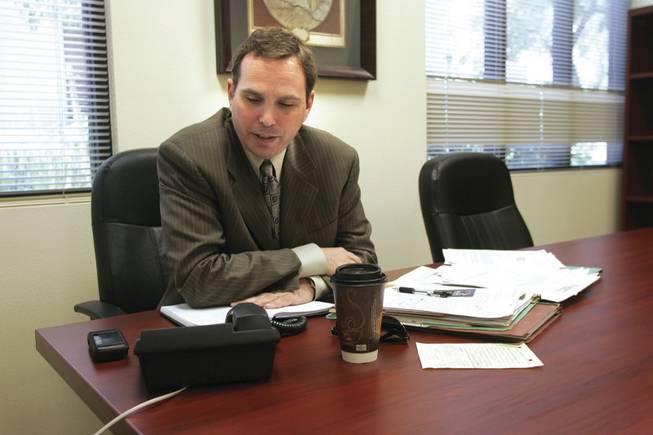
Ian Hirsch of Fortress Credit Services, with his 10-person staff, has taken on nearly 300 clients facing mortgage difficulty in the past year. With more homes going into foreclosure every month in Las Vegas, Hirsch says he doubts the market has reached bottom.
Sunday, April 12, 2009 | 2 a.m.
Make your voice heard on the recession
To help people struggling in this sour economy, federal and state governments are taking steps to extend tax credits and mortgage relief and to free up frozen credit markets so consumers and businesses can get loans again. Are you being helped by government efforts? Are banks or other creditors working with you to give you a break? If so, the Las Vegas Sun would like to hear from you. Please e-mail us as at: economy(at)lasvegassun.com, or write to us at Las Vegas Sun, 2275 Corporate Circle, Suite 300, Henderson, NV 89074.
Sun Topics
Sun Archives
- Home prices key to economic turnaround, economist says (30-6-2009)
- Report: 58.2 percent of Las Vegas homes have negative equity (3-4-2009)
- ‘More pain to come in this Vegas land market’ (3-1-2009)
- New-home sales plummet again with no signs of improvement (2-27-2009)
- Las Vegas counts on Obama housing rescue (2-27-2009)
- Report: Las Vegas home prices at July 2003 levels (2-24-2009)
- Economist: Vegas housing market to recover in 2010 (2-23-2009)
- How Obama's mortgage relief plan pencils out (2-21-2009)
Beyond the Sun
Ian Hirsch is just getting warmed up. He turns on the speakerphone and a Cheshire cat grin crosses his face at a point when most people would slam down the phone in disgust.
He is unleashing a mix of hectoring and schmoozing, slowly but definitely bending back a huge, faceless company’s resistance to making it easier for a 71-year-old widow to live out her life in her house, her home.
Hirsch is a debt adjuster and manager at Fortress Credit Services, one of only two homegrown companies in his line of work with a state license. About a year ago, he discovered that his ability to cajole and badger could be put to use helping people hang on to their houses. He persuades banks and other companies to modify mortgages. Hirsch and 10 staff members have taken on nearly 300 clients in the past year. Two-thirds of the cases are still in process, but he says no one has lost a house.
Listening to Hirsch’s speakerphone offers an on-the-ground lesson on what it means for Nevada to be on top of the nation’s list of foreclosure rates.
The aggressive advocate for homeowners at their wits’ end spends his days parrying often contradictory and confusing responses from the nation’s largest financial institutions, while attempting to make sense of the Obama administration’s evolving approach to rescuing the American dream of owning a home.
Many of his clients work in casinos and earn tips. Others played bit roles in the real estate boom as title clerks, loan processors. Maybe one in 10 are senior citizens on fixed incomes who are struggling under mortgages with rising interest rates.
About half his clients are in default on their mortgages. The rest want to avoid that fate but are finding that companies don’t want to modify mortgages that are in good standing.
Although Hirsch doesn’t advertise, word of mouth has expanded his business so much that a recent visit found him moving into a larger office at his company’s Sahara Avenue address.
The case he is calling about this early afternoon involves a 71-year-old pensioner who signed on to one of those mortgages whose monthly payments start to expand like a balloon being filled with air. Two years ago, she was paying $947 a month. Now the amount is $2,519. She stopped paying in November. Hirsch is in his second month of sending in paperwork and making follow-up calls to the company that holds the mortgage.
He gets past the prompts telling him to press button after button. He has called many times and found the name of someone at the company’s Florida address who seemed to be moving the case forward. Today, that person is on vacation. Hirsch gets switched to someone else. He asks whether they are answering the phone in the United States. No, it’s Bangalore, India.
Hirsch nods with a “here we go again” look on his face.
He asks to be transferred to a supervisor at the Florida office. No, he can speak to a supervisor in India. The wait on hold begins, the first of several throughout the call, which lasts nearly 45 minutes.
When a voice finally returns to the line, Hirsch asks the name of the person on the other end. “Anthony,” he starts off, detailing what paperwork he has sent, when he sent it, what other Anthonys have told him. He describes a Feb. 10 call lasting an hour and 19 minutes. The person in Florida told him to call back in 45 days. So where are we at with this case? he says.
On hold again, he complains: “We have to speak to somebody in India about a mortgage in Henderson held by a lady who was born in 1937.” Four minutes pass before Anthony returns to the line and proceeds to lead Hirsch down a long, blind alley. Hirsch says he sent this or that. Anthony says he hasn’t seen the paperwork.
Then Anthony mentions “the Obama plan,” really a series of suggestions, including the most basic — a person should not be paying more than 30 percent of his income on a mortgage. But, Anthony says, “we have regulations, we just don’t have the guidelines. We’re waiting for them to be released by the government.” Hirsch returns to the facts: “I’ve sent in four separate modification updates.”
This continues for some time. Anthony says he’ll just have to wait 10 more days, then asks, “Do you have a foreclosure sale date scheduled?” No. “Just in case, we will consider adjourning it or postponing it.”
After the call ends, Hirsch notes that the mortgage companies haven’t figured out the Obama administration’s response to those facing foreclosure, even variously interpreting such apparently straightforward notions as the 30 percent issue — is it net income or gross income? He attempts to put the call into context. It was similar to hundreds of others he has made. “Do you remember what Donald Rumsfeld said at the beginning of the Iraq war?” he says. “He said, ‘There’s the known unknown and the unknown unknown.’ That’s what this is like. When these home loans were made, no one planned for this. There are now entire departments of banks that didn’t even exist six months ago.”
Just as Hirsch himself didn’t have hundreds of green file folders piling up on the desks of his staff six months ago.
For years, he made a living helping people whose credit card bills were piling up while their credit scores went down. One day in late 2007, an employee came to him seeking a raise, under pressure from a balloon mortgage. Hirsch asked the employee to let him go a round with the mortgage company. He succeeded. The employee’s monthly bills were reduced and Hirsch avoided having to pay a raise.
“I began hearing about this problem from other people. I realized I could be making money doing this as well,” he says. Hirsch doesn’t charge upfront or guarantee any result, two tactics scam artists use and that Nevada’s attorney general has warned homeowners about.
After hundreds of cases, Hirsch has also come across people he will not charge — like the pensioner. One box of tissue is emptied every two weeks by those who cry on the other side of his desk.
“Several men have told me they considered suicide because they had their wives and children living in homes they were going to lose and they felt there was nothing they could do about it,” Hirsch says. “They thought it was better to leave them with the life insurance policy.”
He had to tell one of those men he couldn’t help and instead sent the man to a bankruptcy attorney.
He cites the claim that “anyone could do this on their own,” noting that yes, it is possible to attempt to modify your own mortgage, but you need, first, a lot of time, not to mention a fat Rolodex built by researching company directories. There’s also an X factor: “knowing what to expect, not being intimidated, not backing down.”
That persistence is hard to maintain in the face of things that don’t make sense about the foreclosure crisis, he says.
First of all, “There is no ‘they,’ as in, ‘They should do something about this.’ I can never get on the phone with someone” who cares at companies handling mortgages.
Second, most companies won’t deal with his clients until they are past due and en route to foreclosure, instead of modifying their mortgages before that point to keep them in their homes. “If the companies are going to accept less through a short sale or a foreclosure, then why not accept less and keep people in their homes?” he says.
And the capper: Hirsch hasn’t “figured out how to help the guy with a good job, he’s making his payments, but he’s upside down with his house.”
More than 234,000 homes in Nevada — 55 percent of the state’s total — are upside down, or valued at less than what is owed on them, according to a December report by First American CoreLogic, a data analysis firm. That percentage is the highest of any state. Put a different way: Most properties bought here from 2004 to 2007 are upside down or “underwater,” according to Steve Bottfeld, executive vice president of Marketing Solutions, a Las Vegas housing consultant.
Hirsch is not sanguine about the valley’s immediate future. “I feel we’re not at the bottom of this ... as fast as we grew, that’s how we will keep spiraling down,” he says. Las Vegas’ foreclosure rate in February, one filing for every 60 households, was seven times the national average. There were 8,406 filed against homeowners that month, a 32 percent increase from the month before and nearly double the amount for February 2008, according to RealtyTrac, a California firm that tracks foreclosures.
Not only does Hirsch think there are more foreclosures to come, he also says it will take some time for companies to develop a uniform approach to modifying mortgages.
Even when the surge of foreclosures wanes and home values stop sinking, he notes, an all-but-forgotten Nevada law passed in 2006 may continue to hold the American dream out of reach for many in the Las Vegas Valley. The law, AB440, was intended to provide protection to workers who live off tips and want to buy homes, according to the Nevada attorney general’s office. That’s about half of all homebuyers in the Las Vegas area, say some industry sources — and much of his client base. When the law took effect in late 2007, several large lenders drew nearly the opposite conclusion: Don’t lend to so-called stated-income earners. Then the foreclosure crisis exploded over the valley, pushing the issue off the front pages.
Lunch hour has passed. Hirsch still hasn’t touched a sandwich, preferring a cup of coffee. He calls about a new case. After the last time he called, he sent in paperwork on the homeowner’s income, but one thing disturbed him. The company representative told him his client might have an easier time if he went into default first. Hirsch explained that his client didn’t want to ruin his credit for seven years. This time around, Hirsch attempts to confirm that is still the company’s advice. The voice on the other end instead asks for patience. They are still looking at paperwork. Hirsch remains nonplused, cordial.
After hanging up, he says, “I haven’t lost a house yet. But it’s going to happen, I know.” Then, perhaps remembering where he works, he says, “I’m just going to have to play poker.”

Join the Discussion:
Check this out for a full explanation of our conversion to the LiveFyre commenting system and instructions on how to sign up for an account.
Full comments policy