Monday, June 30, 2008 | 2 a.m.
Reader poll
Sun Archives
- Gas 'peakers' set to kick in when weather sizzles (5-19-2008)
- More commuters taking bus route (5-9-2008)
Beyond the Sun
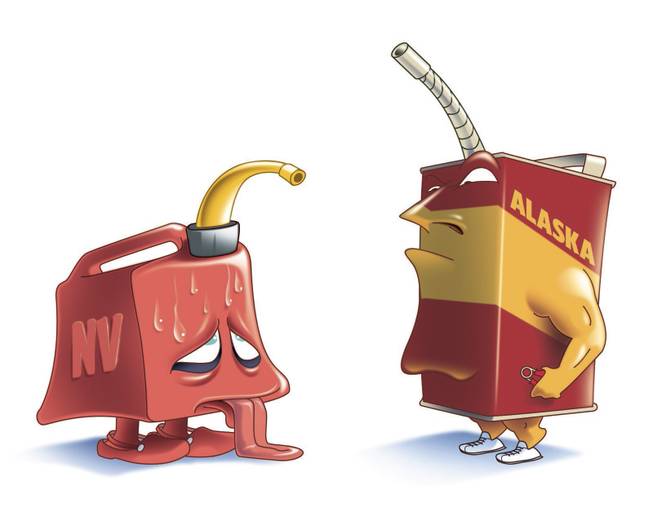
A gallon of gasoline isn’t quite a gallon of gas in the summer, and that has Southern Nevadans in a court battle to get motorists more for their money.
As gas heats up, it expands, losing mass and energy. The industry standard for a gallon of gas is 60 degrees. That means you will get your money’s worth from gasoline only if its temperature is 60 degrees or lower at the pump.
But in the Las Vegas Valley, it’s generally higher, often far higher. That’s the primary reason valley residents are among the plaintiffs in a massive class action lawsuit that alleges the oil industry and gas station owners are guilty of consumer fraud and conspiracy.
The problem is not confined to Las Vegas, of course. Plaintiffs in the lawsuit come from 25 other states, Washington, D.C., and Guam. Attorneys for the consumers — including Las Vegas attorney Randall Jones — estimate each motorist has to spend, on average, an additional $40 to $100 a year to cover the difference caused by gasoline that is warmer than 60 degrees.
In Nevada, about 95 percent of gasoline arrives via pipeline, says Steven Grabski, administrator of the state Weights and Measures Department. Once here, gasoline is stored in large above-ground tanks that bake in the sun all day. In the summer the temperature of gas spikes.
The gasoline is carted from the storage tanks to gas stations in tanker trucks, where the temperature of the fuel stays about the same as it was in the storage tanks, Grabski says. Finally, the gasoline is deposited in underground tanks, the last stop before the fuel goes through the pumps, which act “as a thermos” because they’re double-walled, Grabski says.
An industry standard established in 1923 set a gallon of gas at 231 cubic inches at 60 degrees. When gasoline is at 90 degrees, which is not uncommon in summer months, it expands to more than 235 cubic inches, the Kansas City Star reported in December 2006.
Last week, when it was 108 degrees in the valley, the Sun measured the afternoon temperature of gasoline sold at three stations. It ranged from 103 to 103.9 degrees.
The state is conducting a more scientific study of the temperature of gasoline that officials began in late February. That month, gas averaged between about 57 degrees and 64 degrees, depending on the station and the time of day, but by late May the average was in the high 70s when the mercury outside was in the low 80s. (The data provided by the state runs through May 29.)
“The volume of gas people are getting in Las Vegas is not what it’s advertised for,” says Tyson Slocum, director of the energy program for Public Citizen, an advocacy group based in Washington, D.C. On one tank of gas, he says, consumers are barely affected. “But when you add it up over a year’s worth of daily commutes, it’s not insignificant.”
And it becomes more significant as the price per gallon keeps climbing.
Some analysts say heat expansion boosts revenue of oil companies and gas station owners by $1.5 billion annually. The oil industry and its retailers, however, dispute that tally of heat-fueled extra revenue as an “extreme analysis.”
Josh Eichberger, vice president of government relations for the National Association of Convenience Stores, argues that competition among retailers negates most of the heat effect — to the point that retailers typically make just a 1-cent profit on a gallon of gas.
Mindy Long, spokeswoman for the National Association of Truck Stop Owners, notes that the composition of gas varies nationwide, so other variables are at play besides temperature, as well as competition.
Long says observers should not underestimate the power of economics. “There are other costs beyond just temperatures.”
But Slocum says Public Citizen has found no evidence that competition neutralizes the cost of less-potent gasoline.
“I don’t see this as a remedy that supply and demand will successfully address,” he says.
Retailers’ lobbyists also insist that formal adjusting for temperature is not legal and that they’re required to sell a gallon of gas at the industry standard of 231 cubic inches.
But so far, U.S. District Judge Kathryn Vratil, who is presiding over the lawsuit in Kansas City, has rejected the industries’ efforts to quash the lawsuit.
It may be a tall task for the industries’ attorneys to disprove the contention of consumers that retailers deceived them. According to Vratil, writing in a February court order, the retailers “may have a duty to disclose such information to avoid liability under consumer protection statutes.”
Some Costco-run gas stations in San Diego County have begun to do so, but still fail to “inform consumers of the actual fuel temperature or make adjustments to the price of fuel,” Vratil wrote.
Some industry lobbyists say representatives of state weights and measures departments have not taken issue with the way gasoline is sold. They also insist they did not conceal material facts.
That last point is up for considerable debate. Because the price of fuel sold at the pump isn’t adjusted for temperature, oil companies reap a windfall of “hidden profits” in excess tax reimbursements paid on wholesale purchases, Vratil noted in her order.
Essentially, some oil companies pay federal and state gasoline taxes upfront, based on gasoline at 60 degrees. Then they collect taxes from consumers to recoup the money. If the gasoline has heated up and expanded, the amount of tax money collected from consumers would be more than the amount of taxes paid earlier by the industry, says attorney Kyle Smith, who works in Jones’ firm.
Oil companies and retailers, the lawsuit alleges, have been “unjustly enriched.”
The resolution of the lawsuit could be years away, and even if the plaintiffs prevail in Vratil’s court, an appeal is all but certain.
Retailers, Vratil wrote in February, had yet to “address plaintiffs’ contention that they should adjust the price (not volume) of motor fuel to account for temperature.”
In the courtroom, she continued, attorneys for the gasoline industry “conceded that it might be permissible under state law to adjust the retail price of motor fuel based on temperatures.”
And the defendants, Vratil added, had “not shown ... that state regulation actually prohibits them from adjusting the size of a gallon of motor fuel to account for thermal expansion.”
The industries also supported — and maybe even facilitated — Canada’s moving to temperature compensation equipment. In the largely warmer United States, however, they oppose it. In the 1970s, the industry cited a $6 billion cost to upgrade equipment nationwide, but now, the estimate is considerably lower, at $2.2 billion, Vratil noted.
Eichberger, the convenience store lobbyist, says small-business owners would take a beating if forced to install the equipment. “If a convenience store is making $25,000 profit a year, they may not be able to afford it,” Eichberger says.
Slocum and some elected officials in Washington propose using royalty payments from the extraction of oil from federal land to help retailers pay for new equipment. A bill in the Senate, however, hasn’t gotten very far.
In her order, Vratil outlined a long history of the industry’s efforts to sweep aside the heat expansion issue, including a claim in the 1970s that the national average temperature of gas was 56 degrees, meaning temperature expansion worked in favor of consumers. In 1979, however, the American Petroleum Institute acknowledged that its prior contentions were wrong.
Institute representatives declined to comment for this story, citing a policy of not commenting on lawsuits.

Join the Discussion:
Check this out for a full explanation of our conversion to the LiveFyre commenting system and instructions on how to sign up for an account.
Full comments policy