Pablo Martinez Monsivais / AP
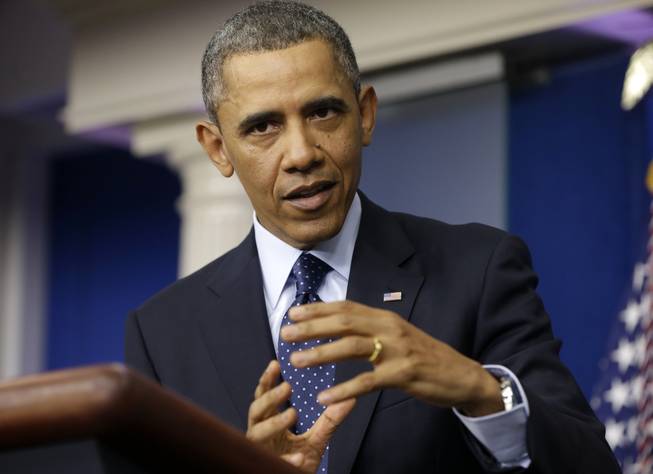
President Barack Obama gestures as he speaks to reporters in the White House briefing room in Washington, Friday, March 1, 2013, following his meeting with congressional leaders regarding the automatic spending cuts.
Tuesday, March 12, 2013 | 2 a.m.
Sun coverage
As watchers of "The West Wing" will remember, few gestures have as much political significance as when a president goes down to the Capitol to make a deal with Congress.
But that’s just what President Barack Obama will be doing this week, making three trips to confer with Senate Democrats at their regular caucus luncheon today, House Republicans at a special conference session early Wednesday afternoon, and Senate Republicans and House Democrats, independently of each other, on Thursday.
Obama is visiting with rank-and-file members of Congress in the midst of an entrenched dispute between Republicans and Democrats over budgets and deficit reduction, particularly how to fund the government past March 27, when current authorization expires, and how — or whether — to avoid about $85 billion in across-the-board sequestration cuts over the rest of the fiscal 2013 year.
Through an intensive public messaging campaign, Obama has largely framed the standoff as an ideological dispute between him and Republicans, who refuse to raise tax rates as a way of closing some of the budget gaps.
But Obama’s schedule of meetings on Capitol Hill indicate that he is coming not only to hash out differences with Republicans but also to improve relations with Democrats.
As the Las Vegas Sun reported in early January, the "fiscal cliff" situation heightened tensions between the White House and the office of Senate Majority Leader Harry Reid over whether Obama was taking on enough personal responsibility in selling his policies to Congress.
Many Democrats took issue with some of the terms of the New Year’s deal to avoid the fiscal cliff — the combination of tax rate hikes and cuts that, absent the deal, would have kicked in Jan. 1, potentially delivering the country a major economic blow.
In the last hours of 2012, the White House dispatched Vice President Joe Biden, and the deal went through. But Democratic aides complained that in the future, if Obama wanted to make compromises that undercut the Democrats’ bargaining line, he was going to have to make the pitch himself.
Though the present stakes are lower than those associated with the fiscal cliff — sequestration cuts, as even the president has said, would be an unwelcome setback to the economy but would not deliver an apocalyptic blow — the political tightrope that party leaders must navigate to get a deal is far thinner.
House Republicans, who agreed to allow tax rates to rise on Americans making more than $400,000 ($450,000 for couples) in the fiscal cliff deal, have refused to discuss raising revenue — even through closing tax loopholes — as a means of deficit reduction.
They are going back to their starting argument in their new budget bill, which Rep. Paul Ryan, R-Wis., plans to release later this week, demanding significant budget cuts, a revamp of Medicare and Medicaid, and the repeal of Obama’s health care law despite the fact that many Republicans, including Nevada Sen. Dean Heller, have said that the 2012 election ended the Obamacare argument.
Obama has said he is willing to discuss reforming entitlement programs, and during the fiscal cliff process, he seemed willing to at least entertain a discussion about slowing and reducing Social Security cost-of-living increases.
Whether Obama’s direct engagement with members of Congress will yield better results is difficult to predict, as it is the president’s first time talking with the various conferences and caucuses of Congress outside the context of a State of the Union or inaugural address.
But, so far, congressional Democrats and Republicans seem glad Obama is paying a visit.
“It can’t be anything other than a positive step,” said Greg Lemon, a spokesman for Nevada Rep. Joe Heck.

Join the Discussion:
Check this out for a full explanation of our conversion to the LiveFyre commenting system and instructions on how to sign up for an account.
Full comments policy