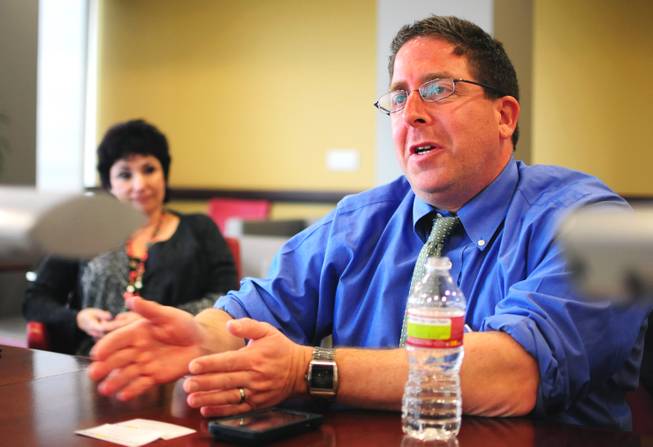
Frederick Hess, director of education policy studies at the American Enterprise Institute, talks about education reform efforts with the Las Vegas Sun editorial board on Thursday, Jan. 24, 2013. Public Education Foundation President Judi Steele looks on as Hess, also a consultant for Clark County Schools Superintendent Dwight Jones, speaks.
Monday, Jan. 28, 2013 | 2 a.m.
The Clark County School District is moving in the right direction but still has a lot of catching up to do.
That's according to Frederick Hess, an education scholar at the American Enterprise Institute, a conservative Washington, D.C., think tank, who spoke to the Las Vegas Sun editorial board last week.
Hess has been studying the district for the past year as a consultant for Clark County Schools Superintendent Dwight Jones. Hess, a former teacher turned education reformer and author, argued the district had made great strides in student achievement but could do more to become more cost-efficient.
"The School District is on the right track, but it started phenomenally behind," Hess said. "It hadn't done any of the rudimentary building blocks of the past decade, partly because the (population) growth was probably all-consuming."
Hess, who spoke at several events last week to promote his new book, "Cage-busting Leadership," referred to Jones as that kind of leader.
In a passage in the book – which aims to help district superintendents become bold "change-agents" – Hess relates an anecdote of Jones while he was the state education chief in Colorado, trying to change the system from within.
One of Jones' senior staff members would arrive to work late and leave early, Jones told Hess. So Jones put the employee on a schedule, requiring her to notify him before leaving the office every day. Soon enough, many people who didn't want to work as hard as Jones did left on their own, Hess said.
"To change the culture, I have to model what hard work looks like," Jones told Hess in the book. "Once I built the new system, the rest of the employees saw the accountability and culture had changed, and (the wrong people) left on their own."
A reform-oriented leader is crucial because changes in education policy are difficult to execute, Hess said. Too often, bold legislative actions in the statehouse aren't matched by bold reforms in the schoolhouse, he said.
"We've got leaders we've trained to be nervous rather than encouraged to solve problems," Hess said. "All of these policy reforms aren't going to pay off the way we hope unless we've got leaders who take advantage of them."
Hess pointed to a recent Florida law that imposed a new teacher evaluation system, which called for every educator to be assessed by student test scores and five classroom observations each year. The changes were put in place because 99 percent of teachers nationally were rated effective by their school district, and "nobody believes it's 99 percent," Hess said.
After the law took effect, about 98 percent of teachers in Florida were considered effective, Hess said.
"You can spend a lot of time, money and political capital on these policy fights, but if the leadership is importing old behaviors, nothing changes," Hess said. "District reform doesn't work in isolation."
Hess blamed a bureaucratic school culture that encourages the status quo in the classroom. Too many of the nation's school leaders have never had training or experience in how to run schools like an efficient and effective business, Hess said.
Hess, who taught at Rice University's business school, cited his own research, which looked at 200 syllabi from some of the nation's top leadership preparatory schools for educators. Of the 370 combined weeks devoted to personnel management, only two of those weeks dealt with removing low-performing principals and teachers.
"Responsible leadership according to the way we train (education) leaders is you're supposed to identify people who need help and help them. But there is never a time and place in which you should say, 'Fish or cut bait,'" Hess said. "I'm not saying you shouldn't try to improve all your people. But you could spend all your time on your worst 20 percent of your employees and never get a chance to build, encourage and reward your best. We've got a fundamental dysfunction in how we're training people."
Additionally, no one in education has been taught to look for waste, fraud and abuse, Hess said. Although Hess estimates wasteful spending may account for less than 1 percent of the Clark County School District's $2 billion budget, the district could do better to spend all of its money more wisely and efficiently.
The School District has made some strides in this endeavor, saving nearly $3 million in the past few months, Hess said.
For example, the district saved about $1.2 million by eliminating about half of its Spanish-language translators, many of whom had had been translating individual education plans for special-needs, non-English-speaking students and their families – which isn't required by local or federal laws.
"The idea that undocumented folks who are getting this 18-page document mailed to them are going to make any sense of it is unlikely and, more to the point, the district is backlogged and mailing these things out 12 months late," Hess said, explaining why the district eliminated about 20 of its 36 translators. "This is $1.2 million that could be spent to fund about 17 classroom positions that is instead getting wasted."
In addition to trimming the fat in school systems, Hess recommended that districts better maximize the instructional time they have. State legislators and education activists often have clamored for longer school days, but in reality, only about 65 percent of the current school day is really used on instruction, Hess said.
Hess pointed to a tip popularized by Doug Lemov, author of the educator book "Teach Like a Champion." Lemov found the average elementary school classroom passes 10 to 15 pieces of paper between students and teachers every day. When the time to pass the papers was calculated, Lemov discovered schools were losing nearly half an hour of instruction time every day.
Lemov advises teachers to take time at the start of the school year to have students practice passing papers faster, down from about three minutes per exercise to less than half a minute. It could be like a game for the children, Hess said.
"If you tally that up, it's a lot of time," Hess said. "If we could get (paper-passing) down to 25 seconds, we could add 63 hours to the school year. That's like the Legislature voting to add two extra weeks to the school year."
Schools also could be doing a better job of encouraging teachers to take fewer absences, Hess said. Nationally, the average teacher is absent from school eight days a year, costing districts sick-day pay and additional pay for substitute teachers.
Furthermore, students don't learn as much with a substitute teacher, Hess said.
"Sub day is basically a vacation day for everyone," he said. "That's eight days a year, two weeks of students' education we're paying for where nothing happens in the classroom."
The School District currently spends about $38 million a year on substitute teachers, Hess said. If the district could reward schools with high teacher attendance with money from substitute teacher savings, teachers would have an incentive not to take as much sick leave, schools could save million of dollars and students would learn more, Hess said.
"You're suddenly recapturing four days of instructional time, about 35 hours or about 2 percent of a student's instructional year, at zero cost," Hess said. "(But) no school system pays attention to this. It's just off the radar."
Such out-of-the-box thinking – which extends to technology in the classroom and paying teachers bonuses for taking on larger class sizes – must be championed by a group of "cage-busting" district leaders to truly change education in Nevada, Hess said.
Hess remained somewhat optimistic for the district's chances. There is enormous pushback to Jones' and State Superintendent Jim Guthrie's reform efforts, notably from the teachers union, Hess said.
"There are always people who feel frustrated (by these changes)," Hess said. "It's a bucking horse right now. They're not used to it. ... We're hearing the squealing when people are finally being held responsible, and they don't like it."
Furthermore, the bench for these education change-agents is "phenomenally thin," Hess said. Superintendents and state education leaders cannot change the school system alone, he added.
"Right now, there's not much in the way of a coalition to actually support these (changes)," Hess said. "There are a lot of people entirely soaked in a culture that doesn't equip them to do any of this."
That is why the Public Education Foundation has launched its leadership institute, which aims to connect adminstrators with national "thought-leaders" in business and education, such as representatives from the KIPP charter schools, Parent Revolution (parent trigger advocates) and the New Teacher Project, which brings top college graduates into the classroom.
The foundation, a private, nonprofit group that supports Clark County educators through programs such as the Teacher Exchange supply warehouse, has tapped Hess as senior fellow of the leadership academy. The initiative received $100,000 in state support and raised about $400,000 from the community.
The thinking is the district will begin to develop a cadre of top educational leaders who can effect change in Nevada's education system.
"If you do this over a period of five, six years in a state like Nevada, suddenly, you've got a cohort of alums – 100 to 200 people – who are connected and hopefully in a position of responsibility," Hess said.

Join the Discussion:
Check this out for a full explanation of our conversion to the LiveFyre commenting system and instructions on how to sign up for an account.
Full comments policy