J. Scott Applewhite / AP
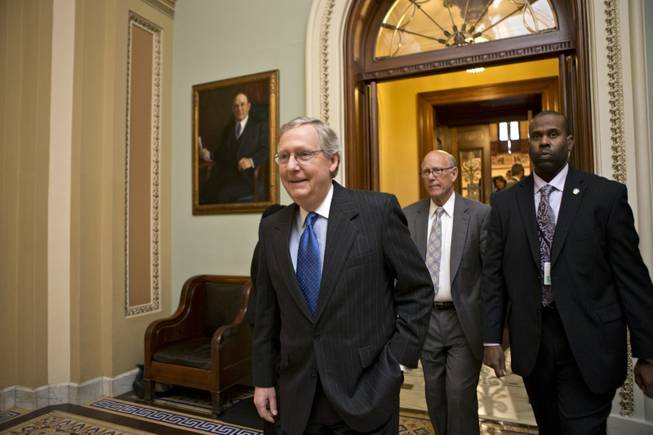
Senate Minority Leader Mitch McConnell, R-Ky., followed by Sen. Pat Roberts, R-Kan., second from right, leaves the Senate chamber to meet with fellow Republicans in a closed-door session as the “fiscal cliff” negotiations continue at the Capitol in Washington, Sunday, Dec. 30, 2012. Leaders in the Senate and the House are under pressure to find a legislative path to head off the automatic tax hikes and spending cuts set to take effect Jan. 1, 2013.
Tuesday, Jan. 1, 2013 | 2:45 a.m.

Related stories
- Why lawmakers’ failure to beat fiscal cliff deadline might benefit them
- White House, Senate Republicans reach ‘fiscal cliff’ deal
- Biden and Reid take good cop-bad cop approach to negotiating with Republicans
- Payroll tax hike to take $1,000 bite out of average worker’s annual pay
- Country to head over fiscal cliff as lawmakers continue negotiating
- More Sun political news
WASHINGTON — The confusing struggle to head off a national fiscal crisis has made one thing crystal clear: The era of the Big Deal is over.
Despite repeated, intense and personal efforts byPresident Barack Obama and House Speaker John Boehner as well as bipartisan coalitions, gangs of senators, supercommittees, special commissions and wonky outsiders, the grand bargain remains the elusive holy grail of fiscal policy and seems destined to stay that way for now.
“We don’t seem to be able to do grand bargains very well,” said Sen. Susan Collins, R-Maine, who has long been a force for compromise.
While some groups have produced the framework for smaller deals and even gained some bipartisan support — particularly the 2010 Simpson-Bowles plan that fell just short of a 14-vote threshold required to get before Congress — the alchemy of Obama and the current Republican-controlled House, not to mention the ideologically diverse Senate, appears hopelessly inhospitable to bring something huge to the finish line.
As Obama all but acknowledged Monday, big bipartisan legislative dreams seem all but certain to be miniaturized as incremental policy visions.
“My preference would have been to solve all these problems in the context of a larger agreement, a bigger deal, a grand bargain, whatever you want to call it,” he said. “Maybe we can do it in stages. We’re going to solve this problem instead in several steps.”
Republicans appear to agree.
“We’ll continue to work on smart ways to cut spending,” Sen. Mitch McConnell of Kentucky, the Republican leader, said on the Senate floor. “But let’s not let that stand in the way.”
The list of unrealized goals from Obama and Boehner’s last attempt at a grand bargain two weeks ago are breathtaking in their number, particularly when compared with the probable outcome of these final congressional negotiations. Ambitious plans to overhaul the individual tax code, tackle corporate rates, revamp the Medicare program and possibly consider changes in Social Security appear to have given way mainly to a tax increase for big earners.
Members in both the House and the Senate said perhaps that was OK.
“We can’t do the task all at once,” said Sen. John Hoeven, R-N.D. “I pushed for a big deal, but in this case, this time we can only get the tax piece done; so we need to move, we need to get it done.”
The downside of incrementalism is apparent every month in Washington, as a new battle emerges and legislative Band-Aids are affixed to fiscal gunshot wounds.
While Congress appeared Monday to be lurching to a deal to avoid significant tax increases for millions of Americans, the emerging patchwork tax deal would push over a series of fights into the next Congress, most of them very likely to be marked by the same 11th hour, rancorous dynamics that have been the signature of every other fiscal deal.
Most pressing, Congress will have to come together as early as next month to lift the debt ceiling, which Republicans are already hoping to leverage to eke more spending cuts from Democrats. A similar fight almost led to default in 2011, and damaged the nation’s credit rating.
In March, Congress will spar once again over a short-term spending agreement to keep the government open, the same sort that led to a near shutdown almost two years ago.
It appeared Monday that scheduled spending cuts to the Pentagon and other parts of government — the result of last year’s debt ceiling agreement — will be delayed for two months, yet another short-term kick of the can. Republicans and Democrats will most likely revisit the recurring question of revenues versus spending cuts when those two months are up.
Because the sharply divided 112th Congress and the White House have repeatedly eschewed large-scale deals in favor of quick fixes, myriad bills left undone will now be in the hands of the 113th Congress set to convene at noon Thursday.
The legislation includes a farm bill to replace the one that has expired, a lapse that may result in soaring milk prices; a transportation bill; a funding mechanism to supplement the waning gas tax reserves to meet the nation’s infrastructure needs; and even a measure, once completely uncontroversial, to prevent domestic violence.
Also left to the new year is a bill to help states hit by Hurricane Sandy; the Senate passed such a measure last week, but Republican House members, as has been the case with every disaster relief bill in this Congress, disagree with Democrats on its level of spending, and a final deal seems unlikely until the next Congress. The House was also set to vote on Tuesday on a measure to deal with dairy prices.
Doing business in pieces may end up a more productive formula — in the sense that walking 100 miles will still transport a person without an airplane or a bus — but many outside Congress do not think such halting forward motion should be confused with actual success.
“That’s the nature of the dysfunction,” said Julian Zelizer, a professor of history and public affairs at Princeton. “For the parties, it gives them temporary cover and to fight again on the issues in the next few months. The parties please their base, but the country does not get a solution.”
But that seems to be the nature of what constitutes progress in such a sharply divided political world.

Join the Discussion:
Check this out for a full explanation of our conversion to the LiveFyre commenting system and instructions on how to sign up for an account.
Full comments policy