Majestic Realty Co.
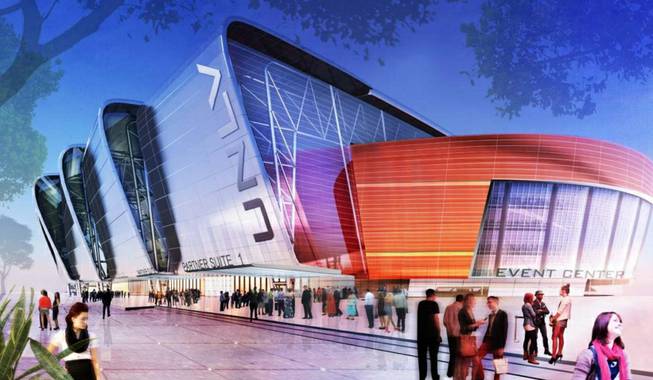
UNLV Now mega events center rendering.
Saturday, Feb. 16, 2013 | 2 a.m.
Sun coverage
The Federal Aviation Administration has raised concerns about the height of UNLV's proposed stadium.
Federal regulations require that developers looking to build a tall structure near an airport must first consult with the FAA. The agency analyzes blueprints and determines if the proposed building poses any hazards to air travel based on its height and proximity to the airport. The UNLV Now "mega-events center" would be less than two miles from McCarran International Airport.
The FAA doesn't have any authority over local planning and building permits, so these aeronautical studies are only a recommendation. However, Clark County requires FAA approval for all proposed buildings in the county’s jurisdiction, which includes UNLV’s Maryland Parkway campus.
Submitted plans for the UNLV Now call for a 205-feet-tall stadium.
In a letter to university officials, the FAA said the stadium was too tall, posing an "adverse physical or electromagnetic interference effect" on flights coming in and out of McCarran. The FAA argued the stadium as presented could affect departure and landing routes, block radar and interfere with communication signals between planes and the air-control tower.
The FAA requested that UNLV Now officials decide between two options:
• Revise the proposal for a stadium no taller than 106 feet. (UNLV’s Thomas & Mack Center was designed at a height of 104 feet.)
• Request another study for a stadium up to 168 feet, which is the FAA's "not-to-exceed height."
UNLV Now's project leader Don Snyder said the university was well aware of FAA's concerns but had submitted taller-than-expected plans to test the FAA's building parameters.
"That's a very normal part of a project like this," Snyder said. "We want maximum flexibility because we're in the preliminary design phase."
The actual plans for the UNLV stadium call for a turf-to-ceiling height of 195 feet, which is still beyond the FAA's maximum height limit.
However, UNLV and its developer partner, Majestic Realty, have always planned to sink the stadium about 30 feet into the ground to create a "bowl" effect, Snyder said. Such a stadium would fit within the FAA's parameters, he said.
"Just being close to the airport adds a few more hoops," Snyder said. "But I feel really confident we're on the right track."
This wouldn't be the first time the FAA had concerns about tall buildings in the Las Vegas Valley.
In 2007, developers behind the Crown Las Vegas resort concept had called for a 1,888-feet-tall observation tower on the southern end of the Strip, a few miles from McCarran. After the FAA study, developers scaled back its plans to a 1,064-feet tower. The $5 billion resort, which was scheduled to be completed in 2014, was scrapped in 2008.
In the mid-1990s, developers of the Stratosphere scaled back their tower proposal from 1,800 feet to its current 1,149-feet height. Developers also decided to build the observation tower within the boundaries of the city of Las Vegas instead of Clark County because Las Vegas has fewer regulations for FAA approval on buildings.
Similar concerns from the FAA during the early 2000s caused delays in building University of Phoenix Stadium, the Glendale, Ariz., complex that is home for the NFL’s Arizona Cardinals. In a more extreme case that happened a few years ago, the city of San Diego forced a developer to chop 20 feet off of a building that was built beyond FAA specifications.



The hight of a stadium is VERY important. Tall stadiums provide steep grandstands and offer all spectators proximity to the pitch. And 205 feet is not very tall, in fact, it is very reasonable. The first option with a heigth of 106 feet is simply not discussable it just means: "Don't built any stadium". However, if FAA tolarates 168 feet, the only option will be to dig to the ground! Place the the grass field 40 feet below the current ground level, this will also reduce the additional support, that the grandstands need by the surrounding construction. To be honest, UNLV must come up with a new complete new symmetrical redesign with lower building costs, regular video cube, and a retractable roof. The right design is the key to the success of this project.
This is simply not the right location for a stadium. Why is it necessary to build on the UNLV campus? Isn't the purpose of the university to provide education and not entertainment? If Las Vegas needs a football stadium, it should be funded privately and UNLV athletics can sign a lease to use it.
Please don't use my tax dollars to line some developer's pockets.
As a taxpayer I question the reasoning behind submitting a plan (which would obviously be rejected) to 'Test the FAA's parameters'.
What was their response when the FAA told them 'No'????
Something like, 'Just kidding'????
This makes little sense. It is well known that the FAA is fairly inflexible.
The whole project is starting to get messy. There are more questions than actual specifics on this.
If you read the statements provided by the university, you would see that the statium project is NOT funded by your tax dollars, it is a private venture that will bring additioanl income to the city in the form of new money from the individuals coming to town for the evnets. I will also bring a greater value and recongnition to your university which will enhance the value of the education your childeren get at UNLV. A better location, where? Maybe miles to the east of campus with no connection to the core of the city or campus - sorry already doing that and it does not work.
Reb420plus, from a Sun article dated yesterday:
'That Feb. 22 meeting -- now postponed indefinitely -- would have paved the way for a legislative debate this year on a special tax district to help finance the project.'
Perhaps I'm missing something, but that sounds suspiciously like 'Tax dollar funded'. I can understand some folks apprehension.
UNLV actually has relatively low tuition fees.
And yes this project is expensive, but this project will then bring even bigger money right back to Las Vegas for the next 30+ years, which strengthens our local economy and UNLV's profile.
It's not like paying for an $800M new car we don't need or an $800M vacation where you lose money and that's it. This stadium is an investment, an economic engine enabling Las Vegas to bring in significant money, host hundred of thousands of tourists, create jobs, enhance UNLV's academic and athletic image, etc.
Once the project is complete, the return on investment is what makes it worthwhile for everyone in Las Vegas. This project is very important not only right now, but for the long-term vitality of Southern Nevada.
@vegasbike (John Dough) As the project is almost entirely private, maybe John Duhh might be a better for name your post.
The special tax district is "the campus" area where the stadium would be located. To my knowledge that area does not generate tax revenue at this time. Nothing generated nothing lost - and a lot gained by the income generated by the people who come to Las Vegas to attend events, use the strip etc.
Las Vegas has always been a big thinking city so why not think big about UNLV?
My concern is this. As a Pilot Is the UNLV Campus or the projected Stadium currently in the approch path for MCarran? Reason being if thats the case then the Approch path will have to be displaced on account of aircraft are not to over fly Stadiums. And if it's displaced then who will that displacement impact as far as home owners and such?
@reb420,
The tax district would be not just the campus, but include properties beyond that. The team behind the bid have already have doubts that the revenue would be sufficient from the tax district so are already formulating widening the scope of the public purse.
Even outside this, say the revenues and costs estimates are wrong and a budget deficit $300m arises, who is on the hook for the deficit? I will guess the tax payers will subsidize that bail out.
Just Move it to the Corner of Maryland and Tropicana, where the miles of Crap Strip Centers could be bulldozed down in a day. If the current owners want far higher prices than what the property is worth - Increase Property Taxes Accordingly and keep moving up Maryland avenue raising Tax values as you go along. This will be the Revenue stream to help pay for the Stadium and purchase the required land without impacting the Airport.
Vegas needs to get behind this project. In addition to adding a projected $350M annually to the local economy, a new stadium will provide a world class arena that will attract better athletic recruits improving UNLV overall athletic success. Better teams equal higher enrollment and increased funding for colleges and programs that were gutted in the past 3 years. Lets take a page out of the books of University of Oregon, Oklahoma State or The U. Also, won't it be great to actually enjoy events like Rebel Football, Rugby Sevens, professional soccer in the city rather than drive 20 minutes to Henderson?
UNLV or not, the best place to build the stadium would have been Las Vegas Plaza, north of Fashion Mall and opposing the Wynn.
@Bob_Realist, I don't know of many Junior or Community college that are in the top 20 Percent of Business Colleges or have the best hospitality school in the country. Maybe one of the biggest problem with UNLV is that locals are quick to downplay the university's successes and replace them with thoughtless criticism and labels.