Justin M. Bowen
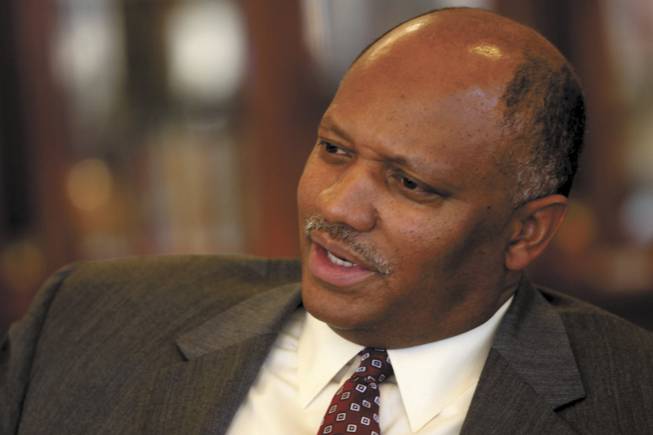
Dwight Jones, the Clark County School Superintendent, is photographed in his office Thursday, January 20, 2011.
Friday, Sept. 28, 2012 | 2 a.m.
The Clark County School District is moving in the right direction despite its mounting challenges, Superintendent Dwight Jones announced Thursday.
The second-year superintendent of the nation's fifth largest school district released his second white paper, which touted the accomplishments of the past year and foreshadowed his plans for the upcoming year.
Jones' phase II report — titled "A Look Ahead: Progress made and the next mile" — comes on the heels of a phase I report released last year that outlined new educational "reforms," such as reorganized school zones, a school ranking system and a different way to measure school improvement.
"Phase I was a giant step forward, (outlining) what we were going to do," Jones said during a School Board meeting. "Phase II really highlights how did we do … and what is ongoing that we’ll continue to focus on.”
In July 2011, the School District announced plans to reorganize its 357 schools into 13 "performance zones," grouping low-performing schools together into a "turnaround zone" and high-performing schools into a "autonomous zone." By doing so, the district better focused resources toward struggling schools and rewarded top schools with "empowerment" — meaning less oversight and more autonomy.
In August 2011, the School District unveiled the Nevada Growth Model of Achievement, which emphasizes student "growth" from year to year rather than just proficiency levels determined by standardized test scores. This growth model will eventually replace No Child Left Behind's stringent "adequate yearly progress" measure, which punished schools that made significant improvements, but failed to hit proficiency.
In February, the School District adopted a new school ranking system called the "school performance framework," which rated all schools on a one- to five-star scale. By identifying "pockets of success" in the large district, one- and two-star schools could learn from the top-performing, five-star schools.
These three major changes were executed this past year in an attempt to raise student achievement in one of worst-performing school districts in the nation. Expectations for students, teachers, schools and the district were to be raised — to ensure that all children were "ready by exit" to pursue post-secondary opportunities without remediation.
Some "reforms" were started, but are still in progress, Jones said.
These continuing changes include a new four-tiered teacher evaluation system, a "new schools division" to expand innovative school models and new ways to attract, retain and train better teachers.
The district is still working on expanding its technology offerings — such as iPads and online courses — and creating more public-private partnerships to study merit pay for teachers, create early-childhood programs and help launch the more rigorous Common Core State Standards curriculum.
The federal "turnaround" efforts at 11 of the lowest-performing schools in the district are also ongoing, Jones said. The first and second rounds of these "turnaround" schools have decreased their numbers of nonproficient students, Jones said.
Throughout these changes, Jones said he has learned several key tenets:
• The School District cannot excuse its demographics — high minority and high poverty students — for its lackluster performance. That's because similar major urban school districts such as Miami-Dade, Houston and Broward County all posted higher student achievement than Clark County.
• Academic success can be found within every school in the district, albeit in different amounts. Some top-performing schools thrive in high poverty areas as well — although a Sun analysis found these schools are in the minority.
Jones plans to take these reforms and lessons learned to guide the district toward his student achievement benchmarks, to be attained by June 2016. The district showed mixed progress toward reaching those goals, Jones said.
The district's preliminary high school graduation rate improved 6 percentage points to 65 percent. The district is well on its way toward boosting graduation rates to 75 percent within five years.
The rate of improvement for minority students grew modestly from the past year, especially among Native American and black students. That means the district is chipping away at the achievement gap between minority and white students.
However, there is still significant work to be done to achieve Jones' other five-year goals, including lowering college remediation rates, increasing Advanced Placement exam passing rates and college attendance rates, and increasing literacy and algebra proficiency rates.
That's why Jones said he will emphasize building on the reforms started last year, supporting teachers through more professional development and finding collaborative ways to foster innovations in education. The district will also focus its resources on programs that have the greatest "return on investment," Jones said.
"We will stay the course," Jones said. "I believe we’re on the right course.”
Sun reporter Brian Nordli contributed reporting to this story.



Imagine a doctor proudly telling you he removed 75% of your cancerous tumor or an employer bragging about paying you 75% of what you earned. Is that the America we live in now? If things don't work out, lower your aspirations. Lower your expectations and accept mediocrity.
Good grief, wizardofoz, that document is not 1000 pages...it's half that. Additionally, you still haven't read it. If you had, you would see that it is the framework for teacher education programs and how to teach English, math, critical thinking. Do us all a favor and actually read the damn thing and then get back to us on what part of it is so scary and wrong. Make up your own mind based on reading the actual document instead of parroting the crazy ideas of some dude with a blog and an agenda. Critical thinking skills, my friend. Use them.
Well, this will give something for all the administrators to do. Here's a thought: RIF half the administrators and retain only those assigned full-time to actual work.
All they have to do is break up the school districts. That's right, we need a Henderson School District, where all the smart kids live with involved parents in the highest rated schools. The Las Vegas district will have mostly white trash parents who are never home and could care less about their children's progress. North Las Vegas will have-Oh God-let's not even think about it. What a great city...
In the 1950's American corporations infamously used time and motion studies to install greater [purported] efficiency in manufacturing. The nature of the organization, however, remained the same. At the same time, W. Edward Deming took his ideas, which had been rejected by US companies, to Japan and helped teach and install those ideas in Japan. To our everlasting regret we know how that turned out for the US economy.
Dwight Jones is not the only educational "leader" following the same path of failure. So long as CCSD remains a bloated, top-down organization no substantive change will occur.
The Sun is to be commended for spending time and energy looking at our schools and it is to be damned for giving us a series of happy-face stories which do not delve into how and why the District functions as badly as it does.
Many correspondents to these stories comment on the negative aspects of CCEA, the teachers union. Why do workers form unions? Usually to counter the irrationality and cluelessness of administration and management. Fifty years ago the Education Associations weren't unions, they were voluntary organizations whose primary purpose was improvement of education and of members skills. Why did they evolve into a union?
Why do CCSD administrators have a union. I've been a union member [IAMAW, LPIW and AFT/NEA] for close to 50 years and only at Boeing were professional and technical employees unionized through the Engineers organization. Even then those folks were not really in supervisory or management position as are CCSD administrators.
Roslenda, with whom I do not often agree, makes a good suggestion. The only problem is that they are protected in their positions by a contract which is even more restrictive and protective than the teachers'. Jones is not at fault, he is surrounded by folks whose primary purpose is to protect their turf and their homies turf. Go back to my third paragraph; you don't know anything about CCSD administration because the Sun's focus has been on the perceived failings of teachers.
In a top-down, centralized organization who should be held accountable for poor outcomes....the people who plan, design, implement and manage or the people who merely carry out their instruction?
Hy Doogie
Hate to break this to you but there are a lot of "-Oh God-let's not even think about it" kids in Henderson as well. There are smart hard working kids and "White Trash" parents all over town including the great and wonderful (not even close) Henderson. The whole system
is broken, "even" in Henderson.
WizardofOz: I make no money in the education business. I'm self-employed in the medical field. Nice try at deflection, though. ;-)
Comment removed by moderator. Name Calling
Interesting that the article states that "The School District cannot excuse its demographics". The first year of this "growth model" should be used to deeply analyze data. Really identify groups of schools with very similar socioeconomic characteristics. Once you identify those, drill down and find what seems to be working inside of those categories. There are obviously going to be a lot of differences with individual students and their lives at home, but I'd have to imagine they can identify some patterns, and really see what works. Is it a parent outreach program? Is it specific types of teacher training? Is it more autonomy for the schools? More autonomy for the teachers?
They really need to answer some of these questions before they rush in to holding teachers accountable for the results, without knowing what they're analyzing. And I say that as a big proponent of performance based compensation. But it HAS to be done in a fair way, but it should also be done quickly (a year?). They need to work with the teachers to come up with something that's fair. I'm sure we've all had a job where we've had to deal with the negative effects of bad ideas coming from the executives, and I'm sure some of us have seen how different it is when you feel like you have a voice, contribute, and work together to come up with a solution. That should be one of Jones' goals for next year...really try to work together with the teachers to come up with a solution. Listen to their grievances. Of course they're angry to see an assistant making more money than they are. Or administrators with less experience making double what they make, working fewer hours. You need to right some of these wrongs in order to get everyone on board with your plans, even if they have a relatively small impact on the budget. That doesn't mean bending over backwards and accepting all of their demands, it means being reasonable and fair, communicating clearly, and LISTENING to their concerns.
We can NOT have an "us versus them" attitude if we want to make real progress. That goes for the school board, Jones, the administrators, and the teachers. I think that a large portion of the public is fed up with the bickering, especially on issues where the solution seems obvious (ridiculous pay for administrators compared to teachers, identifying and firing poor performing employees, etc.).
Sorry for the long post. I'm interested in hearing other ideas.
@bobthebuilder....they can also look forward to working for highly motivated folks who graduated from CCSD schools. I taught Automotive Technology and saw kids ranging from fast-track dropouts to brilliant engineering and robotics kids and everything in between. CCSD has some great teachers and bright kids, parents have to be involved, encourage and monitor. The benefit that your kids have in private schools is that those schools discriminate in favor of motivated kids and parents. There is no diversion of resources to special ed, to remedial education, to dropout prevention, to the vast mass walking through the door every day.
My kids are getting an excellent education in CCSD schools. Gee, I wonder if it could possibly be the fact that their parents value education and have instilled that in their kids? Hmmmm....
Pat Hayes' first post today is the best post I've ever seen concerning the CCSD.
The problems of the CCSD are the fault of the decision makers, not the people who are forced to implement those decisions.
Thanks, Pat.
Oh, geez, wizardofoz, something else that you haven't fully read.
@wizz....education, notwithstanding Federal involvement, is a function of the States and its constitutionality is therefore governed by State Constitutions and Statutes. Are you really an ignorant, scared little man behind a curtain?
@Shannon. Right again. I have already posted the rest of the quote last week to him.
@wizard of oz. As I have told you before, you might not want to use that case. As Paul Harvey used to say, "Now for the rest of the story."
Yes the court said that education is not a "fundamental right, but what you left out was the rest of the comments. To refresh your memory, here they are. "(b) The discrimination contained in the Texas statute cannot be considered rational unless it furthers some substantial goal of the State. Although undocumented resident aliens cannot be treated as a "suspect class," and although education is not a "fundamental right," so as to require the State to justify the statutory classification by showing that it serves a compelling governmental interest, nevertheless the Texas statute imposes a lifetime hardship on a discrete class of children not accountable for their disabling status. These children can neither affect their parents' conduct nor their own undocumented status. [457 U.S. 202, 203] The deprivation of public education is not like the deprivation of some other governmental benefit. Public education has a pivotal role in maintaining the fabric of our society and in sustaining our political and cultural heritage; the deprivation of education takes an inestimable toll on the social, economic, intellectual, and psychological well-being of the individual, and poses an obstacle to individual achievement. In determining the rationality of the Texas statute, its costs to the Nation and to the innocent children may properly be considered. Pp. 216-224."
So you may not want to use this cite to support your claim that education is not a fundamental right. This is the decision that says that public schools must educate every student who shows up at the door.
What the court said is that education is not a fundamental right in the Constitution, but the deprivation of an education causes irrepairable harm, not only to the child, but to society as well.
The CCSD website has two phone directories on line. One is a school directory and the other is a directory of the administrative offices in CCSD. I used both of those directories and the Transparent Nevada salary and benefit data for CCSD from 2011. This was the latest year that data was available. I feel that the salaries and benefits for 2012 would be at least equal to the 2011 figures, if not slightly higher. There may have also been some turn-over but the costs would be roughly the same.
I was unable to find salary and benefit data on Transparent Nevada for the all of the names listed for the Public Education Foundation and Development and Innovation. Some names listed did appear in Transparent Nevada for 2011. Those salaries and benefits totaled $876,457.11. I am not sure about the legality of a school district paying some employees of a 501(c) (3) non-for-profit Nevada corporation.
The first directory that I looked at was the administrative directory. The first thing that I did was to eliminate duplicate names that appeared in more than one listing in the directory. After I did that, I had a listing of approximately 2072 names. After I listed the salary and benefit information for each name from Transparent Nevada, the total was $170,736,957.79. That works out to an average salary and benefit in 2011 for each name of $82,203.64. For a teacher to earn that much in pay and benefits, the teacher would have to have a master's degree with 32 additional credits and be on step 10. For that teacher, the salary and benefits package would total $82,014. The current CCSD contract with CCEA has a salary schedule that has remained the same since the 2008-2009 school year. The salary schedule shows that a teacher with a bachelor's degree and maximum experience makes a total of $57,563 including salary and benefits. The same schedule shows a teacher with a master's degree and maximum experience earns a total of $71,919 with salary and benefits included. An examination of the administrative listing shows that 1603(77.18%) names make more than the teacher with the bachelor's degree. Of those names, 1229 (59.17%) make more than a teacher with a master's degree.
The second directory is the School Directory. This lists the principal, assistant principal, dean and office manager of every school in CCSD. The ESD schools and/or other alternative schools are listed in both directories, and have been included in the administrative directory totals. There are 217 elementary schools listed in the directory. There are 211 elementary school principals and 172 assistant principals. There are 216 office managers listed. Some people hold multiple positions or some positions are currently vacant. The 2011 salary and benefits information on Transparent Nevada shows a cost of $58,575,079.88. There are 59 middle schools listed with 58 principals, 70 assistant principals, 63 deans, and 58 office managers. The 2011 salary and benefits listed is $24,470,969.09. There are 47 high schools listed with 41 principals, 100 assistant principals, 68 deans, and 39 office managers. Transparent Nevada shows a salary and benefit cost of $27,527,996.39. The total 2011 salary and benefit cost is $110,574,045.36 for 310 principals, 342 assistant principals, 131 deans, and 313 office managers, or a total of 1096 names, or 2.88% of the approximately 38,000 employees of CCSD. This is approximately 6.5% of the 2012-2013 personnel budget. Again, the 2012 salaries and benefits will likely be the same if not higher.
Using the same comparisons to teachers with bachelor's degrees and master's degrees, there are 1022 (93.25%) people who make more than a teacher with a bachelor's degree and maximum experience. There are 816 (74.45%) people who make more than a teacher with a master's degree and maximum experience.
The number of assistant principals and deans for high schools is misleading. While the total number doesn't seem large when viewed against the total number of schools, the distribution is uneven. The number of assistant principals varies from 0 to 5. The number of deans again varies widely, ranging from 0 to 3. In some schools, the total number of assistant principals and deans is 6, while in other schools the total number is 2.
Combining both directories, the number of people totals 3168 or 8.33% of the approximately 38000 CCSD employees. After combining the 2011 salary and benefits costs for both lists, the total comes to $281,311,003.15 or approximately 16.55% of the 2012-2013 personnel budget. The cost for 8.33% of the personnel comes to 16.55% of the personnel costs. Totaling, the administrative personnel from the administrative directory and the principals, assistant principals, and deans from the school listing, you get a total of 1378 administrators. Using a total of 18000 teachers employed by CCSD, you get a teacher to administrator ratio of just over 13 teachers to 1 administrator
In the listing, I then looked at positions with titles such as Director, Coordinator, Facilitator, Academic or Program Manager, Principal, Assistant Principal, Dean, or Regional Trainer, as well as Superintendent, Deputy/Associate/Assistant Superintendent. There are 595 positions with those titles. That is approximately 28.7 % of the names on the list. That doesn't include positions listed as supervisors, mentors, or other non-academic positions. To put that number in perspective, if you add the number of elementary school assistant principals, the number of middle school administrators (principals, assistant principals, deans) and high school administrators (principals, assistant principals, and deans) the total is 572. The administrative phone directory shows 495 names with the titles Director, Coordinator, or Facilitator. That is 95 names more than the total number of middle school and high school administrators (principals, assistant principals, and deans). If you just look at the number of directors, coordinators, and academic managers, the total is 352. The total number of administrators (principals, assistant principals, and deans) in high schools is 209. To reach that total of 352, you would also need to include the assistant principals and deans in middle schools. If you included those numbers, the total would be 342, or slightly less than the number of directors, coordinators, and academic managers. The administrative listing makes up approximately 5.46% of the 38,000 CCSD employees.
If you look at the 2012-2013 school year budget, the personnel cost is approximately 1.7 Billion. The 2011 cost of the administrative directory was $170,736,957.79 or just over $10% of the budget for 2012-2013. Those salary and benefit costs are 2011 costs. The actual cost for 2012 will probably be the same if not higher.
"The School District plans to reorganize schools into performance zones, grouping low-performing schools into turnaround zones and high-performing schools into autonomous zones-- the district rewards top schools with "empowerment" -- meaning less oversight." That sounds like it was composed with the Dilbert Mission Statement Generator. lol The cutting and pasting in this blog of previously seen stuff reminds me of the NY Times piece of how internet data centers waste vast amounts of electricity storing a lot of useless data. But I do agree where Oz and some other posters here are going--the education business employs thousands of people whose primary mission is to protect their jobs, their benefits, and their pensions--from your first pre-school teacher to the collector who garnishes your social security checks for a defaulted student loan.
http://www.bioteams.com/2008/09/27/missi...
http://www.nytimes.com/2012/09/23/techno...
@manfromuncle1. Why are you so concerned about what happens in Nevada when you live in California? I repost some of my material because it applies to the topic.