Friday, Sept. 28, 2012 | 2 a.m.
Sun coverage
When the Legislature required the state’s power company to produce a certain percent of its electricity from renewable energy, a primary goal was to spur the “green energy” industry inside Nevada.
Building that industry, Republicans and Democrats have agreed, is integral to the future economic health of the state.
But NV Energy, the state’s largest electric utility, has used wind power from Wyoming, geothermal from Utah and hydropower from Idaho dams, some built more than 100 years ago, to help it meet the state’s requirement.
By one measure, NV Energy met a third of its renewable energy requirement in Southern Nevada through such short-term contracts in 2011, according to filings made by NV Energy and obtained by the Las Vegas Sun.
For comparison, solar from Nevada accounted for about 9 percent of the company’s renewable energy portfolio in Southern Nevada.
Environmentalists and renewable energy advocates say that NV Energy’s purchases, which are estimated to be as much as $100 million since 2009, have been excessive, creating a surplus of renewable credits that can be rolled over to future years.
That excess has, at least in part, dampened the renewable energy industry in Nevada and provides little real economic or environmental benefits to the state, environmental groups said.
“These out-of-state purchases are a waste of money as far as carrying out the intent of the statute,” James Philip Williamson, senior policy adviser of Western Resource Advocates, said in testimony before the Public Utilities Commission of Nevada this summer. “They do not reflect investment of a single dollar in Nevada. They have no long-term effect with respect to increasing Nevada’s use of renewable energy and decreasing our dependence on fossil-fueled resources.”
He called the purchases “cosmetic,” to make NV Energy appear to be meeting the renewable energy requirement.
The Public Utilities Commission of Nevada, which regulates NV Energy, has upheld the company’s short-term purchases, including one Wednesday with the company Pacificorp.
Except for 2009, NV Energy has met or exceeded the renewable portfolio standard set by the Legislature. The company said these short-term contracts with out-of-state energy providers are the cheapest way to meet its renewable obligation and helps it meet its obligations while Nevada projects are delayed.
Higher-cost projects would, inevitably, mean higher power bills for customers.
NV Energy officials also said the out-of-state purchases are only temporary to meet the state-mandated requirement.
“We don’t expect any out-of-state purchases after this year,” said Jennifer Schurict, spokeswoman for NV Energy.
In 1997, the Legislature first passed a “renewable portfolio standard,” which mandated that a share of the energy delivered to Nevadans come from renewable energy sources. In 2005, lawmakers ramped up the requirement — 15 percent of energy in 2011 was supposed to come from renewables, increasing to 25 percent in 2025.
The state’s renewable portfolio standard for its utilities is usually described as a requirement that a certain amount of energy comes from clean energy projects — solar, geothermal and wind. But the system is measured on credits, which the utility can earn directly through its own renewable generation, by purchasing power from in-state or out-of-state producers, or through energy-efficiency savings.
The company receives credits for each kilowatt hour of generation.
The company in 2009 fell slightly short of meeting the state’s goal for renewable energy.
In anticipation of the shortfall that year, NV Energy lobbied the Legislature to pass Assembly Bill 387, allowing it to purchase the out-of-state energy credits.
In 2011, NV Energy reported in securities and exchange filings that 19 percent of its power would come from renewables, well over the 15 percent requirement set by the Legislature. By 2015, it projects it will have 32 percent of its energy from renewables, well over the 20 percent requirement.
Environmentalists and energy advocates said that is a skewed picture of NV Energy’s compliance with the renewable energy mandate and that it could damage the potential for future clean-energy projects in Nevada.
The purchase of short-term credits “generates a cosmetic surplus” that “seriously distorts the true status of (renewable portfolio standard) compliance in future years,” Williamson testified. “This surplus has the potential to displace or defer development of new long-term renewable energy projects in Nevada.”
In other words, if the power company can meet its portfolio requirement through cheap renewable energy credits, there’s little market for Nevada-based renewable energy producers or incentive to build in-state projects.
Williamson, a former PUC auditor, was testifying on behalf of the Nevadans for Clean Affordable Reliable Energy, a coalition of environmental and industry groups.
Bobby Hollis, NV Energy’s executive for renewable energy, replied in rebuttal testimony that the company needed the short-term energy contracts to meet the renewable portfolio standard.
“Without those purchases, Nevada Power would not have met its obligations under the RPS,” he testified. “In fact, Nevada Power would have been deficient by over 25 percent in 2011 had the transactions not been entered.”
Kyle Davis, policy director for the Nevada Conservation League, said environmental groups would work to change the law during the 2013 legislative session.
“The goal of the renewable portfolio standard was to develop a robust renewable energy market in the state,” Davis said. “Using short-term energy contracts is subverting the legislative intent of the original policy.”
He added that the use of renewable energy credits “is not resulting in any pollution reduction whatsoever.”
Lydia Ball, executive director of the Clean Energy Project, which advocates for clean energy development, said the group is not opposed to some short-term credits being used by the company. But the scale, she said, is excessive.
NV Energy is buying renewable power from states without portfolio standards.
Senate Majority Leader Harry Reid has been critical of NV Energy recently, calling on it to shutter one of its older fossil-fuel plants and saying it should be more aggressive with renewable energy facilities.
His spokeswoman, Kristen Orthman, said part of his criticism is about these short-term credits.
Reid “believes that credits toward (renewable portfolio standard) compliance should come from solar, geothermal and wind energy generation projects in our state, not from old renewable generation projects that are out of state or other unrelated categories,” she said.
NV Energy warned that there could be legal problems with restricting power to in-state producers only. Schurict, the company spokeswoman, also said that with Nevada looking to be an exporter of energy to other states, like California, it would send a negative message if Nevada restricted its purchases.
Consumer advocates have also warned that the push for more renewable energy could result in higher power bills.
“This stuff is more costly than traditional energy,” said Dan Jacobsen, a manager with the Bureau of Consumer Protection. Particularly with the price of natural gas at record lows, traditional fossil fuel burning power plants are cheapest.
“People need to understand that any effort to expand renewables will create upward pressure on pricing, because renewables cost more,” he said.



This is a company that tells consumers to save energy, then lobbies for AND GETS a rate increase because profits have decreased due to lower consumption.
BULL...!!!!!!
REALLY?! Since when does New Mexico touch Nevada?! How did this graphic even get approved? _
With natural gas so cheap and plentiful why bother with low density sources like wind and solar. Unless we want to become more like Spain.
NV also got the legislature to allow a regressive solar energy rule for Nevada.
What this means is that if you put solar panels on your roof and generate more electricity than you use- NV ENERGY DOES NOT HAVE TO PAY YOU FOR YOUR EXCESS GENERATED POWER - THEY GET IT ALL FOR FREE!
That is why you don't see many solar homes in NV.
This is wrong and bad for Nevada and Nevada home owner.
Why did the legislature SELL OUT Nevadans to NV Energy?
NV Energy is doing what most of their customers expected them to do - subvert the intention of the policy in order to maintain significant profit margins while continuing to trash their neighbors, the sky and the health of our children.
Even as solar panels produce power at the same cost as coal (about $0.06/kwh) and our solar availability is tops on the planet, our energy pirates are holding us hostage while they ply the market for loose power from aging dams and spring breezes.
Their boom box plays the music of environmentalism just to prove what energy angels they are! Can you hear the sweet sounds above the blasting for coal, the crushing and delivery, the transmission losses, the sucking of water, the coughing of your neighbors??
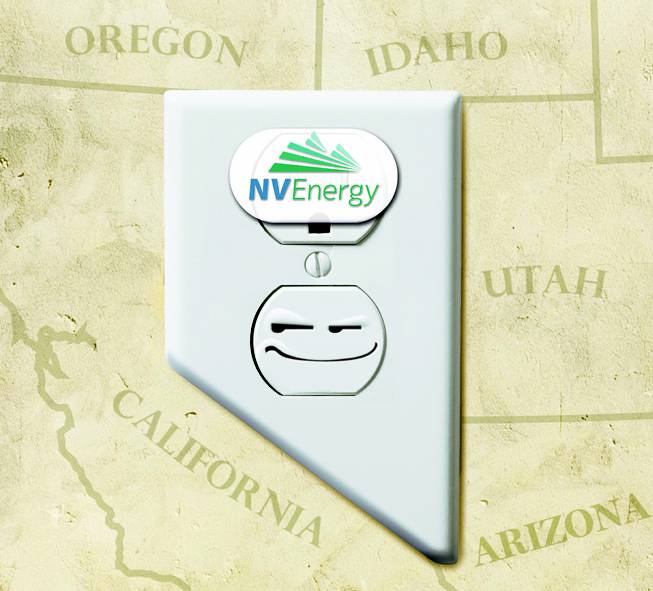
DMCVegas: the previously loaded map had an error in that I made. I'm the illustrator. We rushed to fix it as soon as it was spotted this morning. (I submitted the illustration late last night.)
Apologies for the mistake. Chris Morris
Do like California. The idiots there just signed contracts for the most expensive electricity for their grid with a long term buy of wind energy produced in MEXICO.... Talk about green jobs that can't be exported?????
http://www.utsandiego.com/news/2012/mar/...
"When the Legislature required the state's power company to produce a certain percent of its electricity from renewable energy, a primary goal was to spur the "green energy" industry inside Nevada."
Thats the entire problem in a nutshell. The government cannot "spur" an industry that is not economically viable, just because it so desires. Without government subsidies (our tax money) none of these industries would exist.
The day the market and private investors put their money into green energy products with absolutely no government subsidies, is the day green energy will be cost effective. I don't know if that day will ever come.
"NV ENERGY DOES NOT HAVE TO PAY YOU FOR YOUR EXCESS GENERATED POWER"
Maybe they don't need the power during the window of time your generating it. Why should they be forced to buy it???
Thomas-
How do you think coal fired power was kept so cheap for all of these years, pricing newer technologies out of the market for years? Subsidies, and LOTS of them. If you eliminate all subsidies for every form of electrical production, than distributive (or localized) renewable energy wins out because there are no fuel costs, no transportation costs, no resource extraction costs - all of which are currently subsidized. Natural gas is cheap right now, but that won't always be the case. Coal is as expensive as it ever was because it is a commodity that has become more expensive. Nuclear will never be price competitive.
As for environmental benefit, fossil fuel requires a tremendous amount of water to burn for electricity and we live in the most arid state in the country. In addition, our air quality would greatly improve if we stopped burning carbon to boil water.
The fact is that developing renewable energy in Nevada makes the most sense for Nevadans. NV Energy spends almost a billion dollars a year just purchasing fuel every year for their plants. That's ratepayer money going out of state to create jobs and fund education in other states-- how is that working for Nevada?
Finally, if you don't understand the fossil fuel folly in Nevada, then check out this example: http://lasvegascitylife.com/blog/town/co...
The Market is not always right! It frequently fails to prepare for the future needs by clinging to the outdated current methods. Then when the need arises, it is found wanting and unprepared.
Businesses focus is on short term profits not long term planning! Especially utilities need to be forced into long term planning so that there is no interruption in the supply. Imagine what our electricity situation would be if there was a problem with the train system so that delivering the coal was not possible.. or a failure in the natural gas delivery system..
We rely too much on out of state resources for our well being. We need to foster instate renewable projects for our own future well being. The cost will come down with expansion of the industry as the free market people like to always point out! Its odd that their free market ideals work for all products except when it comes to renewable energy? Very odd!
Why isn't the Tea Party against subsidies for the coal and oil companies? Coal and oil continue to receive subsidies in some form from the government, but the Tea Party rails against helping green energy companies.
Steve,
Thomas Delahunty will never properly answer your questions and cannot even explain the idea of externalities and why they make fossil fuels "...not economically viable...".
"Why isn't the Tea Party against subsidies for the coal and oil companies?"
What "subsidies" would those be?
Fossil fuels are used for two important reasons, they work and are economically viable.
Most conservatives are against subsidies for coal and oil companies. The main difference is these so called "subsidies" for coal and oil are mostly tax writeoffs (that all businesses use) for exploration that does not produce results. Thats far different from tax dollars actually used for green energy.
http://www.instituteforenergyresearch.or...
"The Market is not always right! It frequently fails to prepare for the future needs by clinging to the outdated current methods. Then when the need arises, it is found wanting and unprepared."
When the market is not right its not taxpayers that lose, its the investors. Big difference. And the market will correct itself.
The government has a horrible history of picking winners and should not be doing that. Most of these green subsidies are paybacks to political (both parties) fundraisers and bundlers anyway. Its crony capitalism at its worst. Thats why the Solyndra investors were paid back first. They were guaranteed their money before the taxpayers. If not, they would not have invested their own money. With the government guarantee, they had nothing to lose....only us taxpayers did.
Logical people will see through this reasoning. No developer is going to commit to building a solar plant unless they have a buyer for the power. Most of these deals to build in Boulder City for example were struck with Pacific Gas and Electric. NV Energy gets very little from these facilities because it's just not available for sale.
There is a push now by Harry Reid and the environazi groups to close Reid Gardner coal plant in Apex. The typical solar plant puts out 300 megawatts about half the time when the sun shines. Reid Gardner puts out 600 MW all the time. If you shut down Reid Gardner, and don't think they will stop there as there are two more coal plants in Nevada, the production has to come from somewhere else. We only get 10% of the power from the Hoover Dam. Most goes to CA and AZ.
So why this narrative? Simple, they want to have NV Energy outlay the cash to build renewable facilities themselves. People, listen up:
1. Capital expense construction can be directly passed onto the ratepayer.
2. The wholesale cost of a renewable KW/Hr is between 15-24 cents.
3. The utility has to put a mark up on this power.
4. If Reid Gardner is closed, Valmy is next and then the third in the middle of a gold mine.
5. The mission is to rid Nevada of coal period.
6. These environazi groups are never satisfied and will never compromise.
Thomas points to a think tank filled with low grade research and staffed by obvious political operatives:
http://www.instituteforenergyresearch.or...
Still waiting for the discussion of externalities.
In addition, When the "...market is not right..." as in the 2008 crash, caused by unregulated and illegal activity by Wall Street, did that just hurt the investors?
I won't argue with you Mark, we will never agree on most issues. If you want to spend your own money on green energy nobody is stopping you, just don't force the rest of us to through tax subsidies.
Well what happened at CSX recently was the following, All Ive heard from some policical groups is Drill, Drill, Drill, And that's just what happened. When you drill for oil you will always find Natural gas associated with it that gas is then put in the Natural gas Reserves and now with last years light winter those reserves are filled to the limit hence making natural gas cheaper than coal. So now the oil companies can't make money on the natural gas and they have stopped drilling for oil hench the higher price you are now paying at the pump. And we were hauling 21 trains a week 100 cars in length now we are down to 12 trains a week that means less jobs. Bottom line what is playing out now is exactly what happened in the Seventies. A oil surplus to the point the compines couldn't make money then they stopped producing which then caused a shortage of oil until the market could adjust.
We as consumers need to be able to change our energy use as quickly as the power producing plants as well or at least become less dependent.
I never could understand why most power generated at Hoover Dam goes to Ca. and Az. I thought that after the 50 years and the debt was paid back that Nevada would get the power.
Prime example of UNNEEDED REGULATIONS and requirements that drive up the cost of everything. Power companies will go to renewable energy sources when it is cost effective to do so. Increasing percentages of requirements is just adding to the incessant unfunded demands of politicians. What's in it for them? Are the politicians just trying to find more industries and more reasons for companies to lobby them?
And just today a story reported about another "green energy" loan from the government, this one for a mere $197,000,000.
http://www.foxnews.com/politics/2012/09/...
Thomas,
We have had PV on our roof since May of 2003. Go away.
casinokid: You are correct that more oil production leads to more nat gas production at least in the US. Except for the Bakken in ND where the nat gas infrastructure and the state regulations are not in place to capture the nat gas - so most of it is flared off on the spot. The data however does not show that we are producing less oil in the short run and therefore the conventional nat gas from these fields will continue to put pressure to lower the price of nat gas. This low nat gas price is killing the unconventional gas companies (Marcellus and Barnett Shale plays) and the free market is working not always nice,quick or easy. The industry is trying to export nat gas as LNG - but lots of $$$ and time needed. Foreign markets nat gas are 3 to 4 times the price of ours. I hope you all are enjoying Peak Oil so far! Its only the beginning, more of the same to follow!
NVEnergy cannot be trusted they have beent he scum of the industry since the change from Nevada Power. Yakira and his lot all belong in prison.
Mark, as a taxpayer theres no doubt I helped pay for it. I'm sure there were tax subsidies for the contractor, NV Energy and yourself.
P.S. I'm not going away. I thought liberals were the tolerant ones who supported free speech.
I thought the rate hike in May was a result of NV Energy efforts in making Nevada energy efficient, I did not realize it was to make purchases of energy from other states. Nevada should be the leading state when it comes to energy production and our energy rate should be lower than other states in the nation. We should be selling states energy, we have unlimited sun light, hydro, wind and geo sources but we are the buying. Its time to rid the board of directors at NV Energy and get people who will make the state a leader in energy production.
clean energy credits, carbon credits, who is responsible for all this? Maybe time time get back to basics, real investment based on real returns, no monkey goverment credit accounting.. Tax deductions and credits are available on capital expense, maybe that limit or time frames needs to be raised for the big projects to go ahead.
All this fracking has the US exporting LNG to Asia primarily Japan since the tsunami and meltdowns at 3 Fukushima reactor cores.
LNG has buoyed the profits for the gas industry and offers significant competition down the road (for US!)as we frack up our farms and fields to sell the gas overseas as a clean energy source. Smart, aren't we ??
The tax credit is good through 2016. If. The solar market cannot become self sustainable by then, then this push for solar will fail. Prices have dropped over 60% over the last five years. The solar industry is on pace to be a viable industry by 2016. There are places in the U.S. where it is already cheaper to install solar then use conventional power sources (I.e. Hawaii). There is nothing sustainable about the current way we are using our resources. The U.S. has 5% of the worlds population, but we use 25% of the resources annually. At what point will we learn that we cannot stay on this path.
"The U.S. has 5% of the worlds population, but we use 25% of the resources annually."
Because we are more productive than the rest of the world.
"clean energy credits, carbon credits, who is responsible for all this?"
The politicians who have decided that they can pick winners and losers with taxpayer dollars. Makking electricity prices "necessarily skyrocket" is their conclusion. What a joke.
Thomas, Try reading this and understand why you and Peter are completely wrong about renewable energy:
http://thinkprogress.org/climate/2012/09...
We attempt to work with NV Energy on this issue. They claim out of state purchases are cheaper, but they intentionally corrupt the process of in-state resources so they actually don't know what is more expensive. We are concerned their goal may be to do everything to prevent renewable energy from gaining a solid foothold in Nevada, preventing jobs from being created and an industry that is thriving in other places. They have all the power (pun intended).
This is no surprise, in fact its an old trick. Its like the water utility, scaring everyone into the belief that we are running out of water, and getting everyone on board to conserve. Of course we all do a great job conserving and then the utility complains that they are losing revenue, so they raise the rates.
Every other private company has cut back in many ways. Why not the utility?
On topic: NV Energy is functioning like a corporation, going for profit, and the PUCN seems to be in bed with them as well. The function of NV Energy is to provide power at a fair rate and the function of the PUCN is keep NV Energy in-line.
That said NV Energy is not called as a monopoly, but in fact they are, and they have powerful 'friends' at the state level. The whole idea of NV Energy controlling the amount of wattage being released for energy rebates is a nighmare and poorly managed at best.
The state needs to take control of the rebate programs and NV Energy should be managed by the legislature. The PUCN needs to protect the public. NV Energy will not stop asking for rate hikes. Again, our reward for conserving energy.
NV Energy does not serve the public as evidenced by this article.
Come on PUCN, do your job and get your priorities straight. The tax payers pay you to do your jobs, not NV Energy.