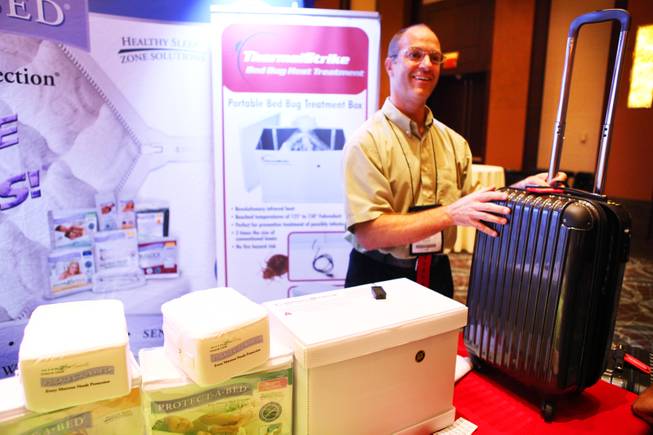
Mike Lindsey of Thermal Strike explains his heated luggage system used to kill bedbugs at the BedBug University North American Summit at Red Rock Resort in Las Vegas on Thursday, September 6, 2012.
Friday, Sept. 7, 2012 | 2 a.m.
View more of the Sun's opinion section

J. Patrick Coolican
Sun coverage
My bedbug obsession began about a decade ago, when I read a story in The New York Times that I was certain was an April Fool’s joke.
I knew bedbugs from a bedtime rhyme of my youth — good night, sleep tight, don’t let the bedbugs bite — but the article said that after near eradication following World War II, bedbugs, or Cimex lectularius, had returned with a vengeance.
It was no joke.
Bedbugs are tiny, nocturnal, bloodsucking insects that travel and can live for months without food, or, in the horrible parlance of the trade, “feeding.” They bury themselves in the cracks of beds and furniture and walls and luggage and are nearly impossible to exterminate without a persistent professional who is an expert in the use of focused heat and insecticides.
Ever since then, I watched with fascination as bedbugs became the scourge of New York City, inviting a classic, straight-faced New York magazine article that described how even rich families on the Upper East Side of Manhattan had been hit (“Bedbugs in the duvet”).
(To be clear, bedbugs do not discriminate among rich and poor — though the rich have the resources to fight the long war required to defeat them.)
Although never afflicted myself, I’ve been known to hold forth on the evils of bedbugs among increasingly weirded-out friends, even though, in my own defense, the problem is spreading like, well, bedbugs.
A few years ago — OK, no point hiding it, I know the exact day — I had a close call in a dumpy motel in Carson City. I upgraded, only to watch my colleague, who’d once been afflicted, scour the room and teach me how to look for them. Ever since, I never travel without doing a thorough check.
So, it goes without saying, I eagerly attended the Bedbug University North American Summit at Red Rock Resort on Thursday.
It did not disappoint.
I met Phil Cooper, CEO of Bedbug Central, the key Web portal and organizer of the summit. His brother, Richard Cooper, is an entomologist who specializes in bedbugs.
I half-jokingly asked Phil Cooper about checking his hotel room for bedbugs.
His response was at once awful and insightful. He’s so careful he says he automatically assumes infestation and travels with specially outfitted equipment so he won’t bring home uninvited guests.
His clothes go into dissolvable laundry bags and he uses a portable device that transforms his suitcase into a heating chamber of bedbug death.
I think he saw my eyes darting around, as I silently estimated the cost of new luggage and specialty gear for myself, because he assured me that many of the items could be viewed on the display floor. He said the industry is catching up and finally fighting back with some effectiveness.
I entered Bedbugs 101, taught by Allie Taisey, a Bedbug Central entomologist who also works for a Cornell University program for eradicating pests in public housing.
Taisey summed up the past decade: Bedbugs 10, humans 0.
Some basic facts: They are nocturnal; they don’t eat a “blood meal” every day, and when not feeding, they spend their time holed up in their hiding places, which can be as small as a crevice as thin as a credit card; the females can lay one to five eggs per day, which will hatch in seven to 10 days; they can hop from one apartment unit to another but also use clothes and luggage to move from one building to another.
The only good news: Their bites are painless, and they do not transmit disease. There’s no West Nile Virus to worry about.
Taisey used phrases such as “veil of darkness,” “cryptic and secretive,” and “Bedbugs can be literally anywhere and everywhere.” I started to feel like Robert Downey Jr. in “Scanner Darkly,” bedbugs crawling all over me.
The solutions part of the presentation wasn’t entirely comforting. “There’s no silver bullet,” she said.
The first problem is detecting them. They use special dogs as well as sophisticated detectors. Taisey recommends both. As for eradication, there’s heat, vacuuming, steaming, freezing, encasing your mattress and the old standby: chemicals.
Her depressing closing: “Any tool, you have to figure out how it works but also how it can fail.”
Phil Cooper took the stage to announce the summit’s big events, including the parties. He promised that at the beer tasting, “You can do some great imbibing while learning all about bedbugs.” He and his brother invented a drink called the “Coopertini.” I decided I like this rugged camaraderie — like members of an Army unit who have a special bond in their fight against the bedbug insurgencies.
A University of Sheffield speaker bounded to the stage to thumping party music before delving into some detailed bedbug biology, including this assessment of the brutal world of bedbug sexuality: “Fully fed females are easier targets because they can’t fight off the males.”
Later, I would hear one of the more menacing sentences ever uttered at a convention: “Blood is the most nutritious food imaginable.”
I dashed off to the display floor, which, for me, was like a drug addict walking through a DEA lab.
Mike Lindsey was an engineer who had his own bedbug experience — he brought them home from a vacation to Mexico in 2008. He was getting his MBA at Colorado State and telling anyone who would listen that bedbugs “are going to be big.” (Been there, Mike.) He invented luggage — just a half-pound heavier than standard luggage — that you plug in to heat the contents to the bedbug kill temperature. (Be sure to remove your cosmetics.) It’ll be available in November from ThermalStrike. God bless American innovators like Mike Lindsey.
The chemical company BASF asks, “Do you have what it takes to outsmart a bedbug?”
Allied Services in Chicago trains dogs in bedbug hunting. The dog, named Allied, is an adorable half Labrador, half beagle and quite effective in the demonstration in exchange for treats.
Across the way at Thermal Remediation Technology, Greg Grabow, who said he’s a veteran of Desert Storm, treats his job like a military mission: “Get ’em in their strongholds! Did we get bin Laden with an airstrike? No! It was boots on the ground!”
And then, “You’ve got to get in and get the air and the heat in the crevices and the soft materials. You’ve got to devastate a population!” Yes!
I caught up with Taisey and asked her about a Harper’s essay I’d read years ago called “Planet of Weeds.” It discusses the devastating depletion of the Earth’s species and posits that soon the only species that could survive would be “weedy” species. These would be particularly adaptive, mobile, aggressive and prolific. Think of white-tailed deer, cockroaches and, of course, homo sapiens.
Do bedbugs apply?
“Absolutely,” she said. “And remember, they’re associated with humans, who are very good at dominating their environment.”
Except when it comes to bedbugs, which, despite our best efforts — using our shoe to beat them black and blue, as the bedtime rhyme implores — remain in the nightmare crevices, awaiting the next feed.

Join the Discussion:
Check this out for a full explanation of our conversion to the LiveFyre commenting system and instructions on how to sign up for an account.
Full comments policy