ASSOCIATED PRESS
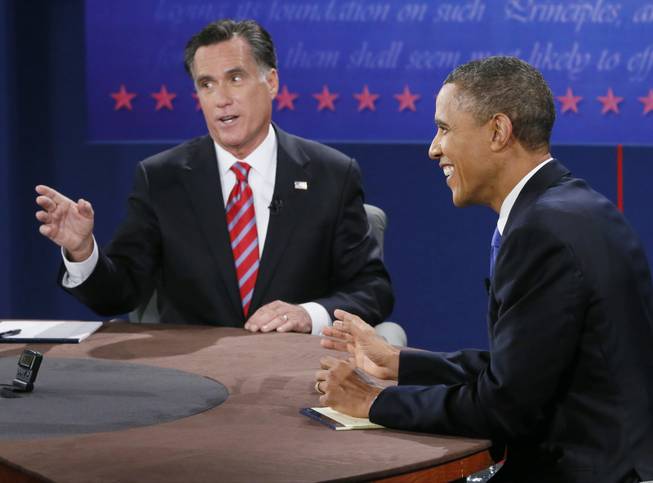
Republican presidential nominee Mitt Romney and President Barack Obama answer a question during the third presidential debate at Lynn University, Monday, Oct. 22, 2012, in Boca Raton, Fla.
Friday, Oct. 26, 2012 | 12:51 a.m.
The outcome of the hard-fought but still deadlocked presidential race between President Barack Obama and Republican challenger Mitt Romney will be decided Nov. 6 by a small percentage of voters in just nine states. That's because presidents are elected not by popular vote, but by the Electoral College.
The system was born from an 18th century political compromise. States are allocated a fixed number of electoral votes based on population. In almost all cases, whoever wins a state wins all of its electoral votes. And the candidate who captures a majority of the 538 electors becomes president.
Most states are reliably Democratic or Republican, but neither Obama nor Romney has a lock on enough states to win a majority of electors. That means the real battle is for the nine "swing states" _ those where the outcome is uncertain. Whoever can carry enough of those states to bring his overall electoral vote total to at least 270 will win.
Nationwide polls, which show the race a virtual tie, do not necessarily predict the outcome. A candidate can win the most votes nationally and still lose by failing to accumulate a majority of electors. What's important is what happens in the swing states. And, for the moment, Obama appears to have an edge.
___
The Electoral College:
Each state is granted one presidential elector for every member of Congress: one for each member of the House of Representatives, where seats are allocated according to population, and two more because each state has two senators. That guarantees that each state will have at least three electoral votes. The District of Columbia gets three electors even though it doesn't have full congressional representation.
In most states, the popular vote winner captures all of that state's electors. The only exceptions are Nebraska and Maine, which award electors proportionally.
The system was written into the U.S. Constitution to overcome concerns by small states that they would be left voiceless among their larger-population brethren. The solution was a middle ground between those who wanted the president to be chosen by Congress and others who pushed for a nationwide popular vote.
In what is largely a formality long after the winner has been determined, each state's electors will meet on Dec. 17 in their home states and cast their votes for president and vice president. Congress will meet on Jan. 6 to conduct an official tally.
The Electoral College system can produce two anomalies. As happened to then-Vice President Al Gore, who lost to George W. Bush in 2000, a candidate can win the most popular votes but lose the presidency. Or candidates can be tied for electoral votes, 269 each, which throws the tie-breaking decision into the House of Representatives. The choice of vice president falls to the Senate. With the House expected to remain in Republican hands, a tie would mean a Romney presidency. Democrats are likely to retain control of the Senate, meaning Vice President Joe Biden would have a second term.
___
The state of the race:
In 41 states plus the District of Columbia, the results are fairly predictable. States like Texas and Alabama are almost certain to support Romney; California and New York are among those favoring Obama.
An Associated Press tally shows Obama ahead in states with 237 electoral votes; Romney leads in states with 191. If that holds, Obama must win in enough swing states to accumulate 33 more electoral votes. Romney needs 79 more.
The two biggest swing-state prizes are Ohio, with 18 electoral votes, and Florida, with 29. Polls show the candidates running even in Florida, but Obama has a slight lead in Ohio.
Both states are crucial for Romney. If Obama wins in Florida, Romney would need to sweep all the other swing states, including Ohio. If Romney wins in Florida, but loses Ohio, Obama would still be just 15 electoral votes shy of victory. That would leave him with several paths to victory. For example, he could win by taking Nevada (6 electors) and Wisconsin (10), two states where polls show him leading.
Because of those stakes, many analysts see Ohio as the pivotal state on election night. No Republican presidential candidate has ever won the White House without also carrying the Midwestern state.
The other five swing states are North Carolina (15), Virginia (13), Iowa (6), Colorado (9), and New Hampshire (4).
___
The issues:
The economy is by far the biggest issue in the race. The United States has struggled to return to full strength after the late 2008 financial meltdown and the Great Recession, which began during Bush's presidency. Obama takes credit for preventing deeper problems and says that the economy, while not ideal, is on the road to recovery and that Romney would reinstate the policies that led to the collapse. Romney says the continued economic weakness demonstrates the failure of Obama's policies and, noting his own record as a successful businessman, says he knows how to stimulate the private sector and create jobs.
Polls show that nationwide, Romney holds a slight lead as the candidate best qualified to handle the economy. Nevertheless, Obama maintains his edge in Ohio, where his decision to lend federal money to the failing auto industry saved thousands of jobs.
Other major issues include the huge federal deficit, health care and immigration. Those may be especially important in Florida. The state has a large Hispanic population, and Obama is far more popular with that voting bloc generally _ not counting the traditionally Republican-leaning Cuban immigrant community. Romney's tough stance on illegal immigrants could hurt him with Hispanics.
Florida is also a haven for retired Americans who rely heavily on Social Security, the federal government pension system and Medicare, the government-run health system for people 65 and over. Some older voters might fear that the deficit-cutting proposals of Romney and his vice presidential running mate, Rep. Paul Ryan, could lead to reduced benefits.
Florida was ravaged by the recession, with high unemployment and a collapse of the real estate market. That economic suffering would seem to argue in Romney's favor.
International issues are unlikely to sway many voters. Obama has pointed to his efforts against terrorism, including authorizing the military operation in Pakistan that killed terrorist leader Osama bin Laden, and the administration's withdrawal of U.S. forces from Iraq. Romney says Obama has been weak with U.S. adversaries like Iran and unsupportive of allies like Israel. Romney has also promised to crack down on what he sees as unfair trade practices by China.
Obama is America's first black president and Romney would be its first Mormon president, but neither race nor religion has been widely discussed in the campaign.
___
Spending:
Money spent on the 2012 presidential campaign has passed the $2 billion mark.
A big reason for the increase this year was the 2010 Supreme Court ruling in the Citizens United case that allowed corporations and unions to spend unlimited amounts in political campaigns. The ruling reversed a century of U.S. precedent that limited financial involvement by those organizations.
Figures compiled so far show Obama had easily outraised Romney personally, but the president was being vastly outspent by outside sources backing the Republican challenger.
___
Congress:
While attention has focused on the White House race, control of Congress is also at stake. Republicans are expected to retain their House majority. Democrats had been considered in danger of losing their Senate majority, but analysts now predict they will hold it by the narrowest of margins.
A third of the 100-seat Senate will be at stake. To win a majority, Republicans need a net pickup of four seats if Obama is re-elected, or three if Romney prevails (the vice president casts a tie-breaking vote). The retirement of some Democratic senators in conservative-leaning states seemed to open the door for Republican gains. But in several states, Republicans who emerged from the nominating primaries were candidates who, while appealing to the party base, are seen as potentially too conservative or otherwise undesirable for mainstream voters.
Republicans, for example, were counting on wins in Missouri and Indiana. But they ended up all but abandoning their Missouri candidate, Todd Akin, after he remarked in August that women's bodies have ways of avoiding pregnancy in cases of what he called "legitimate rape." In Indiana, Richard Mourdock defeated the more moderate veteran senator Dick Lugar, who would have likely cruised to re-election. Mourdock has come under criticism after saying in a debate that when pregnancy results from rape, it is "something God intended."
Other closely watched races are in Massachusetts, Connecticut, Virginia, Wisconsin, North Dakota, Montana, Nevada and Arizona.
All 435 seats in the House are at stake, but incumbents tend to get re-elected. Democrats seem unlikely to pick up the 25 seats they need to gain control.
___
Election Day:
The presidential race is so close that calling a winner could be much delayed. Polls are not closed in all 50 states until voting ends in Alaska at 1 a.m. EDT. But in the three states likely to be most pivotal, all votes will have been cast by 8 p.m. EDT. Virginia polls close at 7 p.m. EDT; Ohio at 7:30 p.m. EDT and Florida at 8 p.m. EDT.
Exit polls will show trends soon after polls close, but barring unexpectedly strong showings by one candidate, the vote counts in swing states could take hours _ or longer. The 2000 election wasn't decided for weeks because of a dispute over the vote count in Florida. Bush's victory was ultimately determined by a Supreme Court ruling.
___
Associated Press writer Ron DePasquale contributed to this report.

Join the Discussion:
Check this out for a full explanation of our conversion to the LiveFyre commenting system and instructions on how to sign up for an account.
Full comments policy