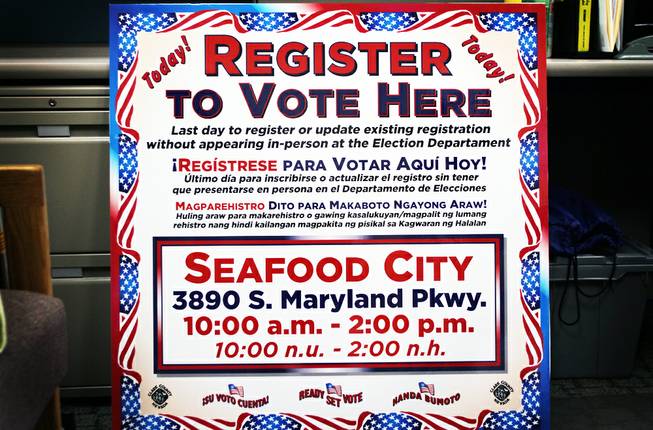
A sign displaying voter registration information in English, Spanish and Filipino. For the first time ever Clark County must translate all election materials into Filipino, the national language of the Philippines, which combines the indigenous language of Tagalog with Spanish and English influences. In 2002, Clark County elections were conducted in Spanish for the first time.
Thursday, July 26, 2012 | 2 a.m.
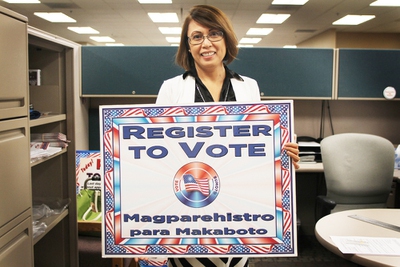
May Manahan, elections operations specialist for Clark County, holds a sign that reads "register to vote" in English and Filipino. In October the federal government informed the county that, based on demographic data, elections materials must be translated into Filipino.
Review leads to change of 'review'
After the primary elections in June, the Clark County registrar of voters received some complaints that the translation of ballots into Tagalog was too formal and difficult to understand for some people who are more used to conversational Tagalog.
May Manahan, who was hired in January by the county to perform the translations, has been going over all of the materials to adjust the translations ahead of the November general election.
One example from the primary was the translation for the word “review.” Manahan said she originally used the word “suriin,” which she called a “real Tagalog” word.
However, after a committee of Southern Nevada Filipino-Americans met earlier in the year to determine which of the dozens of languages spoke in the Philippines to use, they settled on Filipino.
Filipino was named the national language of the archipelago in 1987 and is considered to be a combination of Tagalog, the most prominent indigenous language, and English and Spanish words that have seeped into the language over centuries.
It was decided that “tingnan muli” was a more modern and colloquial phrase to use for “review.”
Now, Manahan has to analyze similar details on a variety of election materials, from ballots to voter guides and polling station signs.
Sun coverage
The first time Clark County Registrar of Voters Larry Lomax was confronted with publishing election materials and ballots in another language, he was prepared for it.
It was after the 2000 census, and the Spanish-speaking population in Southern Nevada had been booming for years. Anticipating that the new census data would trigger federal benchmarks regarding voting materials and the use of languages other than English, Lomax started organizing early and purchased new, bilingual voting machines.
Lomax was caught off guard, however, when, in October 2011, his office was notified that elections materials must now accommodate the growing Filipino population in Clark County.
From the start, the process raised questions. Approximately 100 languages are spoken on the archipelago, and there are four languages with at least 7 million speakers and 13 with at least 1 million speakers. Lomax had no one from the Philippines on his staff and did not know where to start.
“They just tell you that you have to accommodate this certain population, and it’s up to us to determine the most appropriate language,” Lomax said.
First, Lomax reached out to Filipino-American organizations in Southern Nevada to help him tackle the question of which specific language to use.
“There are many language used in the Philippines,” said Amie Belmonte, president of the Filipino-American Political Organization with Equal Representation and who was on the committee of about 15 people assisting Lomax. “We chose Filipino, which is also known here as Tagalog, because that is the national language and the one that you can expect the most people to know.”
The Philippines’ 1987 constitution made English and Filipino official languages. Filipino is considered to be a combination of one of the predominant indigenous languages, Tagalog, mixed with Spanish and English words that have infiltrated the language through centuries of colonization.
Under the federal Voting Rights Act, an elections department must add a language when 5 percent of the voting-age minority population is not proficient in English, or when 10,000 people from the voting-age minority population are not English-language proficient.
Clark County was one of several southwestern, urban areas that added a new Asian language to its ballots this election season. San Diego County, which already offered Spanish, Vietnamese and Tagalog, added Chinese. Los Angeles County conducts elections in eight languages, including two new languages added this year: Cambodian and Hindi.
In January, Lomax had to convince the county to lift a hiring freeze so he could bring in a translator, May Manahan, to get the translation work done. The county has also hired bilingual workers to man polling stations and is still looking for others fluent in Tagalog.
Manahan has spent the past few months translating everything from polling station banners and signs to sample ballots and voter guides. She also must record the audio version of the ballots for the vision impaired.
“I have done a lot of outreach with Filipino-American groups to let them know we are doing this,” Manahan said. “I think even when people may even understand the English, having ballots and materials translated into their language encourages participation. Some people are intimidated by the process, especially the elderly. This way they have a better understanding of everything in front of them.”
In June, Lomax and his team rolled out the Filipino ballots and election materials for the primary election. There were some complaints about the word choice being too formal on the Tagalog translations, and some phrasing is being adjusted ahead of the general election.
“We are making adjustments with some of the terminology based on feedback we got after the primary that some of the language had been too academic and should be simplified,” Manahan said.
From 2000 to 2010, Nevada’s Filipino population soared 142 percent. There are 98,000 Filipinos in Nevada, making up 3.6 percent of the population. The next largest Asian immigrant population in Nevada is Chinese, with just under 29,000 in the state. In Clark County, the 86,000 Filipinos comprise 4.4 percent of the population. When it comes to elections, those may seem like insignificant figures, but in 2004, George W. Bush won Nevada by a mere 2.6 percentage points.
Since 2002, all election materials have been printed in Spanish and English and voters have received bilingual sample ballots and voters guides. Now, postcards are being mailed to voters to determine their language preference. So far, 180 people have asked for materials in Tagalog.
“My observation is that there isn’t a huge demand for this,” Lomax said.
Jim Tucker, a Las Vegas attorney and voting-rights expert, said it was not uncommon for demand to lag early on in the process as word is slow to get out that the service is available. He offered the example of King County, Wash. (which includes Seattle), where Chinese was added to ballots in 2002.
“They got a smattering of requests for translated ballots,” Tucker said. “What they found was that most of the Chinese-speaking population didn’t know that assistance was available. By 2006, the number of requests for Chinese ballots had spiked by more than 5,000 percent.”
Tucker added that even though data indicated just over 10,000 of Southern Nevada’s Filipinos were eligible to vote and not proficient in English, translated ballots have a tendency to increase participation among all members of the immigrant group as some simply feel more comfortable operating in their native language.
Those in the Filipino community in Southern Nevada who aim to increase civic participation, like Belmonte, hope to use the change as a catalyst for mobilization.
“I think doing this really makes the Filipino community more involved and more included in the electoral process,” Belmonte said. “In the Philippines, the election process is corrupt and people feel like their voice doesn’t even matter. Through this translation, where ballots are in the Filipino language in a foreign country, they feel like, ‘Wow, our voice really matters.’”
For an immigrant to vote, they first must become a naturalized citizen, and Filipinos in Nevada are completing the process at a relatively high rate.
While there are more than double the number of people living in Nevada that were born in Mexico than in the Philippines, in 2011 there were 1,668 naturalizations in Nevada of Filipinos and 2,035 naturalizations of Mexicans in the state, according to the Department of Homeland Security.

Join the Discussion:
Check this out for a full explanation of our conversion to the LiveFyre commenting system and instructions on how to sign up for an account.
Full comments policy