Las Vegas Sun

February 23, 2012

Currently: 60° | Complete forecast | Log in

nevada budget:

State treasurer: Fannie and Freddie need to ‘show me the money’

Image

AP Photo/Cathleen Allison

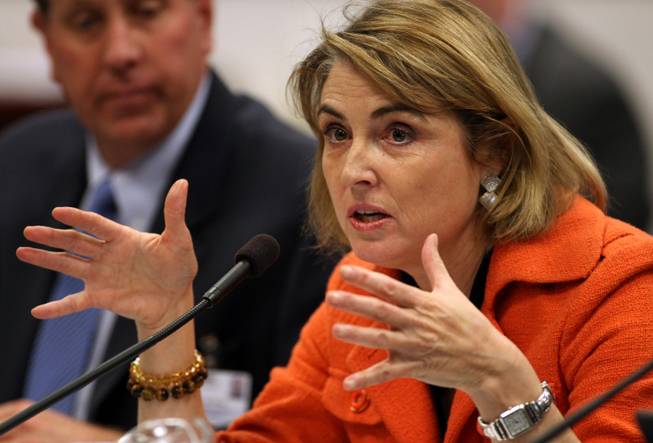
Nevada Treasurer Kate Marshall testifies at the Legislature in Carson City on March 2, 2011. Marshall says Fannie Mae and Freddie Mac shouldn’t be exempt from paying a real property transfer tax on homes in Nevada.

Wednesday, Jan. 25, 2012 | 2 a.m.

When a home is sold, buyers and sellers in Nevada — from big banks to investors to first-time homebuyers — have to pay a real property transfer tax.

Except for Fannie Mae and Freddie Mac.

The state’s treasurer wants Nevada to yank a little-noticed exemption for the federal mortgage giants. It would raise an estimated $5 million a year in taxes, according to the state’s tax department.

Officials said the real property transfer tax yields about $500 for the state, county, and Clark County school districts on the sale of a $200,000 house. Treasurer Kate Marshall argued in a letter to the state Department of Taxation that the publicly traded companies — favorite targets of conservatives as symbols of failed federal policies — should not be exempt from the tax.

Fannie and Freddie, as they are commonly known, “are private actors engaged in private activity,” Marshall, a Democrat, said in an interview. “Therefore, show me the money.”

A Fannie Mae spokesman said the company would not comment on Marshall’s letter. The Freddie Mac press office did not respond to a request for comment.

It’s hard to know how much money the exemption might have cost the state during the boom in Las Vegas, or since, as foreclosed properties have been sold.

It’s estimated that Fannie Mae and Freddie Mac have a piece in 50 to 70 percent of all Nevada mortgages, said Dr. Nasser Daneshvary, director of UNLV’s Lied Institute for Real Estate Studies.

Daneshvary said it was news to him that Fannie and Freddie don’t pay the tax.

Bill Uffelman, president of the Nevada Bankers Association, also said he was unaware that Fannie and Freddie were not paying the tax.

The state has not collected money from the companies’ sales and purchases for “as long as anyone can remember” at the Department of Taxation, said Director Bill Chisel.

But the state’s position was confirmed in memo issued by the Tax Department in 2008, after an inquiry from the Lyon County recorder’s office.

Fannie Mae and Freddie Mac were created by Congress in 1938 and 1970 to back residential mortgages. Traditionally, the sister companies bought low-risk mortgages that lenders (banks) make to homeowners. Both companies’ charters say the corporations will be exempt from state, county and other local taxes.

But Marshall argues that the real property transfer tax is an indirect tax, like a sales tax.

Additionally, Marshall in her letter argues that the companies are not “instruments” of the federal government, which would make them exempt.

“Fannie and Freddie are exercising a contract right as private actors in (the) real estate foreclosure market,” Marshall wrote. The fact that Congress in 2008 put them under a federal conservatorship does not change their status.

A county in Michigan has filed a lawsuit seeking back taxes and Ohio’s tax department has issued a memo stating Fannie and Freddie should pay the tax.

Nevada’s Department of Taxation will issue a new direction to county recorders, who collect the tax, Chisel said.

His office and its attorneys were still deliberating on whether to change the state’s policy.

Discussion: 3 comments so far…

Comments are moderated by Las Vegas Sun editors. Our goal is not to limit the discussion, but rather to elevate it. Comments should be relevant and contain no abusive language. Comments that are off-topic, vulgar, profane or include personal attacks will be removed. Full comments policy. Additionally, we now display comments from trusted commenters by default. Those wishing to become a trusted commenter need to verify their identity or sign in with Facebook Connect to tie their Facebook account to their Las Vegas Sun account. For more on this change, read our story about how it works and why we did it.

Only trusted comments are displayed on this page. Untrusted comments have expired from this story.

  1. "Except for Fannie Mae and Freddie Mac."

    Few realize these two mortgage giants were bailed-out with their tax dollars. Now they're behind the foreclosers who gobbled up many if not most Nevada homes.

    Behind all this looms a much bigger issue -- if Nevada does collect those transfer taxes, is it prepared to refund them when those foreclosures are declared void? Check out the Discussion @ http://www.lasvegassun.com/news/2012/jan...

    "The regulators got bailed out, the middle class lose their jobs and their houses. All this desire to trust in the government to make sure that big corporations won't hurt them actually is a backfire on them." -- Rep. Ron Paul to Jon Stewart 9/26/11, citing the example of the real estate crash as example of government regulation gone bad

  2. Killer is right. There is a bigger issue looming behind every real property transfer in Nevada of property that has been through a foreclosure, a short sale, and possibly a deed-in-lieu-of foreclosure. Title. The slicing and dicing that took place in the securitizations of interests in real property, combined with robosignings and failure of banks, servicers, and trustees/agents of the securitized pools to keep accurate records means that beneficial ownership has become disconnected from the title recording system and has made inspection of the title records unreliable. In short we've allowed most of the land titles in this State to become uninsurable and marketable only at a discount which reflects that unreliability.

    This could probably be fixed by legislation which carefully worked around the constitutional prohibitions against impairment of contracts and taking of property without due process of law.

    But we have another big statewide problem: Nevada has not been collecting the taxes due it. And, again, no one knows why or even when it started. We've seen this with the mining tax (where the companies own accounting statements show a far greater profit from their Nevada operations than they report to Nevada) and we've seen it with the failure to tax comped meals, and we see it again here, where Nevada has never collected the taxes due from Fannie and Freddy on sales of their owned properties in Nevada. It is one thing to be "business-friendly" but something else again not to collect the money justly due the state. We really need to get to the bottom of these derelictions of duty so that they do not continue.

  3. This is a problem with many states, typically at the courthouse steps where the foreclosure auction takes place the lender will waive the mortgage note and bidders will succumb, leaving the winning bid to the lender for a minimal amount, that is what the tax is based on that winning bid. From this article it appears that even these winning bids from the lenders are not being taxed on the transfers. Easy fix, no paper work issued until the fee is paid. I mean, it is that simple! Most communities gripe about the "sales" price at auction paid by the lender, the tax on it which is ultra low if nobody bids for it.

Post a comment

Commenting requires registration.

Comments are moderated by Las Vegas Sun editors. Our goal is not to limit the discussion, but rather to elevate it. Comments should be relevant and contain no abusive language. Comments that are off-topic, vulgar, profane or include personal attacks will be removed. Full comments policy.

If you would like to submit your comment as a letter to the editor, you may submit it here.

Most Popular

  • Viewed
  • Discussed
  • E-mailed
  • Facebook

The Sun

Locally owned and independent for more than 50 years.