Friday, Jan. 20, 2012 | 4:53 p.m.
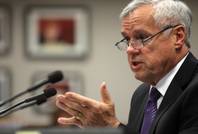
Dan Klaich, chancellor of the Nevada System of Higher Education, testifies Monday, June 6, 2011, at the Legislature in Carson City as lawmakers wrap up their 120-day Legislative session.
Related stories
A framework for a new formula to fund Nevada’s colleges was met with optimism by the state Board of Regents on Friday.
The current formula, which funds the seven public universities and colleges in Nevada, has long been broken, said Dan Klaich, chancellor of the Nevada System of Higher Education.
“There is a pervasive perception in some parts of the state that think the formula is skewed to benefit some institutions over others,” he said. “The perception is widespread, deeply held and impossible to shake.”
Currently, student tuition and fees are collected from each institution and pooled into the state’s general fund, a practice that is frowned upon by critics who believe student money should stay on campus. The Legislature uses a complex budget formula — factoring in enrollment figures, course offerings, whether the college is urban or rural, and maintenance of buildings — to appropriate funds for each institution.
Legislators, university faculty and students have long criticized the formula for favoring smaller institutions by appropriating a larger percentage of the state budget to them. UNLV and the College of Southern Nevada — the two largest state institutions of higher education, located in Southern Nevada — receive the least money from the state in relation to how much tuition they bring in.
The proposed new model for funding public state universities and colleges hopes to create a more equitable way to allocate education funds by shifting the focus from enrollment figures to performance — how many students each institution graduates.
In-state tuition and fees would still be pooled at the state level, but each institution would hold on to all of the student registration fees and nonresident tuition it receives.
State funds would be divvied up according to the level of education and the amount of resources it would take to produce a particular degree. Doctoral-degree programs would be funded more than undergraduate degrees. Resource-intensive degrees in science, engineering and medical fields would be funded more than liberal arts programs.
“We’re not breaking a lot of new ground here,” Klaich said, explaining that Nevada is adopting elements used in other states’ higher education funding formulas.
The new funding model is still in its blueprint phase, but Klaich is hopeful it would be implemented in time for the 2013 legislative session. If adopted, the new formula would create incentives for universities and colleges to innovate and deliver more degrees in high-knowledge fields necessary for the jobs of the 21st century, Klaich said. It would also acknowledge the diversity of Nevada’s universities and colleges, from community colleges to research institutions to rural colleges, he said.
While there were some minor concerns raised about the proposed new formula — such as the quality of degrees produced and the logistics of implementation — student leaders and regents praised the initial efforts to reform the funding formula after unanimously accepting Klaich’s presentation and report.
“We are on the right track,” Regent Andrea Anderson said. “This is the right mindset.”

Join the Discussion:
Check this out for a full explanation of our conversion to the LiveFyre commenting system and instructions on how to sign up for an account.
Full comments policy