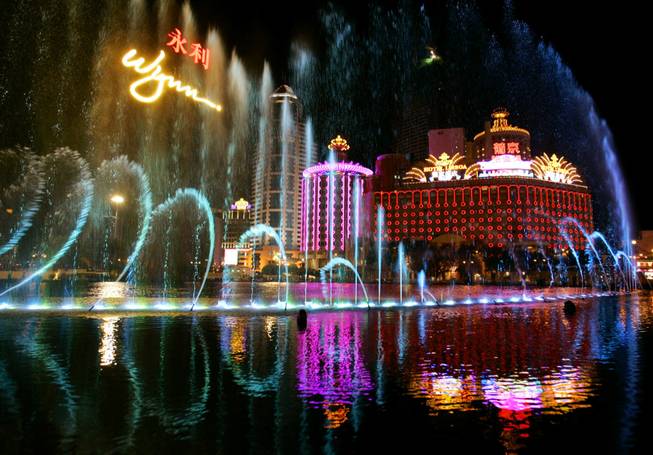
Kin Cheung / AP
The fountain of the Wynn Macau casino performs celebrating its opening with the backgroung of the Lisboa Casino in Macau, Tuesday, Sept. 5, 2006. American gaming mogul Stephen Wynn was ready to throw open the doors of his new US$1.2 billion casino to gamblers Wednesday in Macau _ the Chinese territory that’s rivaling the Las Vegas Strip as the world’s epicenter for gambling.
Thursday, Dec. 27, 2012 | 2 a.m.
Sun coverage
- More Sun gaming news
- Macau: Good and bad for Las Vegas (9-26-2011)
- Relationship between Las Vegas, China runs deep (9-19-2011)
IN MACAU, GAMING IS KING
Macau has proved an Asian sensation, but don’t expect Vegas lovers to switch up their vacation plans.
“We are one-stop shopping with entertainment, food and beverage, convention tourism and gaming all under one roof,” said Bo Bernhard, executive director of the UNLV International Gaming Institute. “That is what’s enjoyable to the Las Vegas tourist, whereas Macau is heavily gaming-centric.”
As we savor our Cirque du Soleil shows and five-star meals, it’s OK to root for Macau gamblers to hit the tables hard.
“More than 90 percent of Macau’s gaming technology revenue is traceable to a company with headquarters in Las Vegas, and 42 percent of its gaming revenue,” Bernhard said.
With the way the Chinese are gambling, that’s a lot of money coming home.
MACAU — We blazed over the causeway in the thick, constant evening fog until suddenly I was surrounded by more light than I could digest. It was disorienting and anxiety-inducing, an over-stimulating visual feast that jammed the circuitry in my head and accelerated my respiration.
For the first time I understood what it must be like to witness the fabulous Las Vegas Boulevard for the first time. No, I wasn’t on that Strip: I was cruising its steroidal kid brother, a place of shocking change that takes place so quickly it makes even pre-recession Las Vegas seem stagnant. This is the street from whence profits come so fast and furiously that they prevented the bankruptcy of at least two of Nevada’s biggest corporations during the depths of its economic meltdown.
I was on the Cotai Strip in Macau. And if I had long since lost my ability to be bowled over by Las Vegas, that first — and second and third — breathless ride along a perfect, massively wide fresh ribbon of asphalt in this most unlikely place made the enormity of a development like MGM Resorts International’s CityCenter feel as if it were a very fancy doll house.
This is not a travel essay, and here’s why: Nobody expects you to ever go to Macau. There’s no marketing machine trying to excite you about the idea of flying more than 12 hours from the West Coast of the U.S. to lounge by the (polluted) South China Sea. Also, they don’t need you. I was told by a bellboy that when he sees Caucasian guests, he assumes they must be evaluators from the Forbes or Michelin travel guides.
And yet, if you care at all about modern Las Vegas, you have to understand — if not care about — what has happened in just the past eight years or so in this previously disregarded and anonymous part of China. It is, simply put, the first wholesale export of what we know to be Vegas, right down to Las Vegas Sands Chairman and CEO Sheldon Adelson actually filing a request to trademark the term “Asia’s Las Vegas.”
You’ve probably heard the numbers about Macau, but they bear repeating. Its casinos field more than $33.5 billion a year, five times more than Las Vegas. These gambling dens are vast plains of baccarat tables and salons; Venetian Macao Resort Hotel — a supersize replica of the Las Vegas original with three canals rather than just one — has the largest casino floor in the world at 550,000 square feet. That’s more than double that of Las Vegas’ MGM Grand. There are 800 table games there, a good number of which are baccarat; MGM Grand has about 140, including its poker tables.
Macau is the only place in China that allows legal betting, and that’s because gambling has flourished there since the 1800s, under colonial overlord Portugal. It became such a key piece of the economy there that Beijing couldn’t pull the plug when it regained control in the late 1990s. Instead, the central government decided to try to disinfect the corrupt and violent destination of oppressive, crammed and unsafe casinos that had reigned since the 1960s — think Las Vegas during the mob era, minus the glamour. The handful that existed, led by a few gambling giants such as Casino Lisboa, were owned by Hong Kong billionaire Stanley Ho, a monopolist who also held a stranglehold over the privatized ferry system, one of the few means of getting to the Macanese peninsula. (There is now a land-based border crossing that is a manic scene of mainland Chinese people queuing up to cross over for gambling outings, but prior to the Chinese repossession of Macau, citizens rarely were permitted to go.)
The government opened up Macau to bids from non-Chinese companies for casino concessions, or licenses. Among those that won them were Las Vegas Sands and Wynn Resorts; MGM Resorts International, then named MGM Mirage, was forced to enter into a partnership with Ho’s daughter Pansy to get a piece of the action. Each concessionaire spent billions on resort construction on land the government could seize at any time, and they’d each pay a 35 percent tax rate on gambling profits. Still, Adelson, Steve Wynn and others decided it was worth it because of one simple fact: While Las Vegas is within a five-hour flight to 300 million people, Macau is within a five-hour flight to nearly 3 billion people. That’s almost half the world’s population, at least 1.3 billion of whom have been starved for centuries of the ability to gamble legally despite a strong cultural inclination to play games of chance.
“There is no gambling addiction in China,” Adelson once told me. “It’s just part of their culture.”
The first time I visited Macau was in 2001. My lasting recollection was meandering into Casino Lisboa, Ho’s flagship, and leaving horrified. Men crowded 10 deep around every table, every one of them smoking and barking angry bets; I still have no idea how anyone kept track. In 2004, Adelson opened his casino-only Sands Macao — opting for the alternate spelling to seem authentic — and the Wynn tower opened with 600 rooms in 2006.
That year, Macau surpassed Las Vegas as the world’s top gaming destination. And that was before Cotai.
The original Macau was a peninsula now best likened to Las Vegas’ historic downtown. After the introduction of Sands, and then the 600-room MGM Macau in 2007, millions of new gamblers quickly became accustomed to a more civilized gaming atmosphere. Ho built Grand Lisboa Macau to compete.
Meanwhile, Cotai was on the horizon. Wynn and Adelson were at the height of their legendary rivalry, as Adelson became the first of the two to commit to building there. Although Cotai is isolated, Adelson plowed ahead and opened the Venetian in 2007, effectively blasting the roof off profit records for casinos. Five years later, Cotai boasts five upscale casino-resort and resort-hotel complexes with more than 10,000 rooms and suites. After witnessing Adelson’s success, Wynn Resorts (which had added an adjacent Encore tower in 2010) landed its license to build on Cotai, what Wynn is promising will be his crowning achievement and “the most innovative, beautiful resort the world has ever seen.” It is expected to open in 2015.
Across new Macau, but especially on Cotai, the imprimatur of Las Vegas is simply everywhere. It’s not just the enormity of each structure, with their porte cocheres and contemporary casino décor, replica marquees and same-name restaurants. There’s even some Vegas cheese — in the form of all-you-can-eat buffets, gargantuan aquariums filled with rare fish, and free indoor hourly laser and mechanical-statue shows. Even slot machines, an afterthought in the pre-Sands version of Macau, get sizable real estate with a variety of games as well as tournaments, although some slots feature the number eight instead of seven in tribute to the Chinese belief in its lucky-number prowess. And just like in Las Vegas, other superstitions are catered to: Oftentimes, there’s no fourth floor because the Chinese character for four sounds similar to the character for “death” in a different tone.
Also mind-boggling: The shopping is such madness that the Louis Vuitton and Prada shops at Wynn Macau have waiting lines, lest the stores reach their capacities.
But not everything has proven transferable: When Wynn Macau opened, for instance, it had a Tryst nightclub, but it failed to draw a crowd (except perhaps the wrong one), so the space is now a restaurant. Precious few big-name chefs have made the pilgrimage to Macau aside from Joël Robuchon. Entertainment, too, has been a real puzzle. One-off concerts by Lady Gaga or Cantopop stars do gangbusters, but the Venetian Macao shuttered its Cirque du Soleil production, “Zaia,” this year. Nearby, however, Franco Dragone’s House of Dancing Water — at $250 million, it’s said to be the most expensive live production ever staged indoors — is killing it.
In Macau, gambling is really the thing — and it’s a theater all its own. The casino floor can be an exciting, noisy place, but the high-roller action takes place in the countless VIP salons on every floor throughout these skyscrapers. What’s more, most of those patrons are brought into Macau not by the properties themselves but by what are known as “junket operators,” private services that market to mainland Chinese people and potential players across Southeast Asia. This is, by far, the most controversial and baffling element of the Macau boom. Gambling debt is not legally enforceable anywhere in China, so the casinos don’t provide lines of credit. Instead, it is outsourced to the junket operators, who essentially lease portions of the casinos and provide capital to players. How that debt is collected, given that there’s no force of law, is an ongoing mystery; it is assumed strong-arm, Mafia-style tactics come into play.
Yet, that is the state of play over there, and the American corporations see such arrangements as the price of doing business. They eagerly forge ahead, mesmerized by the idea that Macau hasn’t even reached its potential. Their excitement is understandable; MGM Resorts International and Las Vegas Sands both teetered on the brink of bankruptcy in 2009, held up only by the torrent of cash flowing in from across the Pacific.
“There is so much demand, I could build 10 Las Vegases over there,” Adelson once boasted to me.
And he might just do that.
This story was first published in VEGAS magazine, a sister publication of the Sun.

Join the Discussion:
Check this out for a full explanation of our conversion to the LiveFyre commenting system and instructions on how to sign up for an account.
Full comments policy