Tuesday, Aug. 28, 2012 | 2 a.m.
In the ongoing debate over whether universities and colleges in Southern Nevada are getting short shrift at budget time comes this question: Who can be trusted to come up with a fair and equitable funding formula, a consultant hired by the chancellor or one retained by the Legislature?
There is, after all, tension between the two. The Nevada System of Higher Education and its elected regents run the state’s public colleges and universities, but they’re funded mostly through the Legislature.
At stake is the slicing and dicing of $350 million in operating funds for the Nevada System of Higher Education.
This can be the basis for high drama in the state capital — especially given the competition for money between UNR and UNLV — and it’s playing out this week. On Wednesday, a legislative committee is scheduled to get recommendations from its consultant for a new funding formula that is supposed to make budget decisions more fair.
The state has traditionally divided money based generally on enrollment, without specifically using the money as a tool to promote technology growth in specific regions.
There’s a general expectation that a new funding equation will end up delivering more money to UNLV and the College of Southern Nevada, which will not only benefit those students and faculty but ultimately strengthen commerce and industry in Southern Nevada.
But there will be two formulas in play.
On his own, working outside the process outlined by the Legislature, Chancellor Dan Klaich hired a consultant to study the formula. Klaich has presented those findings to the legislative committee that’s waiting for its own consultant to weigh in.
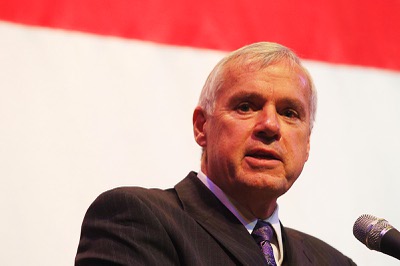
Chancellor Dan Klaich speaks during a town hall style meeting about education Tuesday, Nov. 29, 2011 on the CSN Cheyenne campus.
Klaich then presented a tentative higher education budget to the state Board of Regents on Friday, based on the funding conclusions reached by his consultant. The rush? A tentative budget is supposed to reach the governor’s desk by this Friday.
It shifted some money to the south but maintained protections for the north.
Senate Majority Leader Steven Horsford, D-North Las Vegas, who heads the Committee to Study the Funding of Higher Education, grumbled about the formula proposed by Klaich’s consultant.
He complained that the company didn’t justify how it arrived at it.
“We have not been able to back up those conclusions,” he said. “We know they’re based on something. We just can’t validate what they’re based on. It’s troublesome to me as an elected official.”
Horsford further complained that Klaich had proposed a budget filled with numbers before he had a chance to understand the rationale for the formula behind it.
“We’re trying to come up with an equitable, fair methodology based on sound policy,” Horsford said. “Once you make those decisions, then you can allocate dollars.”
Among other criticisms of the Klaich consultant’s formula is that it doesn’t give enough money for masters and doctoral classes. And there were complaints that it wants to set aside $5 million a year, for the first two years, to offset cuts at rural campuses. This money is derisively referred to among UNLV professors as “affirmative action for cowboys.”
Klaich was unapologetic about bringing his own consultant into the mix.
“We wanted to be part of framing the discussion,” he said. “I think that makes a lot of sense. We wanted to put a model in front of (the legislative) committee consistent with trends in higher ed financing and best practices. We took initiative that put the model on the table.”
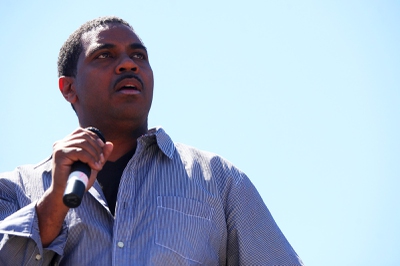
State Sen. Steven Horsford, D-North Las Vegas, addresses hundreds gathered Saturday, April 30, 2011, at Cashman Field to protest proposed cuts to education.
Meanwhile, Horsford’s committee will find out Wednesday what SRI International, its consultant, proposes as a funding formula. It began its work in February, after being hired by a split vote of Horsford’s committee. It is getting paid with a $150,000 grant from the Bill and Melinda Gates Foundation.
The consultant hired by Klaich in December 2011 to work on the formula is the National Center for Higher Education Management Systems, which the legislative committee had rejected in favor of SRI. Klaich said the company he hired will cost less than $10,000.
Ultimately, it will be up to the Legislature to determine the funding formula.
Sondra Cosgrove, a professor of history at the College of Southern Nevada who has been active in statewide higher education issues, said both the committee and the system’s proposals are “moving in the right direction.” But the tension highlights distrust between the System of Higher Education, which is governed by an elected Board of Regents, and the Nevada Legislature, which funds a large part of the system.
“The system has been repeatedly accused of padding its budget and being less than truthful,” Cosgrove said. “On the other hand, the Legislature has been known to say, ‘Jump through these hoops and we’ll give you money,’ and the system jumps through the hoops and the Legislature says, ‘Sorry, no money.’ ”
Paul Takahashi contributed to this report.

Join the Discussion:
Check this out for a full explanation of our conversion to the LiveFyre commenting system and instructions on how to sign up for an account.
Full comments policy