Sunday, April 22, 2012 | 2 a.m.
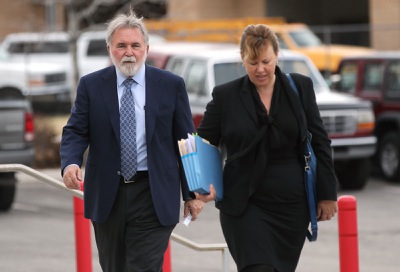
Monte Miller
Sun coverage
Miners and gamers across the state breathed a sigh of relief last week when Las Vegas businessman Monte Miller announced he was dropping initiative petitions to raise their taxes.
But the mining industry might have reason to hold its collective breath a bit longer. Even though Miller has said he will abandon both petitions, the mining tax petition has already cleared a judge. That means any other mining foe — and mining has plenty of foes in the state, some of them well-funded — could potentially pick it up and run with it.
That possibility is hypothetical at this point. But it’s a hypothetical that the gaming industry and its lawyers worked carefully to eliminate when they convinced a judge to throw out Miller’s gaming tax petition.
Both of Miller’s petitions were challenged on the premise that the 200-word “description of effect” was either inadequate or misleading — a common method used by petition foes to either halt or slow the progress of an initiative petition.
In the case of the mining petition, the district court judge, James Wilson, sided with Miller, deciding his description of effect was sound.
Not so with his gaming petition.
In the past, when a judge has found fault with a description of effect, he has either ordered it re-written or participated in re-writing it himself. But this time, the gaming industry’s lawyers succeeded in convincing Judge Todd Russell that if he tinkered with the description he would be “judicially cleansing the petition.”
Political observers expected Miller would back away from his initiatives. He had admitted to proposing them, in part, as bargaining chips against efforts to pass a broad-based business tax by the two industries.
But if Russell had, in effect, “judicially cleansed” the gaming tax petition, it could have potentially rendered it bullet-proof for someone else to pick up. The gaming industry wanted to avoid that possibility entirely.
Miller, a conservative crusader who has long sought to use his influence to fight tax increases, never found any allies willing to help fund what would be an expensive undertaking to qualify the gaming and mining tax petitions for the ballot.
And in the wake of the apparently collapsed effort to pass a business tax at the ballot, Miller decided to abandon both of his petitions. But both the mining and gaming tax hikes remain politically popular alternatives to a business tax.
And forces in the state who have long sought additional revenue may see an easy path to a mining tax increase by picking up a petition that has already been vetted through the court system.
Most observers say that hasn’t been done before. Some were unsure if it’s even legally possible. Either way, it’s unlikely.
Miller’s petition would simply raise the cap on the mining tax, giving the Legislature the ability to raise the industry’s net proceeds tax. That didn’t exactly please liberal groups that have been lobbying for a mining tax increase.
“If we were going to spend the money and resources on a ballot initiative to tax mining, it would be something with some teeth in it, not something as neutral as Monte Miller’s faux mining tax,” said Bob Fulkerson, director of the Progressive Leadership Alliance of Nevada, which failed to gather enough signatures on a mining tax petition two years ago.
Fulkerson added that his organization will focus on ensuring Senate Joint Resolution 15 makes it through the Nevada Legislature next year. That resolution — subject to voter approval — would remove mining’s tax protections from the state constitution.
A more daunting problem for anyone hoping to pick up Miller’s petition, however, is the June 19 deadline for turning in more than 72,000 signatures to qualify the petition for the ballot. It’s a short time frame, even for a petition that has already cleared the district court.
Still, the petition may appear an attractive backup plan in future years, should SJR 15 fail.

Join the Discussion:
Check this out for a full explanation of our conversion to the LiveFyre commenting system and instructions on how to sign up for an account.
Full comments policy