Las Vegas Sun

May 24, 2013

Currently: 76° | Complete forecast | Log in

Budget deficits aside, School District moving forward on multimillion-dollar technology upgrades

Image

Christopher DeVargas

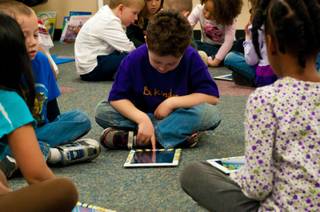
Kindergartners at Explore Knowledge Academy use Apple iPads during class to enhance their learning experience. Thursday Feb. 16, 2012.

Explore Knowledge Academy iSchool

Kindergartners at Explore Knowledge Academy use Apple iPads during class to enhance their learning experience. Thursday Feb. 16, 2012. Launch slideshow »

CCSD iPad Pilot Program

Stacks of iPad 2 tablets line the tables as students wait in the distribution lines at Silverado High School on Tuesday, Sept. 13, 2011. Launch slideshow »

iPad Education at Vegas High School

Students at Southwest Career and Technical Academy High School utilize iPads during a Biology class, Thurs. Jan. 19, 2012. The school has been recognized as an Apple Distinguished School due to students utilizing digital technology to enhance their learning experience. Launch slideshow »

Even as the cash-strapped Clark County School District faces a $64 million budget deficit next year, officials are contemplating spending up to $65.1 million over the next several years to expand technology offerings to students and teachers.

That’s on top of about $84 million the district spends each year to maintain its current technology infrastructure: computer servers, telephones, computers, Internet and networks.

During Wednesday’s School Board meeting (which was dominated by budget talks), Jhone Ebert, the district’s chief technology officer, presented a $149.1 million budget proposal that, if approved, would help propel Clark County toward an increasingly digital curriculum over the next several years.

Students can expect more tablets and laptops in classrooms, as well as software and electronic textbooks. It’s all part of the School District’s efforts to raise student achievement, Ebert said.

Over the past decade, technology upgrades and maintenance were paid in large part from the 1998 school construction bond program. Bonds allowed the district to build more than 100 new schools to address Las Vegas’ rapid population growth and helped pay for new computers, smartboards and audio equipment in classrooms as well as a districtwide Wi-Fi network.

As the bond program comes to a close, however, the district is considering a new, $5.3 billion school bond program to help modernize its buildings over the next decade. The proposal could go to voters in November.

If approved, most of the money from bond sales would go toward upgrades at dilapidated schools. However, about $1 billion may be used to purchase new technology and equipment. (If the program isn’t approved, the district has the option to absorb technology costs in its general operating fund.)

Ebert’s $116.1 million budget proposal outlined how the district might start spending the money if a new program is approved.

•••

A little less than half of the technology budget will still be allocated toward annual technology maintenance. The rest will go toward a number of new digital initiatives.

The School District currently spends about $84 million a year on its existing technology infrastructure. About $33 million comes out of the district’s general fund; the other $51 million is from bond proceeds, Ebert said.

The $33 million represents about 1.65 percent of its $2 billion operating expenses, Ebert said. Most government entities spend about 2.7 percent of their operating budget on technology, she added.

Other major school districts spend more of their budgets on information technology, Ebert continued. The Los Angeles Unified School District, the second largest in the nation, spends more than 3 percent of its $7.3 billion on IT, she said.

Still, the Clark County School District spends more than $20 million each year on computers, printers, projectors, smartboards and document cameras used in classrooms.

It also has more than 33,000 telephones and more than 12,200 Wi-Fi access points. More than 330 schools have their own servers, and the district is considering consolidating all of its server space into one main hub.

Further, there are a number of employee and student data systems to administer payroll, compute grades, compile attendance records and issue transcripts.

Many of these data systems are aging and will need a complete overhaul, Ebert said. For example, the student information system is no longer supported by its vendor, which means a catastrophic failure could result in student data inaccuracies.

“These systems are past the end of their shelf life. It’s not a matter of if but when it’s going to fail,” Ebert said. “We need a more efficient tool so that teachers can spend more time with students in the classroom.”

Austin, Texas-based consultant Greg Gibson recommended in September that the district replace its outdated human resources and student information systems at a cost of $33 million over five years.

Ebert compared the technology infrastructure supporting students, teachers and administrators to an iceberg, the bulk of which is hidden underneath the water. When students and parents see classroom computers and digital projectors, they are only seeing the tip of the technology infrastructure needed for the district to function, Ebert said.

“There’s all this technology below to help support the 21st-century student,” she said.

•••

Amid the recession and despite some initial controversy, the School District has begun loosening its purse strings for technology.

It began piloting electronic textbook initiatives at several schools this year, despite its controversial decision two years ago to purchase $1 million worth of iPads for administrators.

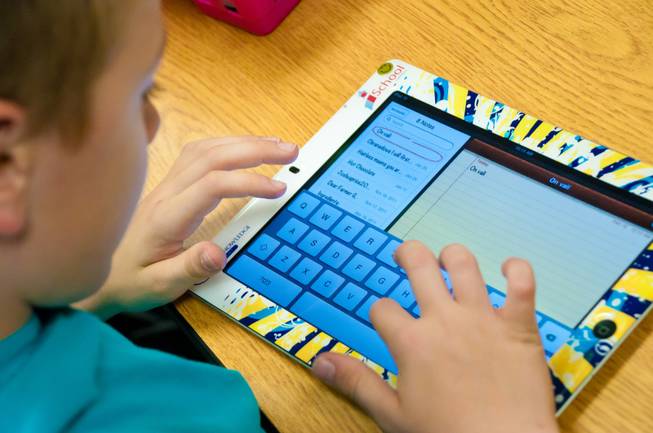
In the fall, it launched one of the largest iPad textbook programs in the country at a cost of about $800,000. Some magnet, charter and career technical academies also have adopted iPads and other digital technology in the classroom.

The district plans to expand these pilot programs gradually, Ebert said. A tablet and netbook program is expected to start this fall at five middle schools at a cost of about $1 million per school.

Officials hope to have about a third of the district’s 309,000-student population studying in online and “blended” online and traditional classrooms by 2015. To get there, they hope to have the money — about $300 per student per semester — to harness online curricula and digital tools for learning, Ebert said.

This isn’t so much a funding increase but a funding reallocation, she stressed. Digital devices — like an iPad — will replace traditional paper textbooks and graphing calculators, she said.

Click to enlarge photo

Kindergartners at Explore Knowledge Academy use Apple iPads during class to enhance their learning experience. Thursday Feb. 16, 2012.

The district is unlikely to raise enough capital to give each student a netbook or iPad, Ebert said. Instead, the district is looking at beefing up its technology infrastructure – wireless networks and server systems – to prepare for a future where students bring their own laptop to school and standardized tests are taken online.

“Our job as educators is to prepare students for the modern workforce,” Ebert said. “Construction workers, architects, everyone is using technology to receive, consume and digest information.”

•••

Most School Board members said Wednesday they felt the School District must make an investment toward creating classrooms that are better suited for students in the 21st century.

Board member Deanna Wright said it would be foolish not to embrace technology because students are already digital learners.

“It’s frustrating to me that people want to reduce education to pencils and papers in a red schoolhouse like in Laura Ingalls Wilder,” she said, referencing “Little House on the Prairie.” “The world is expecting more from our kids.”

School Board member Carolyn Edwards questioned the costs of constantly upgrading technology and accessibility to all students but also said she supported the digitization of the classroom.

“This is so critical if we want to be No. 1 in the country,” Edwards said.

Adopting a technology-minded education is crucial to compete in the global marketplace, School Board President Linda Young added.

“We don’t have a choice. We’re in an international competition,” she said. “We have to move forward.”

Discussion: 14 comments so far…

Comments are moderated by Las Vegas Sun editors. Our goal is not to limit the discussion, but rather to elevate it. Comments should be relevant and contain no abusive language. Comments that are off-topic, vulgar, profane or include personal attacks will be removed. Full comments policy. Additionally, we now display comments from trusted commenters by default. Those wishing to become a trusted commenter need to verify their identity or sign in with Facebook Connect to tie their Facebook account to their Las Vegas Sun account. For more on this change, read our story about how it works and why we did it.

Only trusted comments are displayed on this page. Untrusted comments have expired from this story.

  1. Guess the question is whether LV and NLV will be populated with $100 IPads. From our beloved schools. Hope they can shut down the tablets if they are stolen. Whatta' you think?

  2. Does lipstick on a pig sound familiar?

    "This is so critical if we want to be No. 1 in the country," Edwards said.

    uhh, they can't read or write or add...Maybe poking one's aspirations so far above where the work needs to be done makes a good sound bite, but what does it do for education??

    Not saying technology is not the future or that as a society, we need our next generation to be included...Just saying that when we avoid the basic skills in the formative years, then it's likely these investments will turn into toys at a time when the brains are begging for simple understanding, groping for substantial challenge, and needing to make a connection to someone human.

    It's maybe just my geezerness that shades my perspective, but most kids I know would lose them...or sell them :)

  3. Technology is essential to the advancement of our society's educational system. You might be a traditionalist when it comes to schools and learning saying "I didn't need an iPad 30 years ago to learn". But I am quite sure you used a scientific calculator for your advanced math and science classes, something people 60 years ago didn't have those. Point is, as you are out and about, take notice as to how many children above the age of 2 (sometimes younger) are playing with portable electronic devices! One of the buzzwords in the educational community is "student engagement". How better to ENGAGE students that with something they KNOW how to use and LOVE to use? The technology will NEVER replace the teacher in the classroom, but it is a NECESSITY.

  4. Back in the day we were forced by the LACK of technology to engage our brains, and it became a habit, so tomspeak. yesterday a friend mentioned his recent weight training regiment included how many reps he could rip off of pressing 80% of his weight.

    "What do you weigh?" I asked.

    "175, anybody got a calculator?"

    Well, 10% of 175 is 17.5, right? 17.5 times 2 is 35 and 2 of those 35s is 70 and 2 of those 70s is 140, right?

    Another way to USE YOUR HEAD is 4 fifths of 175. A fifth of 175 is 35, right? Four of those is 140, right?

    Technology provides the engagement you describe, Ron Lott, but challenge and effort provide the internal links known as learning, as moving from what we know to what we want to know.

    You may be mistaking CONVENIENCE and EASY ACCESS for engagement of thought processes. If it's too easy, it's entertainment; when it reaches IN and stimulates ENGAGEMENT of what's already there and results in reformulation through application, then we have constructivist development, aka learning.

  5. Lamy is quite correct in his assessment. The basics must be taught first; then technology. Students have to be able to function even if the electricty fails or the batteries become exhausted. Having said that, due to ever changing electronic technology, it is incumbent upon the public school system to educate students in its power and use if they are to function in the world of tomorrow. Using lead pencils or ball-point pens will not cut it as the electronic age progresses.

  6. It is an unbelievable waste of money. Big Government at it's finest.

  7. BILLIONS for BUILDINGS!
    MILLIONS for TECH-TOYS!
    6-FIGURE SALARIES for ADMIN!

    For our Teachers???
    SHAME, RIDICULE & PAY CUTS!
    (The audacity of this bunch to 'unionize'!)

  8. I worked on CCSD's software implementation that modernized their IT systems for supply chain and finance a few years back. The full project that was to include HR and Payroll was not completed and I can tell you that their remaining IT systems are terribly outdated, inefficient, and wasteful. CCSD has some tough choices to make but sometimes you need to bite the bullet and spend a little in the short term in order to save money in the long term and to ensure that your organization can function efficiently in the future.

  9. I read this story at 5 this morning after getting up to feed the various and sundry critters but prior to coffee, all the while building to a major rant. Number 1 in the nation? At what? Worst graduation rates? Poorest math proficiency? How about worst staff morale? The Board needs to get a grip on reality. Arkansas used to be in the bottom 5 in education and tool Bill Clinton. a bipartisan legislative coalition, the education establishment a large numbers of pissed-off parents twenty years and bucketloads of money to get them up to average. CCSD is still in the way below average category and the application of technology will not provide the shovel to dig us out of this hole.

    Joe and Jerry appear to be of my generation. All three of us can do math in our heads because [in my case] multiplication table and numerical relationships were memorized often with the encouragement of a switch wielded by a penguin-clad authority figure.

    Let me play devil's advocate. Why do we want to educate every child to meet the definition of upper-middle class success? A capitalist, class segmented society, which we most surely are, relies on skills and contributions from each segment while allowing mobility. We need low skill, low wage workers in many industries. For us notably hospitality, health care and construction.
    In my own field, auto and truck service, I have found that I make more money by focusing on higher level thinking diagnosis and repair while some low wage worker changes oil and tires, swaps parts as directed and plays well with others. Class warfare? No, I want those folks to succeed but honestly, most do not have the brains, the desire or the work ethic.

    Overemphasis on the use of technology is not a panacea. Yes it's easier for kids [and adults] to look up answers and pass tests but they still can't engage in critical thinking.

  10. Reading the comments, I amazed that so many missed the point of the technology. A number were of the tone that basics are more important than technology. This is NOT the issue. They are proposing technology to help teach the BASICS. When a 2 year old can use an iPad, maybe there are are ways it can help our students. I have 5 grown children and none of them even buy books anymore, they all use electronic readers. You can't even by a paper Encyclopedia Britannica today. The School District is correct, this is the direction that we need to go to give our children a fighting chance in the future.

  11. Amazing,

    I'm convinced of the value of technology appropriately sharing the instructional load, along with other tactics. As wharfrat Hayes points out, technology is absolutely a benevolent aid in some instructional processes, but it doesn't work well for critical thinking. Kids need to learn to set up problems from scratch, plan a solution and do the math.

    The tech-friendly nature of the ipad is a great beginning, and utilizing it for what it can do is a boon to all of us. Learning is more than doing problems well and getting answers that agree with the textbook or scoring gizmo.

    The ipad, computer-asssisted instruction, even the Khan Academy all have marvelous applications in schools. They can instruct and challenge, exemplify and show variations on themes, processes and solutions.

    Their huge benefit is the impersonality plus their repetitively constant ability to correct and re-address a similar issue but in different ways. And they are available 24/7 to enable asynchronous instruction for the kid who works days and does school at night. They relieve the teacher of time constraints so teachers can work one-on-one with a kid whose difficulties require a human touch.

    All of these technological devices have their place and the ascendency of the technological revolution is upon us in a big way; only a fool would discredit them or deny their potential for improving instructional capacity.

    The issue I raised which Jerry Fink and Pat Hayes echoed is the failure of gizmos to address critical thinking, to stress the incorporation of higher levels of thinking, or access depth of knowledge. These will come. Kahn is moving this way from basically a step-by-step math processing instructional path to a broader conceptualization.

    Early on in the computer-assisted learning labs (1998) in GED classes I taught at a community college, we had a simple program that some kids used for significant benefit, but its successes fell into specifically rote learning categories with demonstrations of problem/solution and exercises. The point that Pat Hayes makes clear is the weakness there - critical thinking, problem set-up, application, evaluation.

    The point you make however is abundantly clear, however. That little tyke at 2 can rip on that ipad, do the game, get the drill and gobble up the skill and info utilization at her own pace and grow all kinds of neurological paths, and it's absolutely valuable. No argument there. They are fun. They isolate the learner with a comfortable environment, and they instruct better than a bad teacher.

    But a panacea, a universal elixir, an educational silver bullet, a source of critical thinking skill - not YET!

  12. For English Language Arts teachers, let me toss you a bone...

    www. chompchomp.com

    is one fabulous series of effective instructional games in language skill. Check it out. Excellent scope, very fun, challenging and recursive, interconnected and kids like it. It's great for both initial instruction and review. Grades 4 - 12.

  13. Are you kidding? By the end of the year it will all old stuff outdated with in five years you got pile of broken outdated junk...
    Teach them the basics, that never go's go's out of date.

    I have yet found a kid that can answer this simple question: How many four legged Elephants in a dozen?

    Try it and see the answers you get.

  14. Millions more spent on technology, yet support and training for the current technology infrastructure has been slashed due to the current CCSD budget cuts. Anyone need an expensive paperweight?

Post a comment

Commenting requires registration.

Comments are moderated by Las Vegas Sun editors. Our goal is not to limit the discussion, but rather to elevate it. Comments should be relevant and contain no abusive language. Comments that are off-topic, vulgar, profane or include personal attacks will be removed. Full comments policy.

If you would like to submit your comment as a letter to the editor, you may submit it here.

Most Popular