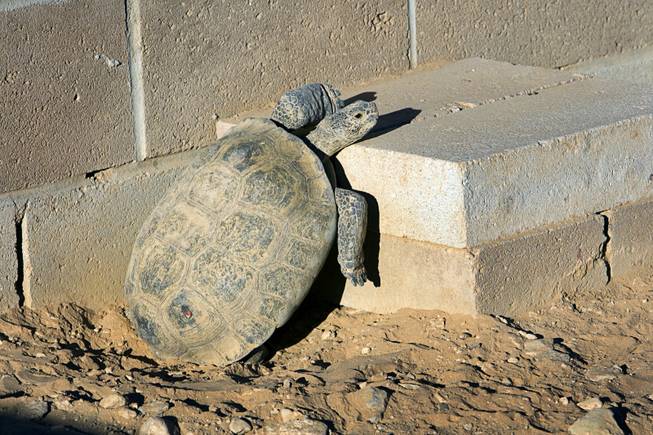
A Mojave Desert tortoise is shown in a quarantine area at the Desert Tortoise Conservation Center in Las Vegas on Friday, Sept. 2, 2011. The tortoise, some kept by people as pets, will be returned to the wild when they are healthy enough to leave.
Published Saturday, Sept. 3, 2011 | 2 a.m.
Updated Saturday, Sept. 3, 2011 | 1:10 p.m.
Related stories
- Delays in protecting species spur lawsuits (2-19-2010)
- Tortoises creep into the public debate (10-11-2009)
Beyond the Sun
A study of Clark County’s protections for desert tortoises and other wildlife could lead to higher fees for development and an expansion of the area covered by the protections.
Although still in its early stages, a proposal to modify the county’s Multi-Species Habitat Conservation Plan could raise the fees from $550 to $1,600 an acre; expand by up to 200,000 acres the area covered by wildlife restrictions; and reduce the number of animals designated for research, from several dozen to fewer than 20.
“With climate change and renewable energy development (taking up thousands of acres of desert) ... and two decades of pretty much unmanaged breakneck-pace growth, we have to step up our game,” Nevada Conservation League Executive Director Scot Rutledge said.
Proponents of the changes such as Rutledge — a member of the advisory committee appointed by the Clark County Commission to review the protections — think the county should act now even though growth has slowed dramatically, to avoid the federal government imposing harsher restrictions.
But several commissioners don’t see the need for change now.
Commissioner Steve Sisolak said he doesn’t see the sense in pushing ahead with plans to preserve and protect animals on land that won’t be touched for years. The commissioner, whose district includes a habitat of relocated tortoises, thinks the drive to adopt a new plan has as much to do with a handful of government employees wanting to remain relevant while development is on hold as it does protecting wildlife.
“I think they want to expand their empire at the expense of development and other worthwhile causes,” Sisolak said. “It’s the tortoises, the frog, the butterfly, the mustard plant. It’s kind of like a black hole. You cannot throw enough money into this thing.”
To understand how the money is spent, Sisolak ordered the Desert Conservation Program to report on expenditures of money received from fees and through a federal land program. That report is scheduled to be delivered at Tuesday’s County Commission meeting.
“We should definitely protect endangered species, but we’ve studied this for a good 20 years. It’s gone too far,” Sisolak said.
Commissioner Tom Collins said the proposal has no chance at being adopted. “The likeliness of that thing passing is about the same as a whore with no teeth winning a beauty pageant,” he said.
Collins’ response reflects the strong emotion and line-in-the-sand stances that the desert tortoise evokes. It has been that way since 1990, when the Mojave Desert tortoise earned a place on the threatened species list, sending Clark County into action because the federal government would not allow development on its land — the U.S. government owns most of Clark County and Nevada — without plans to protect the species.
By 1995, a long-term conservation plan was formalized, a multispecies plan was approved in 2000 and in 2001 the U.S. Fish & Wildlife Service issued an “incidental take” permit for a multispecies habitat conservation plan. “Incidental take” means developers may kill a tortoise without penalty while developing desert land.
Rutledge wants the revised plan to change that by requiring the surveying of land and moving of tortoises before development, and in some cases building around habitat instead of bulldozing it.
The new process would be more expensive, and Rutledge, citing an independent economic analysis presented to the committee, favors increasing developers’ fees from $550 to $1,600 an acre.
“If you look at the fee increase on a per-home basis, given a moderate density of eight homes per acre … that’s not going to break anyone’s bank,” he said.
That plan permitted 145,000 acres for development through 2031.
With the development boom of the mid-2000s, desert was being developed faster than expected. At its peak in 2003, 8,500 acres were developed.
In response, the County Commission, in mid-2007, decided the plan needed to be amended. After years of study, that plan is close to being presented to commissioners for review, Rutledge said. The amended plan could call for the addition of 200,000 acres to be covered by the conservation plan.
Meanwhile, about 67,000 acres remain in the first conservation plan, with development occurring at a pace of only 900 acres a year. But Sisolak said he doesn’t see the point.
“We don’t need this right now,” he said. “This land won’t be touched for years.”
Even though growth has slowed, Rutledge believes that if the county doesn’t act now, the federal government will act for them once growth resumes.
“This is not a job-killing proposal,” Rutledge added. “And developers will be shooting themselves in the foot by not moving forward with a compromise.”
But Rutledge admits that political opposition to changes appears strong. That’s a worry because “politics are going to make the decision, not the science.”

Join the Discussion:
Check this out for a full explanation of our conversion to the LiveFyre commenting system and instructions on how to sign up for an account.
Full comments policy