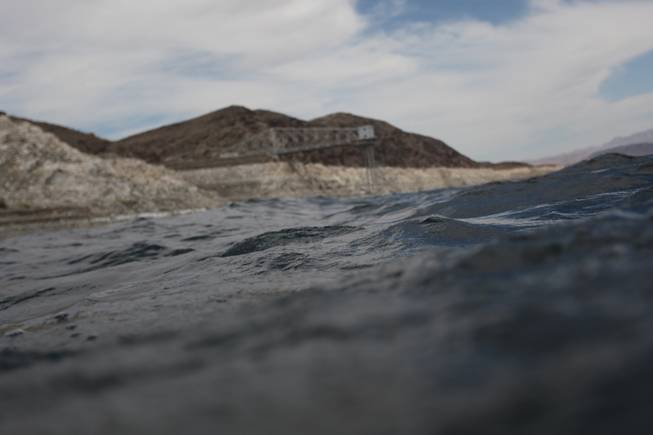
An intake at Boulder Harbor at Lake Mead rises out of the water. The white coloration on the rock along the shoreline indicates where the water level once was.
Thursday, March 10, 2011 | noon
Special coverage
It is nearly a certainty that extra water will flow into drought-plagued Lake Mead this year, according to the latest projections from the U.S. Bureau of Reclamation.
The bureau reported in January that increased snowfall in the Rocky Mountains -- more than 30 percent above historical levels -- could lead to more water for the lake if Lake Powell's water level rose to 3,643 feet by April 1.
That would trigger the release of an extra 3.13 million acre-feet of water into Lake Mead, officials said, pushing the lake's surface level up 20 feet or more.
Earlier this week, the agency updated its projections and estimated there is a 97 percent chance that Lake Powell will reach the 3,643-foot threshold. In January, the bureau had projected a 76 percent chance.
Only a historic plunge, 2.1 million acre-feet, in forecast water volumes for Lake Powell would prevent the extra water from flowing, officials said.
The forecast has dropped that far only once in 32 years.
As part of the Colorado River Compact, Lake Powell annually releases 8.23 million acre-feet of water into Lake Mead. According to agency statistics, if the higher threshold were reached at Lake Powell, a total of 11.36 million acre-feet of water or more would flow into Lake Mead by September.
Andrew Munoz, spokesman for the Lake Mead National Recreation Area, said 100,000 acre-feet is equal to about 1 foot of elevation on the lake. If 3.13 million additional acre-feet of water was pumped into the lake at once, the surface level would rise more than 30 feet.
Munoz cautioned, however, that the water would be released gradually so the total change in water level would likely be less, especially when factors like evaporation were incorporated.
Officials said it’s still good news for Lake Mead, where water levels have dipped significantly in recent years. Since the drought struck the Colorado River Basin in 1999, Lake Mead has dropped to historic lows, dipping to 1,082 feet in October and forcing the closure of several boat launch ramps. When full, the lake should be at 1,220 feet.
Less snow has accumulated since the drought began. Last year, Munoz said accumulation was about 20 percent below the historical norm.



They still blame low water levels on drought when this town and others along the river use water and waste water like it's unlimited.
Every tree and bush in Las Vegas has irrigation running to it. They still plant grass in many areas.
Many complexes water daily when it's not necessary, etc...
Let's hope these predictions are true. If Lake Mead were to rise another 20+ feet, we would be back at 2008 levels. I'll be watching here: http://graphs.water-data.com/lakemead/in...
The problem is NOT Las Vegas which by the way only uses about 1% of the water from the Colorado River. The problem IS California, take a drive there and you can really see how much water is wasted... Why does CA have 1st priority for our water? That needs to change!
nice graph, Save --- here's another I like....
http://www.arachnoid.com/NaturalResource...
If only people would know their history... "Why does CA have 1st priority for our water?"
Hoover Dam was constructed to control flooding on the Colorado river, the dams further down from Hoover manage the water (in CA) for agriculture.
Lake Mead is the reservoir for that irrigation needed to make food for you to eat. No water in Lake Mead, no fruits and vegetables for your McBurger and salad!!
Dylan: This month's article is a little more balanced than last month's where you gushed that a trend of higher water levels in Lake Mead may be forthcoming.
Since last month, the total snowpack above Lake Powell diminished from 130% to 120%. Although it is a near certainty that this will be an above average snow year, it's not going to be big enough to reverse the trend of diminishing water levels in Lake Mead.
In water years 2008, 2009, and 2010 we had an above average, average, and below average year respectively. Yet when you look at the graph in the link provided by vegas_tom above, you see that there is no direct correlation between the depth of the snowpack in the given water year with the maximum elevation achieved in Lake Mead. Despite the depth of snowpack, each year's maximum elevation is lower than the last.
This shows that the elevation of Lake Mead has less to do with the actual snowpack than it does with how Hoover Dam is operated.
It will be interesting to see if the maximum water level in Lake Mead increases over last year's maximum. It would be the first time since 2005 that it happened. That would be bucking the trend for lower elevations to continue, however.
MG: You must not have lived in the west very long if you think there is such a thing as "our water." Whiskey is for drinkin' and water is for fightin' over.
The division of water and power for Hoover Dam was developed by Herbert Hoover in the 1920's. It is called the Colorado River Compact and it sets the split among the 7 states that the Colorado passes through. California gets something like 59% of the water and power from Hoover Dam. This agreement should be updated. Google it, it's an interesting read.
Even though the damn was named after Mr. Hoover, he had nothing to do with the allocation of the water or power agreement.
Seven states hashed out the Colorado River Compact.
California gets 58.7%
Arizona gets 37.3%
Nevada gets 4%
Arizona also gets some allocation from the Upper River Basin before the water gets to Lake Mead.
Mexico gets Five times more water then Nevada does.
The snow pack is good this year and hopefully will be for the next few years.
Lake Mead is also currently storing some of Mexico's water since their water system was damaged by the earthquake last year. Mead is also storing some of Arizona's water since their water storage in some area's are full. That is helping the lake come back up.
Lake Mead has cycled since the start of the damn and it will continue to cycle. Some area's need to start using water more wisely though since there are more people drawing off of it.
In the last few years Vegas has used LESS water even though we have added more people. Conservation in this area has been better then most.
Anthony - "No water in Lake Mead, no fruits and vegetables for your McBurger and salad!!"
Spoken like a true californian, what a bunch of BS, when's the last time you were able to buy decent fruits and vegetables in Las Vegas. California takes the majority of our water some of which is even used to grow food which for the most part STAYS in ca. Time to update history and make some very over due changes for Lake Mead and CA.
Something is rotten in Denmark or should I say Lake Powell. How is it that the lake has not gone up "at all" even with all the extra snow and water runoff? So much for your 97% chance that it will occur... Hey Dylan, how about a follow up to this story with what actually happened???