Courtesy photo
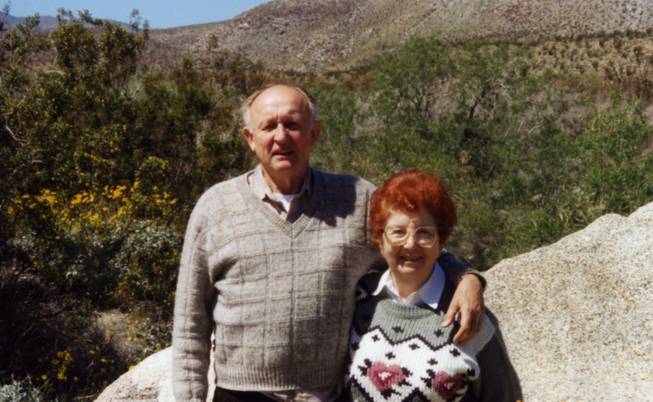
George Yago Jr., 83, and wife Maureen, 79, of Las Vegas were killed crash on Jan. 22, 2004, after they pulled up to a parking space on the fourth floor of the Golden Nugget parking garage downtown when their white 2002 Toyota Camry sedan suddenly plunged through a cement panel wall and tumbled into the alley below.
Sunday, June 13, 2010 | 2 a.m.
Related story
Related Documents (.pdf)
Sun archives
- Gov’t: 89 deaths tied to Toyota acceleration (6-1-2010)
- Toyota sued in Las Vegas over vehicle defects (2-19-2010)
- Toyota working overtime to fix recalled vehicles (2-11-2010)
- Insurance rates not accelerated by Toyota recall (2-10-2010)
- Toyota recalls at a glance (2-1-2010)
- Car plunges off parking garage (1-23-2004)
FEDERAL FUNDING CALLED INADEQUATE
Clarence Ditlow, executive director of the Washington consumer advocacy group Center for Auto Safety, blames the Toyota controversy on “draconian cuts in the National Highway Traffic Safety Administration’s enforcement budget and staffing,” “lax enforcement,” “flawed research on electronic controls,” “manufacturers exploiting weaknesses in NHTSA’s regulatory programs,” and “inadequate crash data collection programs.”
The agency’s budget actually increased substantially since the 1980s — the Obama administration is proposing $877 million for fiscal 2011 — but the agency’s staff is still smaller than 30 years ago. The administration is proposing 66 new employees for 2011, but that would bring the staff to the full-time equivalent of 650 positions, 200 fewer than in 1980.
Although the agency’s budget has increased, most of that money has gone to highway safety grants. Traffic safety experts have complained to Congress that more should be spent on vehicle safety research and investigation, where funding has been stagnant when adjusted for inflation. Joan Claybrook, former administrator in the Carter administration, for one, says the $132.8 million the Obama administration has proposed spending on vehicle safety investigations is “ridiculous.” “It should be at least $500 million,” she says.
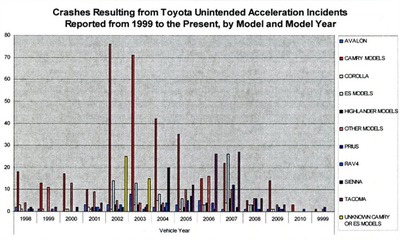
Crashes resulting from Toyota unintended acceleration incidents.
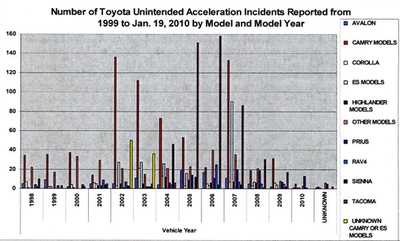
Number of Toyota unintended acceleration incidents.
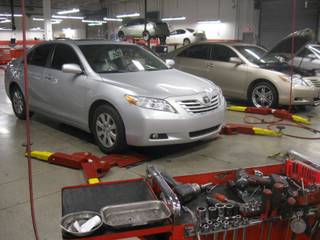
George Yago III has been waiting six years to find out why his parents’ car took a deadly plunge off a downtown Las Vegas parking garage.
The police don’t have an answer. Neither do federal investigators.
The Yagos’ car accelerated forward “for unknown reasons,” the Metro Police report said. The feds said much the same. The Clark County coroner floated a theory that a stroke caused Yago’s 83-year-old father to force his foot down on the accelerator, but the autopsy was inconclusive.
The son, who knew his father had been in reasonably good health, tried to make peace with the idea that he would never know what went wrong.
Then, last year, deadly runaway Toyotas started getting national news coverage.
George Yago Jr. and his 79-year-old wife, Maureen Yago, had died in a 2002 Toyota Camry.
On Jan. 22, 2004, the banking industry retirees were meeting a relative for brunch at the Golden Nugget. As they drove onto the garage’s fourth floor, the Yagos were trailed by two motorists who saw the Toyota’s brake lights as the Yagos pulled into a space. One witness even told Metro Police he saw the Yagos’ car come to a complete stop — right before it suddenly accelerated and slammed through the cement panel wall at the head of the parking stall.
The white sedan flew over the edge, hit power lines, flipped trunk-over-hood in midair and landed on its roof in the alley below.
And today, as automotive safety experts campaign for an expanded recall of Camrys to include older models like the Yagos’, they cite what happened to the Las Vegas couple at the Golden Nugget parking garage.
Whether the Yagos’ vehicle was to blame for their deaths remains undetermined. But auto safety experts and consumer advocates say it can’t be ruled out because federal investigators weren’t thorough enough and lacked technical know-how about the brake systems in question. Had they more exhaustively investigated the crash, regulators might have caught on to Toyota’s problems sooner. Other crashes might have been prevented. Other lives might have been saved.
Two key members of Congress — House Energy and Commerce Committee Chairman Henry Waxman, D-Calif., and Rep. Bart Stupak, D-Mich. — agree with critics that a 2004 investigation by the National Highway Traffic Safety Administration into allegations of sudden acceleration in some Toyotas, including the Yagos’, was seriously flawed. Stupak, chairman of the House’s Oversight and Investigations Subcommittee, said in an e-mail to the Sun that the investigation’s findings about the Yagos’ crash and others “deserve a second look.”
Some experts say the highway administration didn’t have the expertise to examine whether the earliest versions of Toyota’s electronic throttle control network of sensors and electrical circuits were causing drivers to lose control of Camrys because of surging engines.
The highway administration’s critics say more deaths, crashes and consumer complaints are tied to runaway 2002-2006 model Camrys that haven’t been recalled than 2008-2010 models that have been.
In March, Clarence Ditlow, executive director of the Center for Auto Safety, a Washington-based consumer advocacy group, told a Senate committee that more than twice as many deaths from unintended acceleration could be tied to the 2002-2006 Camrys that haven’t been recalled than could be tied to later-year Camrys. The death toll for the older Camrys is 15 and for the newer ones, seven, he said.
Ditlow noted the Yagos’ deaths during his testimony.
The Yago case was one of only a few fatal crashes the highway administration says it examined in its investigations of acceleration complaints tied to Toyotas, even though the agency disclosed May 25 that as many as 89 deaths and 57 injuries may be attributed to unintended acceleration in all Toyota models dating to 2000. In the past decade, the agency has fielded more than 6,200 complaints alleging acceleration problems in Toyotas.
In 2004 — the year of the Yagos’ crash — six other fatal crashes involving 2002-2004 Camrys that may have been caused by sudden acceleration were reported to the agency, but none was investigated, Safety Research & Strategies, a Massachusetts-based traffic safety consultant that has worked with lawyers suing Toyota, told Congress.
Safety Research founder and President Sean Kane told the Sun: “It’s unusual to look at a particular problem without looking closely at the deaths. If they had properly investigated those deaths years ago, would Toyota and NHTSA have been in the crisis they are now? Instead of having recalls where millions of cars have been affected, we could have had a more contemporaneous campaign to address the problems when they happened. We have never seen an explanation as to why those deaths weren’t counted in earlier investigations.”
In e-mailed responses to numerous questions from the Sun, the federal agency’s spokeswoman countered that although the Yago crash was the only fatality it mentioned when it wrapped up its 2004 investigation, the agency “reviewed” three other fatal crashes while that investigation was ongoing. She also noted the highway administration “reviewed” fatalities in two subsequent investigations of sudden unintended acceleration in Toyotas.
The feds found no problems with Toyota’s electronic throttle controls, but the highway administration’s critics say that conclusion has more to do with the federal agency than with Toyota. The agency had grown too cozy with the automakers it regulates and was rushing through investigations, critics say. Its dearth of expertise to investigate increasingly advanced vehicle electronics reflects decades of underfunding and understaffing, they say.
Those critics include Joan Claybrook, the agency’s administrator during the Carter administration.
“They should reopen the 2004 investigation (which included the Yagos’ crash) because the number of complaints about Camrys in 2002 and 2003 was huge,” Claybrook told the Sun. “One problem is that the agency doesn’t have much electronics expertise. They can’t identify or pinpoint problems with electronics so they conclude that the problems are due to driver error.”
The detective who wrote the Metro report on the Yagos’ crash raised the possibility of driver error. Maybe Yago inadvertently stepped on the gas pedal instead of the brake, and then in a panic pushed down harder because the car was not stopping. But police could not conclude that happened, the report noted.
The key is that witnesses saw brake lights on the Yagos’ car as they parked, Ditlow said.
“If (Yago) was already in the process of stopping, he wouldn’t have been likely to step on the accelerator.”
•••
Since fall, Toyota has recalled more than 8 million vehicles worldwide, citing driver-side floor mats and sticky gas pedals, not faulty electronic throttles.
Toyota Motor Sales U.S.A. spokesman Brian Lyons said that after conducting more than 2,000 vehicle inspections, the company has yet to find evidence that its electronic throttle control system has ever caused unintended acceleration “in a real-world scenario.”
“We have sold more than 40 million cars and trucks with the electronic throttle control system, and we are confident that this system is not the cause of unintended acceleration,” Lyons wrote in an e-mail to the Sun. “Toyota engineers have repeatedly and rigorously tested the electronic throttle control system under a variety of extreme and adverse conditions, and time and again, they have never found any evidence that a system malfunction can cause unintended acceleration.”
Toyota’s critics counter that the automaker has a conflict of interest when it comes to investigating the systems in the earlier Camrys because its corporate life is on the line. Because the safety of millions of motorists is at stake, too, a second opinion by independent experts is long overdue, critics say.
Having given up on the reliability of the highway administration, their hopes are pinned on the National Academy of Sciences. Transportation Secretary Ray LaHood announced March 30 that the academy will examine unintended acceleration and electronic vehicle controls throughout the automotive industry. The highway administration also has contracted with NASA engineers with expertise in computer-controlled electronic systems and electromagnetic interference to study Toyota’s acceleration issues.
An ideal place to start could be the Yagos’ crash. Just a week after the accident, highway administration investigators Steve Chan and Scott Yon told Metro Detective Corey Moon that it was the first fatal example of the surging Camry problem that had generated “numerous complaints” in 2002 and 2003.
“Supposedly, operators of (2002 or 2003 Camrys) have been slowing down or stopping and suddenly the car accelerates,” Moon’s report said. “In the previous complaints, some of the incidents had resulted in a collision. This was the first death.”
Metro talked to the highway administration a week after the Yago crash thanks to a California woman who had seen a news report about it. She called the police department and told Moon that the agency was considering an investigation of Camrys based on complaints of sudden acceleration, including one she filed about her 2003 model.
Later in the day, Chan “explained how in 2002, Toyota went to a new type of accelerator,” Moon’s report said. “In the previous years, a gas pedal was connected to the engine via some type of cable or linkage. In 2002, the gas pedal is now connected to some type of a pedal position sensor. This sensor is in turn connected to wires. These wires connect to the car’s computer. There are more wires that connect to some type of a servo or actuator. This connects to the engine to control the engine RPM. After this change is when these types of incidents started to occur.”
A month before the Yagos died, Chan, in an internal memo, had been more pointed about the possibility of a defect. . He wrote that “being a new feature, there is a reasonable probability that the drive-by-wire throttle system may have a defect that could result in an (unintended acceleration).”
His memo disclosed two technical service bulletins that Toyota had issued to dealers warning of possible “engine surging” in certain 2002 and 2003 Camrys.
“Although most of the (unintended acceleration) incidents had occurred at very low speed (5 to 15 mph), the percentage of incidents that resulted in a crash is high. These incidents, though generally at low speeds, are of high risk to pedestrians because they represent situations that could occur in parking lots, at intersections, and at school lots.”
•••
The event data recorder or “black box” in many newer Toyotas stores pre-crash information, such as vehicle and engine speeds, accelerator angle and whether the brakes were applied.
Metro asked federal investigators if they were interested in that device from the Yagos’ sedan, and Chan told Moon that the 2002 Camry didn’t store pre-crash data. The recorders in those older Camrys held only post-crash data, namely information on front, rear and side collisions and rollovers, Lyons told the Sun.
On March 3, 2004, 33 days after Metro talked to the highway administration about the Yagos’ crash, the federal agency launched its investigation into 2002 and 2003 Camrys and the Lexus ES300, which is made by Toyota. But curiously, the Yago crash — noted as the first fatality a few weeks earlier — wasn’t included in the probe until George Yago III e-mailed a complaint to the agency. His lawyer, David Francis of Las Vegas, had urged him to contact the feds.
“They basically sent back an e-mail saying they would review it,” Yago said.
The lawyer then contacted Yon and pleaded with him to inspect the wrecked car, which was in a Las Vegas salvage yard, the lawyer said.
“I told him that the car was ready for inspection, but they never came out,” Francis said. “I felt that the vehicle was an important piece of evidence that would have heightened NHTSA’s knowledge to the point where it might have led to a recall.”
The initial investigation was based on 37 complaints that resulted in 30 crashes or fires and five injuries. Within three weeks, the agency tossed out 26 of those complaints because it had ruled out throttle problems as the culprit or had found that the complaints were included by error or duplication. Of the 11 remaining complaints, none involved injuries or deaths.
But they involved either an engine speed increase that occurred without pressing the accelerator pedal, or engine speed that failed to decrease once the pedal was no longer being depressed, according to an internal memo written by Yon on March 23, 2004.
In most cases, Yon wrote, a driver should be able to control or stop the car by stepping on the brakes.
“However,” he added, “in certain close-quarters driving situations (such as parking), should the subject vehicle throttle control system open the throttle valve without driver intent, the resultant vehicle surge could result in a momentary loss of vehicle control. In some instances, a crash may then result when the driver is unable to react in time to apply the brakes effectively.”
In June 2004, the agency told Toyota of a 400 percent increase in consumer complaints regarding vehicle speed issues in 2002 and later Camrys.
In a July 19, 2004, response to highway administration inquiries, a Toyota executive wrote that the company had received 113 complaints, conducted a “thorough investigation” and found no reason to blame the electronic throttle control system for “alleged unintended acceleration.”
But the executive acknowledged that the automaker examined only two vehicles “brought back from customers alleging unintended acceleration.”
Just three days after getting Toyota’s response, the feds closed their investigation — with a conclusion similar to, and based upon, Toyota’s.
“In many cases, the complaint vehicles were subsequently inspected by dealership or manufacturer representatives who also failed to identify a fault within the vehicle. A defect trend has not been identified at this time and further use of agency resources does not appear to be warranted.”
It was much the same explanation the agency gave Yago.
“I do recall getting an e-mail that what they had found was inconclusive,” he said. “I can’t say I was surprised. It’s all about covering their tails.”
A year or two later (Yago doesn’t recall the exact date), he was invited to an office in Las Vegas to meet with two Toyota officials from out of town.
“They were there to review the case, to review the facts as I knew them,” Yago said. “But some of their questions were silly. ‘Did your parents like Toyota?’ ‘Would they have bought another one if this didn’t happen?’ At the end of the meeting they felt there was no reason for a claim. I was not shocked because I did not have enough engineering knowledge of Toyota issues to know whether there was an issue here with my parents.”
In February 2006, which may have been the same time as Yago’s meeting with the Toyota officials, Toyota examined the Yagos’ Camry.
When asked for details of that examination, Lyons, the Toyota spokesman, told the Sun: “Since we are concerned about the privacy of our customers, Toyota’s policy is to provide vehicle evaluation results only to the vehicle owner (or their representatives), law enforcement and federal agencies.”
It would be no use to Metro, though, because the department had closed its investigation a little less than two years before. Francis said Toyota told him it had not found any problems with the car, but Yago decided Friday that he would request the full written report from Toyota regarding what the “black box” data showed.
“They told me it would only show data from after the air bags deployed, and that the air bags would have deployed when the car hit the ground,” Yago said.
But it seems likely the air bags would have opened when the car went through the perimeter barrier of the parking garage, in which case the event data recorder might include some relevant information.
•••
By last fall, when the automaker began the recalls, the federal agency had investigated sets of complaints about unintended acceleration on six occasions. The issue also had been seared into the public conscience on Aug. 28, when an off-duty California Highway Patrol officer and three others died in a fiery crash of a runaway Toyota-made Lexus he was driving.
Two months ago, the federal government fined the automaker $16.4 million for being too slow to alert it about safety issues.
“When I heard about the recalls, the first thing I thought was, really,” Yago, 57, says. “I didn’t expect Toyota to do anything because most corporations cover themselves. If anything, I had expected the federal government to do something. I assumed that if they saw something or had an issue with an auto manufacturer, they would have raised a red flag to address the issue, but that never really happened.
“Even today, I’m not seeing anything that makes me feel that they’ll go further back with the recalls. There seems to be a focus on the newer vehicles. I haven’t heard anything about the older vehicles.”
Safety Research & Strategies told Congress that the Yagos’ and the other deaths and injuries that occurred by the end of 2004 gave Toyota ample notice of a problem “and yet the company continued to insist that the brakes would always work.” Kane told the Sun that unlike mechanical problems that often result in broken auto parts that are easy to identify, electronic throttle control issues are not readily apparent.
“That’s why it’s an easy issue to pawn off on the customer,” Kane said.
After Safety Research delivered its report, Waxman and Stupak wrote a Feb. 22 letter to LaHood that trashed the 2004 federal investigation.
They complained that although cars have made increasing use of electronic controls, the agency does not employ any electrical or software engineers. “As a result, NHTSA appears to lack the technical expertise necessary to analyze whether incidents of sudden unintended acceleration are caused by defects in the cars’ electronic systems.”
The congressmen singled out Yon and his handling of the investigation, which they said was “marred by highly questionable assumptions.” Congress learned that during the investigation, Toyota held a technical meeting with the highway administration to provide information and demonstrations of the electronic throttle control system.
While preparing for the meeting, Yon wrote in an e-mail to a senior Toyota official that the automaker could “supplement or disregard” some of the suggested agenda items because “I’m not very knowledgeable on this system.”
Waxman and Stupak also found that the agency failed to study sudden unintended acceleration of long duration. Instead, investigators focused primarily on mechanical and human explanations for incidents rather than possible electronic causes — and rushed to close the investigation with Toyota’s blessing.
“The NHTSA records offer no indication that any NHTSA staff consulted with experts in electronic systems during this investigation or critically evaluated Toyota’s claims about the operations of its electronic throttle controls,” the congressmen wrote.
Shown the congressmen’s letter, Yago read it carefully and then leaned forward from his living room sofa.
“The letter itself impresses me,” he said. “When I read about what happened over the years between NHTSA and Toyota, it’s disgusting. There is too much data for NHTSA to have ignored. I will say that I am perplexed.
“It appears to me that there are a lot of unanswered questions. As someone who lost family members, I’d like to see some resolution. If there are unanswered questions, we as consumers and citizens deserve some answers.”
Having spent many years as a mapmaker in Southern California, Yago moved into his parents’ home a year after the crash and earns a living as an auto insurance claims adjuster. He keeps many of his parents’ belongings in boxes.
Yago, an only child, can hardly bear talking about what happened to his parents, and his psychological wounds keep getting ripped open, his wife, Catherine, said.
On May 24, he received a phone message from a local Toyota dealership trying to drum up business. The salesman asked if George Yago wanted to trade in his 2002 Camry.
“If you need to get out of it, let me know,” the salesman said.

Join the Discussion:
Check this out for a full explanation of our conversion to the LiveFyre commenting system and instructions on how to sign up for an account.
Full comments policy