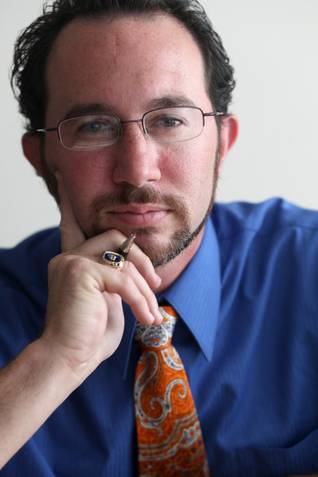
Ira Madnikoff, who has a bachelor’s degree in criminal justice and a law degree, was unable to get a license to teach in the Clark County School District in spite of his experience teaching in Florida.
Sunday, July 18, 2010 | 2 a.m.
Sun coverage
Ira Madnikoff seemed to be just the kind of social studies teacher the Clark County School District was eager to hire. He came from Florida with four years’ experience and a strong track record, and he had a law degree to boot.
But when Madnikoff went to the Nevada Education Department’s Las Vegas office in 2007 to see about getting a teaching license, he was in for a shock — in the eyes of the Silver State, he wasn’t qualified. The Clark County principals who had expressed interest in bringing him on board were out of luck.
When it comes to teacher licensing, Nevada offers reciprocity with many states, which means teachers who are in good standing can move and resume their careers, albeit with certain conditions. Nevada also has an “alternative route to licensure” program to encourage people who have a bachelor’s degree to consider teaching. People can qualify in less time than it takes to follow the traditional college path of taking education classes, passing the requisite competency exams and completing an apprenticeship as a student teacher.
Critics say Nevada’s reciprocity regulations are too rigid to truly encourage the kind of diversity the profession needs, and the “alternative” path isn’t much shorter than the traditional one, which discourages would-be applicants. But state education officials say they face a difficult challenge: How to bring top teachers to Nevada without lowering the professional bar.
To be sure, Nevada needs teachers. Like the rest of the country, the state is experiencing a “graying” of the profession as more teachers reach retirement age. In Clark County, although enrollment is expected to decline for a second consecutive year, the district is continually hunting for teachers in high-need areas such as math, science and special education. Turnover is high in the nation’s fifth-largest district — 50 percent of new teachers leave within five years.
Until recently, Nevada has not offered reciprocity to teachers who went through alternative licensing programs in other states on the grounds that the expedited process didn’t meet Nevada’s standards.
That’s where Madnikoff ran into trouble.
In Florida, Madnikoff’s bachelor’s degree in criminal justice, completing additional education classes and passing the required competency exams were enough to satisfy that state’s alternative licensing requirements. In Nevada, however, his college classes apparently didn’t qualify him to teach social studies to grades six through 12. His law degree won him no extra credit. And Madnikoff said he never got a straight answer as to what classes would help him make up the deficit.
“I would have gone to UNLV right then and signed up for all of them,” Madnikoff said. “I’m still waiting for them to tell me.”
Madnikoff spent months trying to resolve the issue, even traveling to Carson City to ask for help from lawmakers. Adding to his frustration was what he called the lack of clear response — and eventually, any response at all — from the Nevada Education Department.
Worn down by the process, Madnikoff decided to look at private schools, which have greater flexibility when it comes to hiring educators. He landed at the Adelson Educational Campus in Summerlin, where he teaches middle school. His law degree, and his experience teaching high school honors and Advanced Placement classes, were considered a plus by the private school, which has allowed him to develop advanced curriculum to challenge his students.
Madnikoff said he’s grateful that Florida was more receptive when he decided to become a teacher in 2003.
“If I had started here in Nevada and been treated this way, it would have turned me off completely from teaching,” Madnikoff, 32, said. “I can’t imagine the number of great people who are being pushed away.”
In a December report, Harvard University professor Paul Peterson evaluated the nation’s teacher licensing policies and found 47 states offered some form of alternative routes to licensure.
If the requirements for the alternative license were substantially similar to those for a regular teaching license — mandating a similar number of credit hours in education classes such as instructional theory and classroom management — the program was rated as merely “symbolic.” Peterson found 21 states had “genuine” alternative routes because they significantly reduced requirements for course work, or required only that a competency test be passed. Those programs were more likely to attract minorities, who are vastly underrepresented in the nation’s public schools.
Nevada’s alternative licensure program falls into Peterson’s “symbolic” category, because its requirements do not differ substantially from the testing and course work necessary for a standard license.
Told of Madnikoff’s experiences by the Sun, Peterson called it “a wonderful example of a problem that’s vastly bigger than one individual — many people in a highly mobile society find themselves living in a state where they can’t be of help educating the next generation.”
There is little evidence that the certification process has any bearing on a teacher’s classroom effectiveness, Peterson said. From 2003 to 2007, students in states with “genuine” alternative options showed more improvement on the National Assessment of Educational Progress than their peers in other states.
Florida is an example of where genuine alternative teacher certification appears to be improving the overall quality of instruction and student achievement, Peterson said. Test scores there have risen significantly in recent years.
In the late 1990s, Florida “looked like many other Southern states lagging behind the national average,” said Peterson, who is director of Harvard’s Education Policy and Governance Program. “Alternative certification is one of the reforms that helped them achieve the record they have.”
Both Democrat Rory Reid and Republican Brian Sandoval, who will face off in November in the gubernatorial election, say they want to revamp Nevada’s teacher licensing regulations to ensure better classroom instruction. Reid wants to tie license renewals to performance, making it easier for districts to dismiss individuals who fall short of the mark, and allow top educators to earn more pay. Sandoval’s concept leans heavily on Florida as a model for more flexibility in alternative routes to licensure.
In 2009, the National Council on Teacher Quality gave Nevada a D minus grade when it came to expanding the teaching pool and labeled the alternative licensing program “disingenuous.”
Nevada requires individuals to pass competency tests in their subject areas, which is good, said Sandi Jacobs, vice president of the National Council on Teacher Quality in Washington. But the state lacks a minimum requirement for GPAs or college entrance exam scores to improve the caliber of the applicant pool. (That’s already a requirement for school administrators’ licenses.)
Nevada should also be more specific in the course work it expects teachers to complete, rather than just setting a number of credit hours, Jacobs said.
“They need to have the essentials — classroom management, early reading instruction if they’re teaching at the elementary level,” Jacobs said. “Alternative route teachers trying to learn on the job don’t need to take the history of education.”
Nevada is taking steps — albeit small ones — toward improving its alternative licensing program, and the state’s Professional Standards Commission recently adopted several code revisions with that goal in mind.
Districts can now hire a teacher who has completed a nontraditional route to licensure in another state (provided it’s on the Nevada Education Department’s forthcoming list of approved programs) and the district agrees to provide extra support. The new hires have three years to complete the required course work. And in order to be in compliance with federal education law, the state has revised a requirement on competency exams eliminating a long-standing grace period that allowed applicants to receive a provisional license and later show proof they had passed all of their tests. As of this month, all teachers, those seeking both traditional and nontraditional routes to licensure, must pass the competency exams before applying for a license.
Jacobs’ recommendation that Nevada lay out exactly what classes it wants teachers to complete, and not just the total number of requisite hours, is a point well taken, state Superintendent of Public Instruction Keith Rheault said. A task force is examining the issue.
Nevada has made significant progress in the past 10 years when it comes to reciprocity and accepting licenses from other states, but it’s sensible to proceed cautiously, Rheault said.
“We can’t lower the bar just to get people in the door,” he said. “That doesn’t help anyone.”
If Nevada wins federal funding through the “Race to the Top” grant competition, which could mean hundreds of millions of dollars to help turn around underperforming schools, it has agreed to consider establishing an alternative licensing program that can be completed in two years.
Lynn Warne, president of the Nevada State Education Association, said the teachers union supports regulation changes, provided the standards for rigor and instructional supervision are not watered down.
“You can’t just put bodies in a classroom with little preparation,” Warne said. “Just because you have a pulse doesn’t mean you can teach.”



This is just another example of why the US education system does not work. US educated students are just play stupid compared to other developed countries.
Teachers are made to jump through hoops that have nothing to do with being able to educate students.
Students are promoted to keep up with their friends.
The worst problem is that smart students are discriminated against, bullied and made fun of.
The US will continue on is slow slide to a third world country.
I have the excat same problem here. I have two college degrees. I have B.S. in Education and M.Ed. in Teaching and Leadership. I've been teaching for 10 years. When I applied for a license at NVDOE,I was denied without an explaination. It was frustrating. I've met their requirements. Can anyone HELP me getting a job at CCSD???? email me at kmbkbd@cox.net
My "first" suggestion Davy....use spell check,seriously.
Maybe the simple reason for your refusal was your spelling and the lack of.
I am a graduate of the TEACH program at Clark, but chose to attend Arizona State for my degree. I am working not only on my AZ certification requirements, but certification requirements for both PA and NV. If I go to apply for a license but am denied without reason, I am going to be fairly irritated. Despite Nevada's DESPERATE need for 'qualified' teachers, they are turning away people who have had great success in their teaching in other states because they do not meet our "high" standards which is unfortunate and ridiculous.
I don't know how perfect Babyboomer is but it is sad that he looks more at misspelled words than what they are trying to express. He must be a walking spell checker without making any mistake.
"Florida is an example of where genuine alternative teacher certification appears to be improving the overall quality of instruction and student achievement, Peterson said. Test scores there have risen significantly in recent years."
That's quite a leap. My guess is that test scores have risen significantly because SOCIAL PROMOTION has been curtailed. That would be my number one school reform. Passing kids on without proficiency is not a recipe for success. Duh. There is a lack of common sense in how this state runs education. I could write a book...but I'm "just" a teacher, not an expert. The powers that be don't listen to actual teachers here.
Yes, it's important to remain high standards for teachers, but "ridiculous" and "high" are not synonymous.
There is a lack of common sense in how this state operates its education system.
And, as was pointed out in the article, the standards for admission to education programs are ridiculously low - thus too many dummies with education degrees that meet the state's "high" standards because they have a piece of paper that shows only that they passed the college program that admits the lowest high school grads. (This is one reason really smart people avoid teaching.)
I'm so happy to hear that teachers are now going to have to pass tests BEFORE they start teaching. This grace period is where I've seen really low teacher standards - in all honesty, some pretty darn slow-witted human beings who have been allowed to teach for a few years, continuing to fail their tests, until their grace period is over.
It's too bad the state likes dummies with piece-of-cake degrees better than guys like the Florida ex-teacher. I think that's because they retain rigid standards and confuse them with high standards. They don't seem capable of using common sense, so have to use inflexible rules that end up giving preference even to not-too-bright people as long as they have the right degrees - which are too darn easy to obtain. And that's one of the reasons we have those fake colleges, now being investigated by the feds, that admit and take anybody's money, passing out meaningless degrees.*
(Which is not to say that state colleges don't do some of the same.) But, then, you can't attract the best and brightest to an occupation that where employees are treated like crap and never paid a good salary unless they stop being teachers.
* For those of you who keep singing the praises of for-profit education, here's an example of how it operates. Some are now saying that defaults on student loans are going to cause our next economic crash. Passing out degrees that are way, way easy to obtain to whoever can get enough loans to buy them is not a smart way to run a higher education system.
ok, there's the truth:
--this article may speak for the state of nevada but not the ccsd.
--ccsd requires alternative routes to licensure (arl) candidates have a 2.75 college gpa and pass the praxis 1.
--ccsd's arl program is 3 years and they are very picky on who they accept.
--all of your other degrees do not matter.
--they are interested in bringing on math, science, and special education teachers.
--you are also required to go earn a masters degree from unlv within ONE YEAR in the subject you are going to teach.
--ccsd provides a lot of support to the new teachers.
--ccsd arl's phone number is 702-799-1086 or look online.
thanks and good luck
Too many of you posting miss the point -- it's about the frustration of being forced into an endless and mostly pointless process of dealing with the parasites entrenched in every bureaucracy. It's almost never about right nor wrong nor the organic law of that particular agency, it's about how they do things. Without accountability that's the formula for corruption.
I'd recommend Madnikoff have a look at the recent U.S. Supreme Court's extensive ruling in McDonald v. City of Chicago. It's the best ruling on the 14th Amendment in probably 150 years. The relevance is 1) its promise he cannot be deprived in his property interest in his profession without due process, and 2) its Privileges and Immunities Clause means Nevada has to recognize his Florida qualifications.
Ok, here's my idea as a simple tourist:
Let's talk "people", "political party", "juicey".
Why not show some bankroll (and also on your bank account)? So that background checks turn out into invitations.
Why not join the same political party as some important decisive state board director or befriend some important politician?
Why not instead of presenting "you-being-half-way-attorney-and-know-your-rights" present some ideas about spending some money to the supporters of state board/political party/school board/whatever political support group...
from your own pocket money (big bankroll theme)?
Sorry, folks, I could not resist to joke about that kind of corruption.
Regards
Banana_Joe
It is a catch 22.
Nevada wants good teachers but is unwilling to pay them. Nevada is one of lowest states in terms of teacher salary. Many teachers are here because of a spouse that is employed in another career field.
The No Child Left Behind requires each state to institute accountability for hiring teachers. Nevada relies on successful completion of Praxis testing of a teacher in a specific discipline. This is a good thing.
Due to budget cuts at UNLV, the Educational Leadership program was discontinued. This was the only southern Nevada program taking individuals with bachelor's degrees and experience in specific career fields, to become career and technical program teachers.
CCSD allows teachers to teach outside of their licensed area for up to two years. In the areas of math and science where we have difficulty recruiting, there are some classrooms "with a warm body" leading the class. Other classrooms have a full-time substitute teacher because a qualified teacher cannot be found.
Nevada is not a teacher friendly state. Navigating the licensing waters is difficult. Pay is low. The number of students per classroom is increasing, 35 is now the norm. Students are being socially promoted to the point where a significant number of students in a classroom have reading and math skills two and three years behind their expected level. Finding qualified teachers is difficult. Keeping teachers is difficult, 50% of new teachers do not continue the profession in Nevada for at least five years. Increased accountability is coming. Hard to recruit and keep teachers at this pace.
From Brookings: http://jaypgreene.files.wordpress.com/20...
'Hard to recruit ... teachers ...' - not, if the teacher has lots of money and shows big bankroll.
You're in Vegas... we only want big bankrolls, here... LOL.
Dravon, Nevada's teacher pay ranks between 17th highest and 22nd highest in the nation depending on who you cite and yes, those include statistics from the NEA and AFT (teacher unions).
The reason our teacher pay is below the national average is ONLY because massive states like California and New York skew the average upward.
So what do our teachers make? Average teacher pay in Nevada this year was about $53,500 - above the average income in Nevada. http://www.doe.nv.gov/SchoolFunding/DSA_...
Including benefits average compensation exceeds $70,000 a year.
What does it matter? When Sandavol becomes our governor he is going to lay off one in five teachers, and Ira would be out of work next year anyway.
Brian, that would be kinda hard for Mr. Sandoval to do should he win. The governor is not in charge of hiring or firing teachers.
Patrick R. Gibbons is a known TEACHER BASHER.
Heck, if it involves spending a Government Nickel, he is adamantly OPPOSED.
He thinks Vouchers and Charter Schools are a Panacea for all the ills of Education. Well, THAT is a matter that is open to interpretation, ain't it, Pat???
http://www.nytimes.com/2010/05/05/opinio...
He thinks Nevada teachers are overpaid Fat Cats.
Hey Pat...
There is more than one way to look at ANYTHING.
Take Teacher Salaries, for example. Your laughable rank of "as high as 17th" doesn't jibe with MANY OTHER REPORTS and salary comparisons relative to ALL FACTORS relating to cost of living, etc.
Heck, here's one that says Nevader is no better than 45TH!!!
45TH Pat. That ain't all that attractive, is it?
http://teacherportal.com/salary/Nevada-t...
His "facts" are subject to "fuzzy math".
He works for the Ultra-Conservative, NutJob Think Tank known as NPRI, funded by a bunch of folks like Sheldon Adelson who'd rather not pay taxes, and would like "Less Government Intrusion" and "more privatization" of all government services.
"The Government" has never done anything worth a damn according to Pat and his merry band of deep-thinkin', "scholarly" experts (who have absolutely no common sense or real-life experience by which to counter-balance their overly-sheltered, overly-academized world-views and thought processes).
All Nevada regulations are too restrictive.
Meyer Lansky could never build Las Vegas today.
I was taken by this line in the article: "lay out exactly what classes it wants teachers to complete."
they do at UNLV. it's all really obvious. I've looked into it many times. I would suggest they require too many BS classes for an education degree that are a waste of time, as they contribute nothing to creating a good teacher.
Does this have anything to do with where Nevada ranks in being able to attract business?? Naw it must be something else like sewer rates that is causing the ranking results.
The Clark County School District keeps these qualified teachers out to save money. CCSD can hire a long term substitute at a rate of about $125 a day (about 22,500 a school year); in many instances, Title I schools are filled with these long term subs because new teachers coming into the School District do not meet Nevada's "highly qualified" metric.
Ms. Richmond, please look into this phenomenon...
You have a degree? Hmm, that's not good. What? You have experience teaching? Clearly you are not a viable candidate to teach the waifs of Nevada. Now, can you demonstrate how to reload a 9mm? Can you hand out porn without touching a tourist? If yes, you are qualified to "edumacate" our youth.
If Nevada has such high standards then why are the kids here so dumb? Oh, sorry, I mean why do we rank so poorly for education among other states in the nation?
If you are a rich guy, you will quickly get any desired job. Just show some bankroll. If you are working to earn a living, it will be much harder to get a job looking for bread-and-butter. That's just the way it is. Some things will never change... Maybe changing your religious belief might help? Try that one.
Show big bankroll on your bank account.
Then get yourself a J-O-B. Always works. Promise.
Regards
Banana_Joe
So, according to this article Nevada'a licensing requirements are too strict and unreasonable .
According to the comments, our students don't do well, classrooms size is too large, too many teachers earn "worthless degrees" and are allowed to teach, and we aren't being fair because we deny a license to those who are not qualified or cannot pass the test.
Even Florida's reciprocity regulation requires passing the Praxis.
What do people want?
Testing competency of teachers isn't much different than testing competency of students.
Those of you who believe that "social promotion" remains a culprit in student progress of lack of haven't been in the teaching field these past few years. Social promotions are almost impossible to justify with all the testing children are required to complete.
I think it should be difficult to obtain a license. Set the bar high for teachers just as the bar has been set high for students.
cnev,
ok make it tough, but pay appropriately for the requirements you set. It's tough to get an engineering degree for most people, and they typically get paid a lot better for it.
sporty,
I'll bite on that question about why we Nevadans score so low while our standards are high.
It's the kids that show up. A few are going to think, but not as many as you think. Most are toast. What good does a high hurdle do for the teacher when the poor kids are TAUGHT to be lazy, thoughtless, resolutely acquiescent and absolutely entitled to the pablum of their favorite flavor?
Nowhere is parenting observable in manifest decency. Especially in Nevader. Who could expect the apples to fall far?
Gmag, you realize the NYTimes opinion article you posted was PRO school choice?
Comments from Dr. Greene at the University of Arkansas on Dr. Murray's comments in the NYTimes:
1) Yes we should support choice because it increases liberty
2) Murray is wrong that choice never results in improved scores on standarized tests
3) Milwaukee's program now has systemic effects (which means it benefits children not using the voucher because public schools improve to avoid losing students to vouchers
http://jaypgreene.com/2010/05/05/murray-...
Gmag as usual you jump to incorrect conclusions and support them with terrible, if not unusable citations.
First you cite a New York Times column by Dr. Charles Murray to prove me wrong (on charter schools). Dr. Murray, in fact, loves charter schools but the article was about school choice in general. Dr. Murray supports school choice on the grounds that it is about liberty, competition and offering diverse solutions to educating students. Thus the citation does nothing to address the issue you're even making. Nevertheless, Dr. Greene at the University of Arkansas finds Dr. Murray to be right and wrong on the issue:
1) Yes we should support choice because it increases liberty
2) Murray is wrong that choice never results in improved scores on standardized tests
3) Milwaukee's program now has systemic effects (which means it benefits children not using the voucher because public schools improve to avoid losing students to vouchers
http://jaypgreene.com/2010/05/05/murray-...
In regards to teacher pay:
The NEVADA DEPARTMENT OF EDUCATION claims the average teacher makes over $53,000 http://www.doe.nv.gov/SchoolFunding/DSA_...
John Locke Foundation, looks at teacher pay and benefits, seniority and cost of living: Nevada ranks 17th highest in the nation http://johnlocke.org/acrobat/spotlights/...
I'll even use left-wing sources.
American Federation of Teachers: Nevada ranks 19th: http://www.aft.org/pdfs/teachers/salarys...
National Educators Association: Nevada ranks 23rd http://www.nea.org/home/29402.htm
As for teacher certification (CNEV also made the claim that certification keeps quality high), all it does is produce a shortage of quality teachers. Even the left-of-center Brookings Institution finds that there is no statistical difference between certified and uncertified teachers when measuring student achievement. http://jaypgreene.files.wordpress.com/20...
Finally, we pay teachers for things that are unrelated to improving student achievement, like over $5,000 for earning a Masters degree. According to Sanford University professor Eric Hanuskek and Amherst College professor Steven Rivkin,
"most ... remarkable ... finding" from numerous studies "that a master's degree has no systematic relationship to teacher quality as measured by student outcomes" (page 11 of the article, "Teacher Quality"). Advanced degrees are not likely to increase the quality of the teaching and, more importantly, there is no evidence that they increase student achievement. http://edpro.stanford.edu/hanushek/admin...
There are many additional challenges to becoming licensed in NV. All teachers need a fingerprint clearance through Clark County. This process does not happen until you have been offered a conditional contract. Then it can take from 3 to 12 weeks for this process to be completed. Once this has cleared, a licenses has been issued and a TB test comes out negative, the individual who has been offered a job can begin work.
As for teachers earning more money as a result of a Master's Degree, many teachers already have a Bachelor's Degree and wish to teach a different content area. A license in a different content area cannot be issued unless this individual has the adequate college credits. Further, in order to move anywhere on the pay scale, additional education is needed.