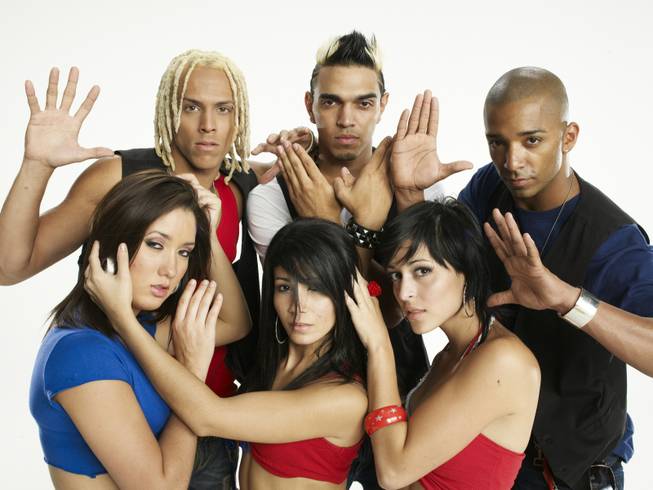
Publicity photo
AfroBorike members are, (top row from left), Josue Vega Torres, Miguel A. Reyes Santiago, Alain M. Lavalle, (bottom row from left) Elisabet Riera, Zoeth L. Cardenales-Velazquez and Veronica Collazo.
Wednesday, Sept. 9, 2009 | 4:16 p.m.
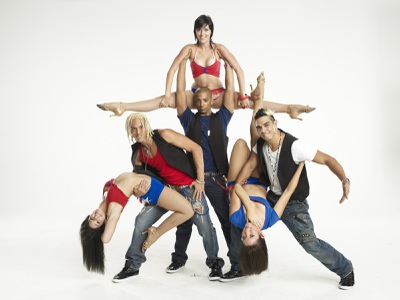
AfroBorike, a dance troupe that hails from Puerto Rico and Cuba by way of Las Vegas, has made it into the top four competition on MTV's "America's Best Dance Crew."
Sun Coverage
If you’ve tuned into the fourth season of “America’s Best Dance Crew” (Sundays, 9 p.m.) on MTV, you’ve probably noticed a crew of dancers whose pointed toes and salsa stylings look more “Dancing with the Stars” than straight off the street.
The dancers of AfroBorike hail from Puerto Rico and Cuba by way of Las Vegas, and despite bringing a distinctly Latin flavor to a show dominated by hip-hop, they’ve made it through the opening weeks of competition and into the top four.
Before they were spending their weekends performing for judges Lil’ Mama, Shane Sparks and J.C. Chasez and their weeks frantically choreographing new dances in keeping with each new challenge, the six-man crew were performers on the Las Vegas Strip and cast members in the now-defunct “Havana Nights” show and ill-fated “Raw Talent Live.”
We caught up with 22-year-old Puerto Rican dancer Veronica Collazo to hear how the competition is treating AfroBorike and where she’d like to be after the final votes are tallied.
How did the dancers of AfroBorike decide to form a crew and try out for the show?
Our choreographer and manager heard that “ABDC” was looking for a Latin crew. So, he just talked to us and told us, “You should make a crew and make a video and send it to the production.” For the beginning, I wasn’t in the plans. I moved to Miami after I left [Raw Talent Live] for 10 or 11 months. … There was another girl, but she had medical problems, so she couldn’t make it on the show. They called me on Sunday and said, “We need you.” So I said, “I’ll book a flight for next week.” And they said, “No. We need you tomorrow.”
What did you do to prepare for the show?
We wanted to bring our Latin flavor, and we’re known as the salsa crew. So, we brought a combination of salsa, but we mix it with hip-hop. We brought a little Afro-Cuban folk [style]. We’re mixing all our cultures. We’ve got five Puerto Ricans and a Cuban, so we’re mixing styles and movements from everybody.
A lot of the crews on “ABDC” do street dance and are self-taught. Are you professionally trained?
The six of us have danced forever. We studied in a dance school. We had to take dance classes every day and the normal classes every day, so everything at the same time. So we know each other, the Puerto Ricans, from a long, long time ago cause we studied at the same school.
Does it help to have gone to dance school?
It helps because every dance crew has their special thing, and I think that’s our special thing. Our thing is doing crazy tricks with our partners, and you have to have basic dance training … well, not basic, but at least some dance training. I’ve been dancing for 12, 13 years.
What has been the most surprising thing about being on the show?
Making it this far. We didn’t think about it, because we were bringing such a different style. At the beginning, people were doubting us, and now people are liking us a lot, so that is pretty much a surprise. That doesn’t mean we didn’t want to make it this far, but we thought it was going to be tough. We are really, really happy to make it to the top [four].
How hard is it to choreograph a new dance every single week?
Oh my God. We don’t have a choreographer; we don’t have a leader, so everybody is giving ideas. And it’s good - it’s how we do it – but at the same time, it’s hard … And we’re like, “Let’s try every idea, and let’s see how it works.” People get mad because we don’t do their idea. And we have to do the choreography in four days. We have to incorporate the challenge, do our style … and perform. The fifth and sixth day you have to have everything ready and perfect. We’re not sleeping, well, not enough, because we want to have it done perfect. We’re representing a lot of people here, and we don’t want to disappoint anybody.
Does working through all the challenges make you a better dancer?
For sure. This experience is getting bigger and bigger, and I’m growing as a dancer, which is what I love to do. I think this has been one of the best experiences that I’ve had as a professional dancer. This opportunity is huge, and I’m really grateful for it.
What do you want to do as crew when you leave the show?
If we win or if not, we’re going back to Vegas. We left our jobs, so I think we’re back to getting jobs. I hope this whole experience makes some gigs for us, but we have to keep moving with our lives. I hope people give us the opportunity to keep representing for all the Latin people in America. Our wish is to stay together after this and perform different places, but we have to see.
Do you think a Latin show would do well in Las Vegas?
Las Vegas definitely needs a Latin show right now. All the shows are Cirque du Soleil. They need a twist. They need a really, really good flavor. There’s heat in Vegas, and we’re heat. Latin people are hot. Vegas should have a Latin show – a really big Latin show.

Join the Discussion:
Check this out for a full explanation of our conversion to the LiveFyre commenting system and instructions on how to sign up for an account.
Full comments policy