Las Vegas Sun

February 9, 2010

Currently: 48° | Complete forecast | Log in

World Series of Poker shows new breed of poker pros

Popularity of game has led to legit card players popping up from all lines of work

Image

Steve Marcus

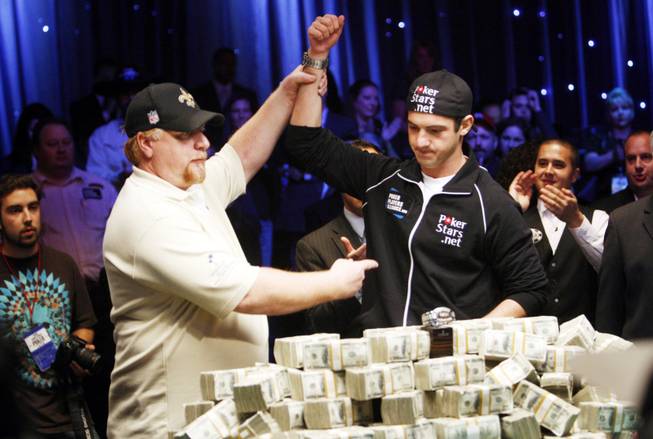
Darvin Moon, left, a 45-year-old logger from Maryland, holds up the arm of Joe Cada, a 21-year old Internet poker whiz kid from Michigan, after losing to Cada at the World Series of Poker on Nov. 10 at the Rio. Cada won $8.5 million.

Wednesday, Nov. 18, 2009 | 2 a.m.

Joe Cada wins WSOP

You need to upgrade your Flash Player

The thumbnail sketches of the two ultimate survivors at last week’s World Series of Poker final table were familiar to anyone who follows the game.

The heads-up clash pitted an Internet poker whiz kid (Joe Cada, the eventual champion) against a self-described rank amateur (runner-up Darvin Moon).

Poker players from both categories have achieved plenty of well-documented success in major tournaments.

It’s a separate archetype, though, that in recent years has drawn the attention of poker veteran Billy Baxter, for decades a respected Las Vegas professional gambler.

“The game is dominated by a new breed of poker player,” Baxter said during the windup of this year’s World Series of Poker at the Rio. “One thing I have noticed is that some of the most successful people in the world in other lines of business now become poker players.

“You see people who made a fortune in the business world and they say, ‘Now I want to play poker.’ They look at it as a great challenge.”

Certainly wealthy individuals from other fields have always tried their hand at high-stakes poker.

Poker pros used to commonly call them “producers” — though Baxter believes that somewhat derogatory term might not be accurate in characterizing members of this “new breed,” who study the finer points of the game relentlessly and have the results to show for it.

At this year’s World Series final table, two of the nine competitors — Antoine Saout and Jeff Shulman — were officially considered semiprofessionals.

Two of the three amateurs at the table, however, could belong to the category of player described by Baxter: Steven Begleiter, a principal at a private equity firm in New York City; and Kevin Schaffel, who has been playing poker for 40 years and recently closed a business he owned and operated for 30 years.

“Poker really is like a second life for many of them,” said Baxter, who has won seven World Series tournament championship bracelets. “It’s another example of how poker has finally arrived after so many years of being seen as a seedy, backroom activity.”

And even in the age of Internet poker, with high-stakes action available 24 hours a day online, “hometown champions” — as they have always been called — still make their way to Las Vegas to try to match their skills against high-rolling professionals.

It’s a trend that has continued unabated virtually since the inception of poker in the city, according to Doyle Brunson, who has won 10 World Series bracelets.

“People who want to gamble and who can afford it, they’re kind of the nucleus of the high-stakes games,” Brunson said. “Then there’s always the hometown champion who wants to come in and take a shot. Every town’s got a champion and they like to test themselves.”

How do those hometown champs fare in the big cash games with Las Vegas professionals?

“Sometimes they stick,” Brunson said, “and sometimes they don’t.”

Jack Binion, who popularized the World Series of Poker and became one of the most influential figures in tournament poker history, said the game’s cerebral and egalitarian qualities will drive its continued growth.

“The way I look at it, if you’re not out there on the golf course every day breaking par, then you know you have no chance against the best professional golfers out there,” Binion said. “Players see poker as a different kind of endeavor because it’s a mental game rather than a physical game.

“It’s viewed as a game where everybody’s got a chance.”

Discussion: 20 comments so far…

Comments are moderated by Las Vegas Sun editors. Our goal is not to limit the discussion, but rather to elevate it. Comments should be relevant and contain no abusive language. Comments that are off-topic, vulgar, profane or include personal attacks will be removed. Full comments policy.

  1. "It's viewed as a game where everybody's got a chance."

    What this really means is that after all poker is just a game of chance like any other form of gambling. Anyone can win, which also means that anyone can lose.

  2. i thought it was a game of skill

  3. It's a game of skill and luck. Cash games and tournaments are two completely different animals and require two completely different strategies. Tournaments do require some luck in a variety of ways.

    Here's some examples of "luck":

    1. Your big hands like AA, KK, and even QQ hold up when you're up against a hand like JJ, 99, or 88. You're an 80% favorite to win if all your chips go into the middle pre-flop, but the smaller pair will crack your bigger pair 50% of the time on third time this match up happens after 12 hours of play.

    2. Your have to win with AK and you have to beat an AK (usually with a pair like QQ, JJ - 22). When your AK beats a pair like QQ then you are running well or "lucky". Vice versa, when your QQ beats an AK, then you are running well or "lucky". Several tournament poker authors state that this almost always happens to a tournament champion.

    3. You have to draw out against a superior hand. The most recent example was Darvin Moon versus Phil Ivey. Ivey had AK, Moon had AQ. The queen hits on the river and Ivey is eliminated and Moon advances. Pre-flop, Ivey is a 75% favorite to win. The 25% dog made it on the end.

    4. You have to avoid all the players who play lots of hands and the true gamblers. I lost to a 7-2 of hearts in the 2003 WSOP Main Event (the Moneymaker year). I had two pair, he made a flush. When people will play any two cards and get there, it's just a deep stack strategy applied at the right time to take a player's stack. It took mine. And it still hurts.

    I consider winning with AA to be lucky nowadays. Lucky that it held up. Some people will say that you're "supposed" to win with AA. You're supposed to win with whatever is the best hand at the river. I'll take AA any day, but I'll take the winning hand any time, even if it's a 7-2 of hearts.

    Tournament poker is a game of recognizing situations as blinds & antes increase and adjusting to the looser play of your opponents as those blinds & antes increase. And tournament poker is a game of luck in the sense that your big starting hands come through when your chips are in the middle.

    There's a lot more than that, but I can only put so much up in one post.

  4. Poker Pro---what oxy-moron term is that?
    This is a joke to perpetuate the gambling.

    What you are should be called vultures not a pro.

  5. A good player might be flattered to be called a vulture. One of the basic strategies which allows you to be a consistent long term winner is to attack weak players. Just like a vulture.

    Note that I said "long term". Anyone can get lucky for an hour, an evening, or a tournament, but in the long run, the money flows from the bad players ("any two will do") to the good players.

  6. Put another way: vultures go after dead meat. Poker pros go after dead money.

  7. WSOP has been a BIG BUSINESS FOR MANY YEARS NOW. ONLINE SITES take advantage of the Moneymaker phenomenon by giving thousands of internet kids the chance to become a millionaire fast. And it's only logical: If thousands of online qualifiers get their lottery ticket for a main event seat, one of them may win, even if he/she is not so "good" in calculating odds and percentages. It's the mass of players that the true professionals just can't no longer beat. They know it, and many professionals no longer participate in that circus act.
    The bigger the number of participants, the bigger the house take. If they have 8000 players and each one of them pays 10,000 usd buy-in, that's 80 million dollars. The house gets about 8 to 10 million , and then they also cut a nice share for staff. We're only talking about the Main Event spectacle here.
    So, it's always a good plan to make it look like "the best player wins" and not to mention the luck factor. Mathematicans and statisticans can prove how much luck is needed, even if you're the best player in the world. They will probably come up with the result that it's easier for novice to win that event than for a pro...if just enough novices participate. Good luck, professionals.

  8. You're saying the luck factor never gets mentioned?

    Umm, there may be some who disagree with that statement. Like, everybody who plays in the tournament, watches the tournament, or who has anything to do with putting it on. People talk about lucky breaks and bad beats constantly.

  9. grandmacrabby, of course you're right. They talk about luck and bad luck (s.o. on the river, etc). But the point is that when you watch these puppets sitting a the tournament tables, you may get the feeling that they believe they're all Superman or PopEye playing against each other. All these Ipods, sunglasses, cool looks. Would be funny to look behind the curtain and see what they really think. So much over-estimation, "professional poker". What a joke. I played 1 single tournament last year while I was in Vegas, 170 players, the Binions Classics, in May. I ended up at the final table and thought what a great player I was. Well, I am not. I like videopoker and normally I play 1-2 and 2-5 no limit. Once in a while I try a tournament and this time I made it to the final table. You know, when they win, it's all skill, but when they lose, it's bad luck. I am sick or listening to all that. That's why I prefer listening to my Ipod music or play videopoker vor relaxation instead of being impressed by these super heroes.

    From Switzerland

  10. If somebody consistently makes a large profit playing poker over the long run, and if they support themselves by playing poker, then they're a pro. What's the big deal?

    There is luck in poker and there is skill in poker. In the long run, the most skilled players make money from the weak players. It's no big mystery.

  11. You only hear of the current heroes. they're the super heroes at the tables right now. You don't hear of the thousands of so-called pros and the ones that used to be successfull (or lucky?) and finally ended up broke because they liked their new life and thought how easy it is to make a money as a poker player. Would be interesting to find out how many Stu Ungars are grinding along and besides this collecting social security or unemployment benefits to make it ..."as a pro".

    Good luck

  12. So, this rises the following question: How much luck is needed to compensate skill, and how much skill does an unlucky player need to become a winning player? Or how about this....how much "time" (played hours, tournaments) does an unlucky, but skilled player need to come out a winner, or, how is this....how much time is needed to break a lucky , but unskilled, player and make him a loser? I am sure that there are some mathematicans among the readers who see the problem and could figure out the right formula for these questions. My money says that an unlucky but skilled player needs a huge bankroll to overcome bad days. This could take months, if not years , for him to come out a head, AS A PRO. And a lucky player who happens to win some major tournaments in a relatively short period of time, and therefore believes he's the greates player in the world, will probably be broke again within 2 or 3 years unless he masters the game from within.
    Any comments on that one?

  13. Good questions, Boris. I wouldn't try to figure out a formula because of the variables, but you could construct a model using a good poker simulation software program. Wilson software makes excellent software for most of the major forms (Hold'em, Omaha, 7 Card stud, at a variety of limit/no limit parameters). A lot of professionals are using such software right now to run hand simulations over a large number of trials to get long term expectations.

    In real life, pros expect to encounter occasional waves of cold cards and bad beats which can last for months. Every pro gets broke at some point. (Pros say that somebody "got broke" instead of "went broke", indicating that it was misfortune rather than lack of skill or money management).

    You'd really have to look at a lot of things to answer your questions. How good (or bad) is the player, what are his or her strengths and weaknesses, what kind of games does he or she play in (strength of opposition, stakes, etc).

    One of the keys to success is choosing the right games. I win consistently at NLH in 2/4 up to 5/10 games. But if I sat down in a $500/$1,000 game, the sharks would eat me alive. I do well in low buy-in tournaments, but when I play in a big one every 3 or 4 months, it's purely for entertainment or as a learning experience. The point is, a player who feels "unlucky" may just need to swallow his pride and step down to a softer game.

    As for the Stu Ungars of the world, it's the life outside of poker that breaks them. Stu could always make a big profit at poker but drugs, other forms of gambling, and general degeneracy did him in.

  14. From my point of view, the term, "professional poker player" is completely over-rated. I see a lot of retired people playing in Vegas' poker rooms. That's people I have seen for years and thus recognized their faces. Many of them are pretty solid players and just because somebody comes to play every day it doesn't mean nutting.
    I also believe that the rake factor, which has not been discussed at all, is something that could make a difference between winning and losing, ....if the remainder of the players at the table are at a certain level, skill-wise.

    A lot of professionals play in "teams". They pool their bankroll, share winnings and losses, play on a percentagewise, etc. Don't ask me please how many of these "staked pros" play dirty games with their stakers by simply dumping chips to an unknown 3rd party, or selling additional percentages of their share prior of a tournament, just to drop out before the bubble unluckily...This is another side of professional poker and nobody talks about.
    I think the luck factor of these games is so extremely high that even 6 months of daily poker do not indicate at all whether somebody is good enough to beat the game, or simply lucky.

  15. When I play poker, I study my opponents to see how they play, and how much they change it up. Every good player does that. I'd have no qualms about saying "this guy's a rank amateur" after 30 minutes at the table. For example, if somebody consistently overvalues suited cards, they're a chump, pure and simple. If somebody consistently gets married to their hand and can't make a good fold when they're beaten and the odds are against them, they're a chump, pure and simple. I don't care if they get lucky and win when they get a runner-runner flush. I know that they're going to lose it back eventually.

    Similarly, after 2 or 3 hours, I can say, "this guy is a good player." (You might think a player is solid after 30 minutes, but as T.J. Cloutier points out, many players play above their heads for 3 hours and then revert to their true ability).

    When people refer to poker pros, I don't think anybody is talking about the regulars in low limit games. We're talking about people who are playing high stakes on a daily basis, with a positive return. For example we're talking about people who multi-table in high stakes games on the internet 6 days a week (4 tables appears to be the norm these days).

    Pros do have backers and do sell shares of themselves. There are card mobs who work together, playing at the same table. But anybody who engages in chip dumping is an idiot. It's easy to prove statistically that you have a much better chance of winning big if each player plays their own stack to the end. The difference is dramatic. Anybody who dumps chips is doing everybody else a big favor.

  16. GrandmaCrabby, this looks like a personal chat room now. May I ask you these few questions, as I am quite curious to know more about the situation in L-V as it presents. Because I realize that you know what you're talking about unlike so many people who just post comments without major reasonning, your comments seem to be pretty smart and, as I see it, even accurate.

    So, I was thinking of the current situation in Vegas. High unemployment, increased possibility of crimes happening, people without job and money tend to do crazy stuff when they got nothing to lose.
    I also believe that the poker games must have turned tougher these days. Many loose goose players probably ran out of money and can't no longer play their game. What's left is a higher percentage of tougher opponents. Have you noticed anything like that?
    Do you also notice that the number of games has diminished? What poker rooms would you consider have still pretty good and loose action? For instance, the red rock poker room has a reputation of being stuffed with very good and tight players, while the Bally's may get some drunken tourists in the evenings. Have you similar experiences to tell ?

    I am planning my next trip to Vegas and therefore it would be great gathering some value info toghether so I get a grasp of where to play, and where it's better to stay away....:)

    Best wishes from Switzerland

  17. Hi Boris. Yes, you're right, this story no longer has links from the main page. I will try to answer your questions later today. Thanks for the kind words.

  18. GrandmaCrabby, I would suggest we keep this rather private. May I give you my email? You can reach me at BorisRadtke at hispeed dot ch all in one word and in the end make sure you use ch for Switzerland but not com. ok?

    I will go on a 4 weeks stay in Vegas in a few months and would be nice getting some inside info from a pro :)

    Thanks and have a great day

    Boris

  19. Hi Boris,

    I apologize, a friend of mine died this afternoon. I'm not up to a reply right now but I will email you next week.

  20. no problem, GrandmaCr., take your time and arrange all personal matters. private life is more important than the chase for the money.

    Best wishes

    Boris

Post a comment

Commenting requires registration.

Comments are moderated by Las Vegas Sun editors. Our goal is not to limit the discussion, but rather to elevate it. Comments should be relevant and contain no abusive language. Comments that are off-topic, vulgar, profane or include personal attacks will be removed. Full comments policy.

If you would like to submit your comment as a letter to the editor, you may submit it here.

Username:
Password: (Forgotten your password?)

OR Create an account (It's free)

Spotlight

Signing Day

Signing Day

Eight locals highlight first recruiting class at UNLV for new coach

Miss America

Miss America

Stories, photos and videos from this year's pageant

CES 2010

CES 2010

Full coverage of the International Consumer Electronics Show

CityCenter

CityCenter

The definitive guide to MGM Mirage's newest property

New Year's Eve

New Year's Eve

Full coverage of New Year's Eve 2009

Sights Unseen

Sights Unseen

A collection of our favorite images that didn't run in 2009

2020 Vision

2020 Vision

As a new decade begins, the Sun looks 10 years ahead

Bottoming Out

Bottoming Out

Gambling addiction in Las Vegas

Funny Face

Funny Face

Carrot Top's stage act a mask of contradictions

Renewable Energy

Renewable Energy

A detailed look at where renewable-energy sources are located in the state

A gamble in the sand

A gamble in the sand

The history of Las Vegas

Guest Gauge

Guest Gauge

The weekend crowd forecast for Las Vegas

  • Most Read
  • Discussed
  • Most E-mailed

Calendar »

  • 9 Tue
  • 10 Wed
  • 11 Thu
  • 12 Fri
  • 13 Sat