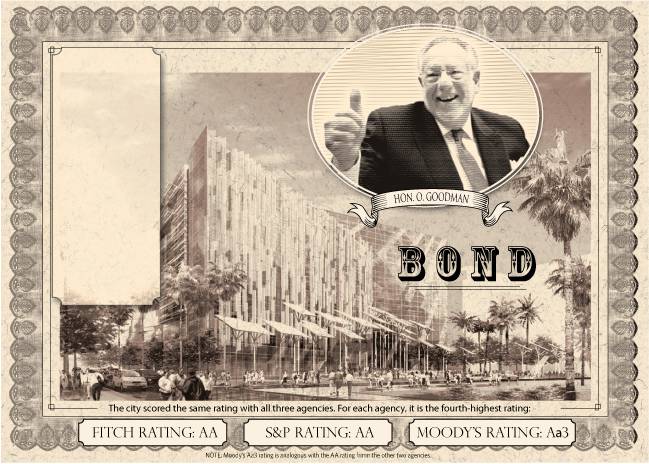
New city hall bonds have given project stimulating effect
Tuesday, Nov. 17, 2009 | 2 a.m.

Sun Archives
- Council support for mayor’s pet project might be slipping (10-18-2009)
- Old Vegas-style financing offered for city hall (7-17-2009)
- City Hall project gets support, leaders note risks (7-1-2009)
- For mayor, unusual disappointments (6-26-2009)
- Goodman: Economy could kill City Hall project (6-18-2009)
- Supreme Court sides with council in city hall battle (5-28-2009)
President Barack Obama’s federal stimulus bill might bail out Mayor Oscar Goodman’s new city hall project.
In recent weeks each of the three major rating agencies, Fitch, Moody’s and Standard & Poor’s, gave the city hall financing plan their fourth-highest rating — increasing the likelihood that the city will be able to raise the $179 million needed for the project.
The rating agencies cited the city’s plan to use stimulus-funded Build America Bonds.
“Given the state of the economy, we’re very pleased with all three credit ratings,” said Las Vegas Chief Urban Redevelopment Officer Scott Adams. They’re “very, very important” to securing an interest rate on the deal the city can actually afford, he said.
The financing plan is a “lease-purchase” arrangement, which would give the city the option of buying the building after leasing it for a period. The city would amass major long-term debt — a fact that prompted the Culinary Union to criticize the project and attempt to kill it, and which more recently has caused several council supporters to question the financing plan.
But that debt would be lowered by the city’s use of the Build America Bonds, a part of Obama’s American Recovery and Reinvestment Act designed to increase spending by state and local governments on large capital projects. The federal government pays 35 percent of the interest cost on projects funded by such bonds, allowing state and local governments to sell the bonds at rates that are competitive with corporations.
According to city officials, the subsidy would save Las Vegas as much as $82 million over 30 years.
Though the city has secured approval to borrow up to $267 million to complete the new city hall, the latest construction estimates put the project’s costs at $145 million.
Goodman and other project backers say a new city hall on the site bordered by Lewis Avenue, Clark Avenue, Main Street and First Street is integral to Las Vegas’ overall downtown redevelopment efforts — including more than $1 billion worth of projects in Symphony Park, on the site of the current City Hall and at the nearby old post office, which is being renovated into the mob museum.
The city recently signed an exclusive negotiating agreement with the Cordish Co. of Baltimore to evaluate building a sports arena, entertainment district and casino resort on the current City Hall site.
According to top officials with Forest City Enterprises, the Cleveland company developing the new city hall, the project appears to be coming together.
The Build America Bonds provide a key financial incentive. And the agreement with Cordish — which does not bind that company to proceed — gives an added push, they said.
Goodman has described the new city hall as part of a series of interlocking projects, some of which will depend on others to move forward.
Eric Louttit, Forest City’s vice president of finance, said the developer is as committed to Las Vegas as ever. That includes the scope of the project, which includes a mixed-use and office building development of the surrounding three blocks.
“At this point, we haven’t changed the plans for the other three blocks,” Louttit said. “We have a serious investment in this property. We can’t scale it back too much without getting an unacceptable return on investment.”
Louttit is in town for Wednesday’s City Council meeting, at which the new city hall financing package will be introduced.
The crucial vote on the project is slated for the following council meeting, on Dec. 2. City officials will attempt to sell the financing package earlier that morning.
If the bond sale goes through and the project is approved, Louttit said, preconstruction work, including demolishing structures on the new city hall site and removing any asbestos discovered there, could begin as soon as January. Construction is slated to take from 24 to 26 months, he said.
Louttit said he couldn’t predict whether the council ultimately would approve the deal, especially given the skepticism shown by several council members whose previous support might be wavering.
“Of course we’re concerned about it,” Louttit said. “Until we see those yeas and nays, we won’t know how it will come out. But we’re hopeful.”

Discussion: comments so far…
Comments are moderated by Las Vegas Sun editors. Our goal is not to limit the discussion, but rather to elevate it. Comments should be relevant and contain no abusive language. Comments that are off-topic, vulgar, profane or include personal attacks will be removed. Full comments policy. Additionally, we now display comments from trusted commenters by default. Those wishing to become a trusted commenter need to verify their identity or sign in with Facebook Connect to tie their Facebook account to their Las Vegas Sun account. For more on this change, read our story about how it works and why we did it.
Only trusted comments are displayed on this page. Untrusted comments have expired from this story.
No trusted comments have been posted.
Post a comment
Most Popular
- Viewed
- Discussed
- E-mailed
- Photos: Scott Disick celebrates his 29th birthday at 1 OAK in the Mirage
- HOA scandal cuts wide swath across Las Vegas Valley
- Man suffers bullet wound when stopping burglary attempt
- Photos: Surrender’s 2nd anniversary with Skrillex, ‘Le Reve,’ Paris and Floyd
- Nearly 40,000 have voted early in Clark County


If no one has looked lately, take a look at todays news which this rag doesn't publish about the disaster the Obamination Stimulus Bill is accomplishing as in using jobs saved in districts that don't even exist. Figures lie and liars figure and the whole bunch in DC are LIARS.
The city, like the State & Fed, needs to start reducing debt, not piling more on. And with all the empty office & retail space in LV, I'm skeptical they really need a new city hall. Sounds like a self-aggrandizing white elephant. (Maybe they'll put statues of Goodman, Obamao, Reid & Berkely in front?)
The Las Vegas Sun seems to only report "news" if it somehow shines favorably on the Democrats. Now, blasted on national news as we spaek is what the experts have been telling us all along, the Obama administration ha've been lying about job creation numbers. Wheres the reporting?? This paper has lost it's way.
When you or I write checks (debt instruments) against empty or overdraft accounts we are prosecuted for fraud.
When our local politicians write bonds (debt instruments) against an overdraft economy, no one faces the music except for the TAXPAYERS.
Nevada and specifically Las Vegas are in critical financial conditions.
Nevada, along with neighboring states California, Arizona and Oregon, are among the 10 most troubled states to watch, according to a Pew Center on the States analysis, "Beyond California: States in Fiscal Peril."
http://www.lasvegassun.com/news/2009/nov...
Whey would Fitch, Moody's and Standard & Poor's give these City construction bonds such a high rating? These are the very same companies that gave us AAA ratings on sound investments like CDO's and other weapons of financial destruction that caused the current crisis.
NCRC FILES COMPLAINT TO SEC AGAINST FITCH,
MOODY'S AND STANDARD & POORS
CALLS FOR INVESTIGATION OF RATING AGENCIES
http://lwvmilwaukee.org/4_7ratingagencie...
U.S. District Judge Shira Scheindlin in New York rejected the ratings firms' arguments yesterday, forcing them and Morgan Stanley, which was also sued, to respond to fraud charges in a class-action by investors claiming the raters hid the risks of securities linked to subprime mortgages.
http://www.bloomberg.com/apps/news?pid=2...
The question is why are all the local and state governments rushing to issue bonds for capital projects in the face of the worst financial crisis in human history??
Credit ratings agencies are charged with issuing the creditworthiness ratings of securities and public companies. The ratings can impact a company's ability to borrow or raise funds and determine how much mutual funds, banks, local governments, and state pension funds will pay for securities.
When home-loan delinquencies went up last year, the investments' value dropped and the credit ratings agencies were forced to downgrade the ratings they gave to thousands of securities. Large banks and investment firms sustained hundreds of billions of dollars in losses because of the downgrades.
http://www.stockbrokerfraudblog.com/cred...
Previous government investments, Bonds and Securities are loosing value daily, add that to the dwindling tax revenues and massive overhead and you have a recipe for default. Default on bonds equals BANKRUPTCY for government.
The answer to this disaster from your officials is to write MORE (bad) checks (bonds) to cover the current shortfall in order to avoid DEFAULT on existing bonds.
Imagine the number of personal and corporate bankruptcy's that could have bee avoided if we let those folks keep writing checks against overdraft accounts!
Call Oscar and Rory and tell them...NO MORE BAD CHECKS ON OUR ACCOUNT!!!
Though municipal bonds are considered safe, as in any other any investment, they have some risks. The two major risks include:
Credit risk - This occurs when a government entity issues bonds and then runs into economic and/or political problems, making its unable to pay the interest or return the principal. Bondholders can protect against credit risks to a large extent by checking the credit rating of a bond issue and/or making sure that the bond is insured.
Interest risk - Since bonds are fixed-income investments, municipal bond prices are inversely related to interest rates. Individual investors can't really do much about interest rate risks other than be aware of the fact and decide on his/her threshold for rate changes
In 1988, a study by Enhance Reinsurance Co. looked at historical patterns of municipal defaults from the 1800s to the 1980s and concluded that municipal defaults usually follow downswings in business cycles and are also more likely to occur in high growth areas that borrow heavily.
Investors rely on credit ratings, which indicate the probability of default. A high credit rating indicates a low probability of default and vice versa. Both municipal bonds and corporate bonds are rated by rating agencies that specialize in evaluating credit quality.
As the cases described in this section illustrate, there is no clean formula that determines who is accountable and who will bear the financial burden in case of a default. The outcome depends on circumstances and usually involves a litany of lawsuits. If payment is not resumed or covered by bond insurance, investors are, in some cases, able to recover their money through litigation, which can involve the entire range of actors, from the issuer to the bond counsel to the underwriters. What seems to be true is that, in most cases, none of the parties assume responsibility and are quick to blame someone else in the chain.
http://www.publicbonds.org/public_fin/de...
I think we should make do with what we have. There is no reason to abandon or tear down the city hall we have. Its only about 40 years old. Lots of cities on the east cost have city hall that is over 100 years old.
$479 per square foot? Anyone see a problem with this?
Three federal agencies and a loose consortium of state attorneys general have for several years been gathering evidence of what appears to be collusion among the banks and other companies that have helped state and local governments take approximately $400 billion worth of municipal notes and bonds to market each year.
E-mail messages, taped phone conversations and other court documents suggest that companies did not engage in open competition for this lucrative business, but secretly divided it among themselves, imposing layers of excess cost on local governments, violating the federal rules for tax-exempt bonds and making questionable payments and campaign contributions to local officials who could steer them business. In some cases, they created exotic financial structures that blew up.
http://www.nytimes.com/2009/01/09/busine...
NOVEMBER 17, 2009
WASHINGTON (Dow Jones)--The Obama administration announced Tuesday the formation of an inter agency task force to combat financial fraud.
"This task force's mission is not just to hold accountable those who helped bring about the financial meltdown, but to prevent another meltdown from occurring," said U.S. Attorney General Eric Holder, who will lead the effort.
http://online.wsj.com/article/BT-CO-2009...
Well said Mrxrox8.
When President Bush Sr. initially invaded Iraq he called out to the citizens of Iraq to take over their tyrant government -- perhaps the same call could have been a local one?
: {
HOW, AND I DO MEAN HOW
DID THEY GET RATED SO HIGH
BY FITCH, MOODY'S, AND S&P
WHEN THIS CITY IS NEARLY TOTALLY
BROKE...?
(2004-2009 Mortgage Loan Industry, anyone...?)