Saturday, Nov. 14, 2009 | 2 a.m.

Education Secretary Arne Duncan talks about education reform during a speech at the National Press Club in Washington on May 29. Duncan plans to give $4.35 billion to states that use the most innovation in the first round of stimulus spending, and officials here are concerned that Nevada will miss out because of its conservative spending.
Sun Coverage
It’s official: Nevada has been shut out of the “Race to the Top,” a federal grant program offering $4.35 billion to improve the nation’s public schools.
Keith Rheault, Nevada’s superintendent of public instruction, said Thursday “it’s looking pretty hopeless ... they won’t even let us come to the starting line.”
To compete for the grants, states must, among other qualifying criteria, allow the use of student test scores in the evaluation of their teachers. During a special legislative session in 2003, Nevada lawmakers passed a last-minute bill that explicitly prohibited using test data in teacher evaluations.
In a telephone conference call with reporters Thursday to discuss the program, U.S. Education Secretary Arne Duncan said he’s waiting to hear from Nevada’s attorney general as to the Silver State’s eligibility. If the statute were to be changed during a special legislative session, Nevada might qualify for a second round of grant awards.
But as far as the first — and largest — batch of grants go, Duncan said it’s no longer a question of “who’s eligible, but who’s going to win.”
There is good news: Nevada could still win millions of dollars from another federal program to help turn around its worst-performing schools, and $650 million is available for school districts that team up with outside organizations on innovative initiatives. Rheault said his staff is working on those applications.
Like Nevada, California didn’t allow test scores to be used in teacher evaluations, but the Golden State’s Legislature voted last month to change the law to qualify for the “Race to the Top.”
The potential funding is determined by the size of the state’s student population: California, Texas, New York and Florida are each eligible for $350 million to $700 million. Nevada would have been eligible for $60 million to $175 million, based on the U.S. Education Department’s projections for the first round of grant awards.
• • •
The news Wednesday that budget cuts and layoffs had nearly tripled the size of the backlog of work orders for the Clark County School District’s maintenance department prompted Sun readers to offer suggestions.
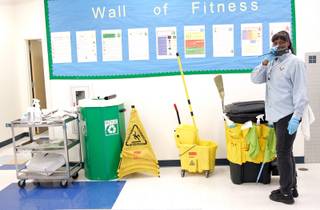
Among them: Why doesn’t the School District ask for volunteer help from the construction industry that profited so richly from building campuses during the boom years? (To be sure, campuses have benefited over the years from the largesse of homebuilders and contractors, who have helped with repainting exteriors, installing landscaping and other beautification projects.)
Others wondered whether the district should retain an efficiency expert to make sure it was following best practices.
In fact, the facilities division — which oversees the maintenance department — is trying new approaches to boost efficiency, including creating small teams of workers to be responsible for a set group of schools in particular geographic areas. The long-term goal is to have four service areas, each with its own warehouse, within the next 10 years.
In the meantime, maintenance workers are assigned laptops and cell phones to better track work orders and cut down on the paperwork for the central office.
• • •
While other schools bemoan custodial cutbacks, Spring Valley High School Principal Bob Gerye is adjusting to the loss of block scheduling, which the district eliminated to save $11 million.
Because students are now limited to the traditional schedule of six classes, instead of a rotating block of eight that left more room for electives, Gerye had to give up 18 teachers.
“I’d clean the school myself if we could have block scheduling back,” Gerye said. “And you can quote me on that.”



Yes, by all means hire another 6 figure consultant to determine if the facilities department is doing its job efficiently...wonderful thinking!
Maybe Principal Bob Gerye, quoted above, should indeed spend some of his time cleaning classrooms...he makes enough money as a principal to do just that. Maybe all of administrative assistants, consultants, specialists and other comrades from the head sheds should join him...they can afford to do it, because all most of them do is shuffle papers and create make-work nonsense projects for teachers anyway.
If a school district is primarily turning out dropouts who end up parking cars and delivering pizzas, is this the teachers fault?
The CCEA says they might, might endorse testing of teacher qualifications, but what happens if 20% of them turn out to be certified dumbbells? Do they just carry on trying to herd their cats in the classrooms?
The bigger the school district, the worse the results. We all know this, but CCSD just lumbers along, in a permanent fog. Just like their students. Sad...
In 2003, the Nevada Teachers Union successfully pushed for a last-minute bill that explicitly prohibited using test data in teacher evaluations.
Now those same teachers are complaining that they are being shut out of the federal grant program for the country's schools.
Teachers: You brought this on yourselves.
Lesson learned: Teachers, be careful what you wish for. (And be careful what you push the Nevada Legislature to vote for.)
4th largest school district in America.
Monopoly.
Break up the colossal district!
Ask each and every person who is running for State elected office if they will sponsor and vote for a law in Nevada to limit the size of school districts to 100,000 students (still very large).
Thank you to the teachers union. Shut out the funds and keep your power. What a joke.
Student's test scores are the main spring to evaluating teachers. The athletic department is evaulated on the number of games won or the number of races won in track or the number of gymnist that place first in their classes on the horse.
The evaulation of teachers by questionnaires hardly evaulates the results the student expected from the teacher and the class.
Questions of questionnaires can be skewed to favor the teacher regardless of the test scores.
So much for having friends in high places, i.e. Harry Reid.
Star,
"Student's test scores are the main spring to evaluating teachers. The athletic department is evaluated on the number of games won or the number of races won in track or the number of gymnast that place first in their classes on the horse."
Coaches get to pick their players, as a teacher I don't have that luxury. There needs to be a more holistic approach to evaluating us. I think there does need to be more critical evaluations, but I think the vast majority of the public does not realize how one unruly child can completely destroy a classroom. We can send then to the principal, but they are there the next day. WE DONT RAISE THESE KIDS, YOU ALL DO. The teachers in Summerlin are not different than the teachers at schools on Fremont, but their test scores are better, any guess why?
"creating small teams of workers to be responsible for a set group of schools in particular geographic areas. The long-term goal is to have four service areas, each with its own warehouse..."
I am not sure that this is going to be a cost saving idea. First we will have to create 4 warehouses instead of the one that we already have. That is new property/buildings to rent or build, more utilities to pay for, etc. Each of the 4 areas will probably have some type of head administrator, and assistant, and their own office staff. There will also probably be one person over this entire area in the district; they will probably have at least one or two assistants and a large office staff. This seems like it will add to our administrator "top heavy" district.
Why doesn't the Star mention the other hurdle that makes Nevada ineligible for the race to the top funds: Schools MUST BE FUNDED AT 2006 LEVELS. Let's see the "No Taxes" bunch wrap their heads around that "minor detail."
But, we can make it real simple; change the law so teachers have the right to strike, and they will accept the test scores as part of their evaluation.
OK, same logic applied to what bouncyhair said. If we break up the school district, having 100,000 kids in each will still result in very large bureaucracies. They should be made into districts of around 20,000. Now, think about the result. We will have 16 to 20 districts, all with school board, a superintendent, and the requisite staffs. How much will that cost. As for maintenance; get rid of the vertical integration, and farm it out to local small business. This will save money. My school has 13 year old carpet that has had 850 kids or more running round on it for that same 13 years. It looks like s#*t! However, we are told we will have to wait another 6 years to replace it. How long does the carpet last in the average house?