Las Vegas Sun

February 9, 2010

Currently: 47° | Complete forecast | Log in

Wood: Not the renewable energy some had in mind

State requirement prompts experimental mixing with coal

Image

Sam Morris

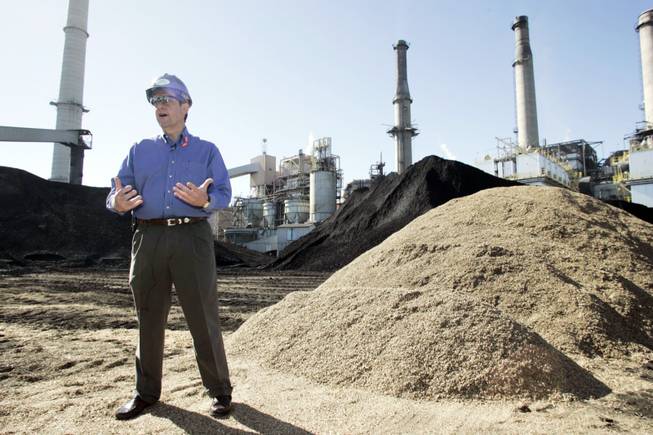
NV Energy project manager David Sims shows some of the 750 tons of waste wood that will be burned with coal in the 30-day test.

Monday, Nov. 9, 2009 | 2 a.m.

NV Energy Tests Wood

NV Energy is testing out a new source of renewable energy: wood. The wood comes from trees that were cut for fire control in an Arizona national forest, and burning it emits less harmful sulfur into the environment than the coal that is traditionally burned.
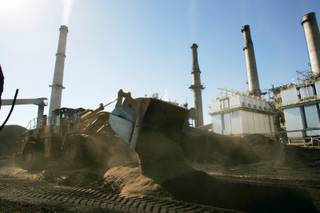
Wood-coal mix

You need to upgrade your Flash Player

Sun Coverage

Beyond the Sun

When people talk about renewable energy, many mean the latest in clean-energy technology, not a fuel that was pioneered by cavemen.

But for NV Energy, what’s old is new again.

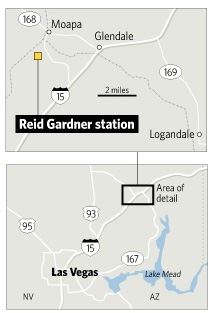
At the Reid Gardner coal plant about 50 miles northeast of Las Vegas, the utility last month began mixing wood chips with the coal burned to produce electricity at the plant.

If it works the way the company hopes, NV Energy intends to use the wood-coal mix to qualify the power plant for a bit of renewable energy credit, another step toward meeting the state’s mandates for increasing the use of renewable energy.

That’s right, NV Energy may have a coal plant classified as producing at least some of its energy from a renewable source — biomass fuel. Biomass is biological material derived from living or recently living organisms. That includes organic garbage, alcohol fuels and wood.

The state renewable energy portfolio standard — NV Energy must produce 25 percent of its electricity using renewable resources and energy efficiency measures by 2025 — allows the use of biomass to generate electricity. But state lawmakers said they hadn’t intended that to mean burning wood in coal plants.

“I don’t think we contemplated it this way,” said Randolph Townsend, the senior GOP state lawmaker on renewable energy issues. “We’d prefer it was just a biomass capacity, not mixed with something that’s not renewable. That defeats the purpose, which is to encourage and incentivize renewable activity.”

But that was about as critical of the NV Energy plan as the Washoe County Republican was willing to get. Townsend said he figures this is a more environmentally friendly way to use the coal plant until clean renewable energy becomes more economically feasible.

And some environmentalists agree — as long as this is just a stopgap.

“While this might be a workable step, we really need to keep our eyes on the prize of clean, renewable energy that we have a lot of here in Nevada,” said Launce Rake, spokesman for the Progressive Leadership Alliance of Nevada.

Burning biomass of nearly any form could reduce a coal plant’s greenhouse gas emission by up to 25 percent — but a coal plant is still a coal plant, he noted.

“One concern I know a lot of people have is: Does this just extend the life span of coal? It’s not ‘clean,’ even if you clean it up a little.”

NV Energy never intended wood burning to be an environmental measure, said David Sims, the utility’s director of project development. The wood chips are expected to have only a small effect on emissions.

“We were led by a desire to meet the renewable mandate,” Sims said. “Our primary purpose was to demonstrate a low-cost renewable energy.”

Although wood char has been incorporated into American coal plants for several years, feeding raw wood into the furnaces is relatively new. NV Energy got a permit from the state Environmental Protection Division to burn the blend for 30 days to see how it affects emissions and whether the plant would need to be modified to make the most efficient use of the fuel blend. The company also wants to see how much wood it can incorporate into the mix without decreasing generating capacity. The test began Oct. 19.

“We’re going to evaluate everything — the efficiency of the fuel, emissions, the cost per kilowatt hour and the cost per ton of wood material,” Sims said. “Once all those numbers are crunched we’ll be able to determine if this is a program we want to continue.”

So far, the company has determined that, to avoid clogging the plant, the wood chips need to be chopped into much smaller pieces than the half-inch bits that arrived. The utility contracted with the Moapa Paiutes, who have a wood pulverizer on their tribal land near Reid Gardner, to do the work. And so far the plant has been able to effectively burn a wood-coal mix with 5 percent raw wood. Sims said that might be the highest amount of raw wood that could be used.

Because of that the company doesn’t expect that incorporating wood into the coal plant will produce enough renewable energy to meet the state portfolio standard. But if the company can do it in a cost-efficient way, it would be foolish to pass up the opportunity, Sims said.

“We’re looking at this because we need to meet that portfolio standard,” Sims said. “We could build a biomass plant, but that would be expensive and the cost would be passed on to ratepayers ... We’re trying to make the best use of the materials and facilities we have at hand.”

But isn’t this process burning up trees that would otherwise convert carbon dioxide back to oxygen for us?

Well, the 750 tons of wood chips that will be used in the test project come from a section of Northern Arizona’s Kaibab National Forest that fire swept through three years ago. The burn zone is being cleaned by a number of small contractors organized through the nonprofit Rural Life Foundation Stewardship Center, based in Utah.

Contractors mill and sell what they can as lumber, and the scrap is chopped up into half-inch pieces and sold to mulch producers and power plants such as Reid Gardner to be burned as fuel.

There are many uses for waste wood gathered in national forests and on private land, but with all the forest fires, projects to eradicate invasive species, and new transmission lines being built in the West, there is plenty of waste wood to go around. If companies can’t find a buyer, the scrap is often burned on site.

That’s worse for the environment and air quality than trucking it 150 miles to Moapa and burning it in the coal plant.

There, the facility’s scrubbers and filters remove much of the particulates and other air pollutants before they make their way into the atmosphere. The test at the Moapa area plant should determine exactly how much pollution is released, but Sims said the company expects it will be much less than burning the wood in the open or letting it decompose, which would release methane, which traps more heat in the atmosphere than carbon dioxide does.

Discussion: 11 comments so far…

Comments are moderated by Las Vegas Sun editors. Our goal is not to limit the discussion, but rather to elevate it. Comments should be relevant and contain no abusive language. Comments that are off-topic, vulgar, profane or include personal attacks will be removed. Full comments policy.

  1. There is a wood fired power plant outside of Susanville CA, up by Reno. Students at the susanville Community college can get a degree related to its operation, I think it might be closed though.

  2. Looks like (according to ecoseed.org) these biomass plants and wood fired plants are making a comback, Thailand, Snowflake AZ, New England. The plant in Susanville was shut down, don't know if it was reopened. We could burn the mussles.

  3. Don't you worry everybody. Obamas Clean Coal coalition will see to it we have access to all the clean coal we need for all our future energy needs.

    LOL

  4. Um"along with wood, the sun, water and wind have also been energy sources for thousands of years.

    It's too bad the left poo poos better alternatives like nuclear.

    And yes, trees are renewable"

  5. Sweden have had these types of plants, CHP plants for decades. The first was built in the 50s, with the idea of using household waste, sawmill waste and forest waste as fuel. The idea was to rid themselves of fossil fuels which were widely used as fuel. Today, these CHP plants are across the nation, and almost every city town or large village has them. The fuel used is the same, renewables, ie wood chips, sawdust and industrial waste, and for the past several years, all household waste is incinerated to provide hot water, heating water and electricty, and now, more than 50% of the nations homes and industries get their supplies from these plants.

    Emissions from these plants are extremely low, approx 40lbs CO2/Mwh, compared with fossil fuel plants which range from 1300Lbs CO2/Mwh upwards to 4000lbs CO2/Mwh on the older coal powered plants

  6. "I don't think we contemplated it this way," said Randolph Townsend, the senior GOP state lawmaker on renewable energy issues." Such a grasp of the issue is hardly re-assuring. Makes one wonder what else they didn't think through...

  7. This is the problem with the liberal types and especially the legislation designed to appease the enviro-whack jobs they serve.

    This Plant burns anthracite coal which has has twice the "heat release" than regular coal. Inserting wood into the mix (same heat release as regular coal) reduces its efficiency by half; therefore, you need more coal.

    The stupidity of the liberal mindset is boggling and yet the sheeple have spoken.

    These are the loopholes of legislation, no wonder nobody believes the government anymore.

    Udde, this is not a garbage incinerator gone wrong, this is a coal fired plant. The lefties are poisoning minds. What's next, loopholes in the government health plan?

    Who would have thunk???

  8. Proving again,that wind and solar are not enough to satisfy the obese energy diet of the average American. LOL! This is the green economy you all fighted for! An economy that insures more coal burning by giving them tax breaks and accelerates climate change! The Sun should be proud how their politiking will increase greenhouse gas! How does it feel to get screwed by the democrats?

  9. Burning forests for electricity is nothing short of insanity. The reason this is happening is MONEY: huge rate payer and taxpayer subsidies for "biomass" which is supposed to be "clean and green." It is neither. While it is "renewable" because trees grow back, biomass burning emits more CO2 per megawatt hour than burning coal, emits particulates and NOx which cause cancer, asthma and heart disease. This is not "clean energy" but dirty energy and not a solution to climate change but a problem.

    There is a growing backlash against the greenwashing of biomass incinerators.

    When we are being told to "save the rainforest" how can it make sense to burn our forests for a few megawatts?

    Check out:
    www.stopspewingcarbon.org
    www.nobiomassburning.org
    www.massenvironmentalenergy.org

    Biomass burning is a scam being foisted on the American people: we are paying for dirty incinerators that poison our families.

  10. We should of used our garbage to be burned in powerplants years ago. Or there wouldn't be the Sunrise Landfill that is polluting Las Vegas Wash. We should also start logging again, they replanted 10 trees for the ones that was cut down and removing all that fire causing underbrush. Has anyone notice that since logging stopped, there has been more wildfires and no access to fight all those fires? We should all wake up and tax new logging industries, but let them sell all the underbrush for those nice power plants to burn.

  11. Megsheehan said

    ""While it is "renewable" because trees grow back, biomass burning emits more CO2 per megawatt hour than burning coal, emits particulates and NOx which cause cancer, asthma and heart disease""

    You are 100% wrong with that quote, most likely you read it in a handbook given out by the fossil fuel companies,
    Sweden have 100s of biofuel plants, and emissions from these plants are extremely low, approx 40lbs CO2/Mwh, compared with fossil fuel plants which range from 1300Lbs CO2/Mwh upwards to 4000lbs CO2/Mwh on the older coal powered plants.
    Dioxins from all of these plants is only 0.7 grams a year.

Post a comment

Commenting requires registration.

Comments are moderated by Las Vegas Sun editors. Our goal is not to limit the discussion, but rather to elevate it. Comments should be relevant and contain no abusive language. Comments that are off-topic, vulgar, profane or include personal attacks will be removed. Full comments policy.

If you would like to submit your comment as a letter to the editor, you may submit it here.

Username:
Password: (Forgotten your password?)

OR Create an account (It's free)

Spotlight

Signing Day

Signing Day

Eight locals highlight first recruiting class at UNLV for new coach

Miss America

Miss America

Stories, photos and videos from this year's pageant

CES 2010

CES 2010

Full coverage of the International Consumer Electronics Show

CityCenter

CityCenter

The definitive guide to MGM Mirage's newest property

New Year's Eve

New Year's Eve

Full coverage of New Year's Eve 2009

Sights Unseen

Sights Unseen

A collection of our favorite images that didn't run in 2009

2020 Vision

2020 Vision

As a new decade begins, the Sun looks 10 years ahead

Bottoming Out

Bottoming Out

Gambling addiction in Las Vegas

Funny Face

Funny Face

Carrot Top's stage act a mask of contradictions

Renewable Energy

Renewable Energy

A detailed look at where renewable-energy sources are located in the state

A gamble in the sand

A gamble in the sand

The history of Las Vegas

Guest Gauge

Guest Gauge

The weekend crowd forecast for Las Vegas

  • Most Read
  • Discussed
  • Most E-mailed

Calendar »

  • 9 Tue
  • 10 Wed
  • 11 Thu
  • 12 Fri
  • 13 Sat