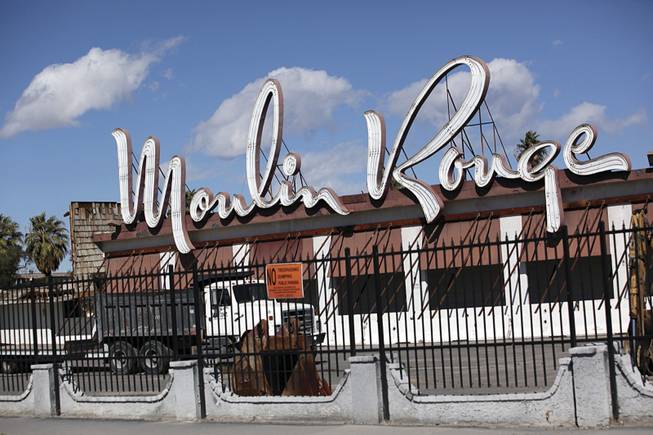
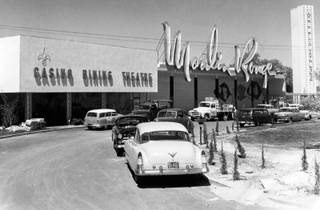
The Moulin Rouge, the first integrated hotel and casino in Las Vegas, lasted six months before closing down in 1955. Five years later it was the site of an accord to desegregate the Strip.
Thursday, March 12, 2009 | 2 a.m.
Sun Archives
- Beleaguered Moulin Rouge lives to fight another day (3-11-2009)
- Once again, a plan for renewing the Moulin Rouge (2-25-2008)
- Low-income residents pushed closer to streets (9-14-2006)
- Historic casino faces challenges (5-27-2005)
- Moulin Rouge revival planned (1-29-2004)
- Blaze is latest chapter in hotel's storied history (5-29-2003)
Historical stories
- Moulin Rouge staff features 'big names' (5-25-1955)
- Nearly finished resort hotel damaged by fire (4-7-1955)
Katherine Duncan remembers answering the phone at 1:30 in the morning on May 29, 2003; the voice on the other end told her the remains of the Moulin Rouge were ablaze. As property manager for the company that owned the former casino at the time, Duncan rushed over to the Bonanza Road site and watched firefighters beat back flames curling over the elaborate script of the Moulin Rouge marquee.
She had invested more than a decade in keeping the memory of the place alive, part of the time as president of a group whose Web site called the property “one of the most significant sites in American civil rights history.”
Though some might debate that characterization, the hotel, which opened in May 1955 and closed by year’s end, was the first business in Las Vegas where blacks and whites could party together. It is the only Nevada listing on the National Register of Historic Places linked to the history of race relations in the valley.
After the fire, the most visible reminder of all that is the cursive sign atop a propped-up wall.
Plans for reviving the resort have been redrawn at least four times in the past five years, but rubble and trash are what mostly remain.
Recent events raise the question, yet again, of the Moulin Rouge’s place in today’s Las Vegas:
• Since late September city inspectors began citing the current owner, Moulin Rouge Properties LLC, for allowing much of the 15-acre site to deteriorate, creating unsafe conditions;
• In December a North Carolina publisher released the first academic book on the subject: “The Moulin Rouge and Black Rights in Las Vegas,” by College of Southern Nevada professor Earnest N. Bracey; and
• On Feb. 5 the owner filed for Chapter 11 bankruptcy protection, pointing to $39.5 million in debt.
The owner also recently promised the city it would move the sign to the lot where the yet-to-be-built Neon Museum stores signs for future display.
For Duncan, this may have ended what she describes as years of beating her head against a series of owners, trying to convince them their plans should include a museum.
“If you move the sign, you take away the symbol from the site,” she says.
It gives her hope that the symbol may someday be used to “explain to the community: Why did we have to have a Moulin Rouge in the first place?”
In other words, the sign could be an educational tool, a chance to explain to the valley’s millions, many of whom are from elsewhere, not to mention the many more tourists, how the Strip remained segregated until 1960, when casino owners and others, including Las Vegas Sun founder Hank Greenspun, agreed to end the practice. That sit-down happened at the Moulin Rouge, by then shuttered.
Removing the sign also could remove the site’s historical considerations from the hands of the property owners.
As Bracey pointed out in a recent interview, the Moulin Rouge wasn’t “necessarily built for symbolism.” It was built as a business. For reasons still not fully understood, it failed as a business. For five decades since then, a series of owners has been unable to rebuild.
Some observers, including Bracey, suggest “the community” should get behind preserving the site. But no one has come forward to promote that idea.
Preservation of the sign, on the other hand, gets plenty of interest. A Moulin Rouge spokesman, in his only comments for this story, said the owners want the sign back whenever the site finally gets rebuilt.
So the question of how and where we remember local black history — and a place that has come to symbolize steps forward in race relations — will doubtless be raised anew.

Join the Discussion:
Check this out for a full explanation of our conversion to the LiveFyre commenting system and instructions on how to sign up for an account.
Full comments policy