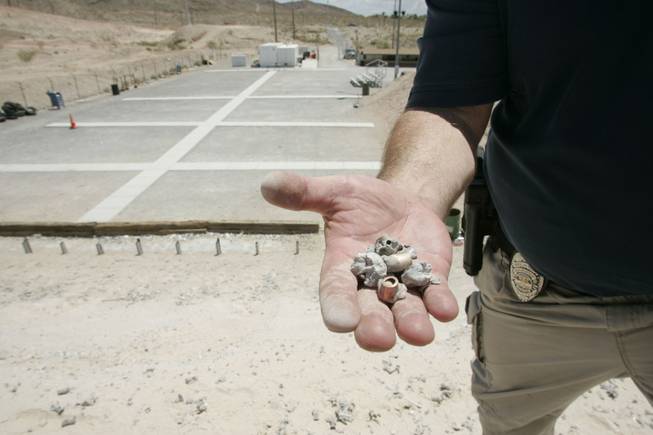
North Las Vegas shooting instructor Mark Bender holds a handful of lead picked up off a berm at the North Las Vegas Police Department’s shooting range Wednesday, June 24, 2009.
Saturday, June 27, 2009 | 2 a.m.
Beyond the Sun
North Las Vegas Police have pumped about 2 million bullets into their firing range over the past 30 years — that’s the conservative estimate.
Next month, a Colorado company will remove and recycle most of that spent lead, sifting through the sand for three decades’ bullets, shotgun pellets and rifle rounds.
It’s 100,000 pounds of metal, the company estimates. It’ll take about two weeks to remove, one 55-gallon drum at a time, at a cost of $91,700 to the city.
The police department isn’t obligated to remediate the range, but spokesman Tim Bedwell is an example of why it wants to: He has been hit with “splashback.”
Splashback is what it sounds like — rounds that, shot into a range pumped full of bullets, ricochet off lead left behind and send metal fragments back at the shooter. The more bullets you shoot, the more likely the splashback.
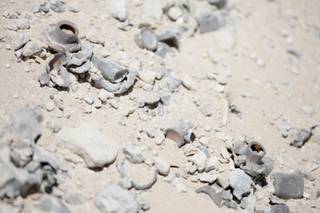
After years of shooting, the berm, a mound of dirt piled behind range targets to catch bullets, is “pretty much saturated with lead,” Bedwell said.
This gets at the department’s other rationale for having the range cleaned: “We are really trying to be good stewards of that land,” Bedwell said.
Though it’s not mandatory, the Environmental Protective Agency has a best practices manual for lead management at gun ranges; guidelines that advocate collecting and recycling lead. The concern is that lead, which can be toxic, could leach into ground water or inadvertently be eaten by birds — though the range, located at the far end of East Carey road, where pavement turns into gravel going up Sunrise Mountain, looks like it hasn’t seen water, or animals, for some time.
Four percent of all the lead produced in the United States in the late ’90s was made into bullets or shotgun pellets, according to the most recent EPA estimates — that’s roughly 160,000 pounds of bullets and shot made every year, a good percentage of which ends up at firing ranges.
The idea that gun ranges should be mined for used metals is still catching on. Because the cleanup is voluntary, police departments must be motivated to do it, spurred by either the splashback risk or the environmental concern or both.
Last year, Metal Treatment Technologies, the Colorado company contracted to tackle the North Las Vegas range, cleaned 25 ranges across the country and recovered more than 5 million pounds of lead from the ground in the process.
The company’s CEO, James Barthel, estimates that the nation’s 10,000 or so shooting ranges contain a 15-year supply of lead just waiting to be removed and recycled. Collecting this lead isn’t just environmentally sound, Barthel says, but a step toward alleviating nationwide bullet shortages.
In recent years, news reports have regularly popped up about police departments having a hard time buying enough ammunition. Part of the problem is troops fighting in Afghanistan and Iraq, battlefields the Associated Press reported consume more than 1 billion U.S. bullets annually. At the same time, China’s and other countries’ demands for metals such as lead and copper have pinched stateside supplies.
Although Bedwell says North Las Vegas Police have not had any difficulties acquiring enough ammunition, a few departments surveyed by the Associated Press in 2007 reported they were facing long delays for ammunition orders.
If market prices hold, the bullet lead will sell as scrap for about 30 cents a pound, Barthel said. Shotgun shot is worth a bit more — 50 cents a pound. The proceeds will be divvied up between the company the city, which is paying for the cleanup with money set aside for gun range rehab.
Recycled bullets will likely become bullets again, Barthel said.
Every police officer must pass an annual firearms exam to remain qualified to carry duty weapons, though many officers practice more than once a year because it’s a skill they care about honing, Bedwell said.
Using rough calculations, he figures that officers fire about 65,000 rounds a year at the North Las Vegas range, which is next to Metro’s gun range. Metro’s range has been mined for expired bullets a few times, spokesman Jay Rivera said, and is set to be cleaned again in the next few months.
Barthel’s process is a proprietary one, but he is willing to put it in simple terms — heavy construction equipment is brought to the gun range, where dirt is pushed through a screening system. After the bullets and lead fragments are removed, they’re put through a pneumatic system that blasts clumps of remaining dirt off the metal so it’s clean for recycling.
Although Barthel says his company can remove anywhere from 80 to 95 percent of lead from the ground, there are bits that can’t be cleaned up — these remainders are treated with a product that chemically converts the metal into a material that does not leach into the earth, Barthel said.
And once that’s done, North Las Vegas Police will, of course, start loading the berm with lead all over again.
Abigail Goldman can be reached at 259-8806 or at [email protected].

Join the Discussion:
Check this out for a full explanation of our conversion to the LiveFyre commenting system and instructions on how to sign up for an account.
Full comments policy