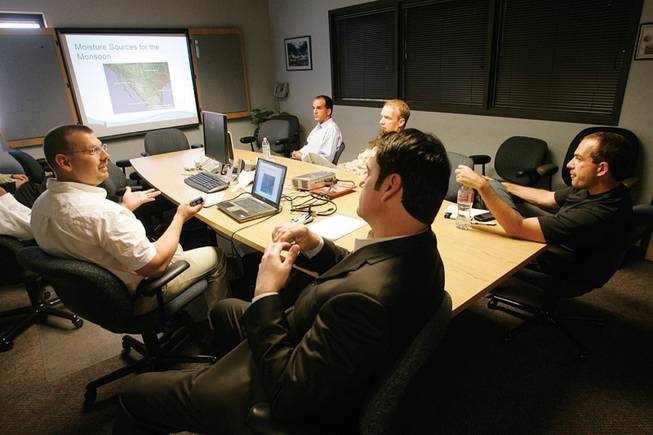
SAM MORRIS / LAS VEGAS SUN
National Weather Service meterologist in charge Michael Staudenmaier, far left, leads a briefing for Las Vegas’ television meteorologists Wednesday. Clockwise from Staudenmaier are Kevin Janison, Les Krifaton, Ted Pretty and Bryan Scofield.
Friday, June 5, 2009 | 2 a.m.
Sun weather coverage
Let’s get it right this year. A monsoon is not a storm. It’s a season.
This was the plea that Michael Staudenmaier made to the assembled television weathermen of Las Vegas last month. Staudenmaier is the meteorologist in charge of the local National Weather Service office, a concrete-block bunker, the interior of which is a cross between an insurance office and NORAD missile control. The office, like its counterparts across the country, provides most of the serious weather data and forecasting for the valley — measurements, analysis, 24-hour monitoring. When your local weatherman speaks in front of a mind-bogglingly lush and expensive display of computer graphics, chances are that he’s hewing to the weather service’s line.
And here, in this friendly little meeting complete with home-baked cookies, Staudenmaier is asking the weathermen to please not addle the public mind by issuing “monsoon alerts” for every summer storm. Because that’s not what a monsoon is. It’s a seasonal wind shift.
Here’s how it works:
Starting in late May or early June, the sun warms up the deserts in northwestern Mexico and the southwestern United States. The air gets so hot and excited that it can’t wait to go share its energy with the cold upper atmosphere. This rising air lowers the air pressure above the desert, creating a bit of a vacuum, especially compared with the colder air over the ocean (the ocean does not get nearly so excited about the summer). Because nature always balances its forces, the cold high-pressure air from the ocean wants to blow into the desert. When it comes, it brings water with it.
But there’s a problem: At the same time all of this is going on, a ridge of high-pressure air sets up shop in Mexico. In June, this ridge mostly blocks moisture from flowing north from the Gulf of California and Gulf of Mexico. By mid-July, however, this ridge migrates north into the United States, where it bums around New Mexico and the four corners area. The farther north it gets, the more it allows moist air out of the gulfs into Southern Nevada — hence the humidity that sets your air conditioner intermittently wheezing through the end of September.
Now, when that air of the gulfs is especially moist, it’ll bump up against our mountains and condense into thunderheads as improbably high and menacing as the mold in a bachelor’s jar of olives.
In the late afternoon or early evening, the now-saturated clouds burst: lightning, sudden downpours, howling winds and sometimes hail. Roads flood, cars crash and every now and then, a person is swept down a wash and drowns.
On the upside, it cools Las Vegas to slightly below the surface temperature of Mercury.
But remember: This is a thunderstorm, not a monsoon. The monsoon is a seasonal weather pattern. The word is derived, Staudenmaier says, from the Arabic “mausim,” which means season.
Saying “Expect monsoons late this afternoon” is like saying “Expect summers late this afternoon.”
So please, let’s keep it straight on TV this year.
And feel free to take some cookies with you.

Join the Discussion:
Check this out for a full explanation of our conversion to the LiveFyre commenting system and instructions on how to sign up for an account.
Full comments policy