Senior Airman Brian Ybarbo / U.S. Air Force
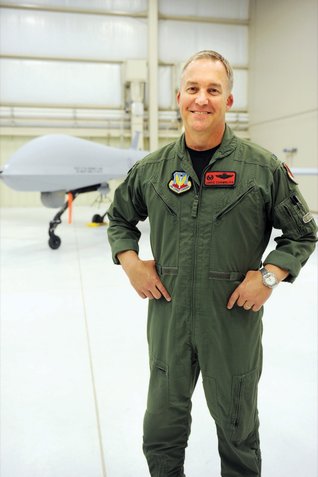
Col. Chris Chambliss has commanded a unit that operates Predator (shown) and Reaper drones.
Monday, June 1, 2009 | 2 a.m.
Sun Coverage
Sun Archives
- Indian Springs will host drone projects (3-17-2005)
- Air Force chief sees bigger role for Indian Springs (3-10-2005)
After two years as the first commander of the Air Force’s only dedicated unmanned aircraft wing, Col. Chris Chambliss hands over the reins today in a typical rotation of command. The wing at Creech Air Force Base flies the Predator and Reaper drones in Iraq and Afghanistan.
How has the mission evolved?
The Air Force has come to recognize the Predator and Reaper are game changers. We’ve almost tripled the size of our operation in both people and capability — and much faster than we had planned. We thought by 2010 we’d have 21 unmanned aircraft airborne at any given moment. We’re already at 35. To keep up, we’ve had to mobilize Air National Guard units and freeze transfers. Nobody leaves here. We’ve also doubled the number of launch sites in Iraq and Afghanistan.
Has this mission permanently changed the Air Force?
Without a doubt. Before, the thinking was that unmanned aviation is interesting but kind of a sideshow. There is a realization now that not only can these airplanes do things we can’t do manned — like stay in the air for 24 hours a crack — but there’s also potential to revolutionalize how we do other missions.
How is that progressing?
We’re in the 1920s of unmanned aviation. Think of the difference between fabric-covered biplanes in the ’20s and the aircraft of the 1940s. The Predator is pretty basic, but once unmanned aircraft start looking more like our fighters, tankers and haulers, easily half of what we do can be done without pilots in the air.
Where does that leave young pilots?
We’ll still need their flying skills, but the cockpit will be on the ground instead of in the airplane.
You were an F-16 pilot for 20 years. How has this been different for you?
Every time I fly, I am directly involved in the fight, supporting ground troops. As a fighter pilot you spend more than twice as much time training as you do deployed. We don’t train here; we just fly combat missions. It might not be as much fun as climbing up a ladder, putting on a helmet and flying an F-16, but it’s incredibly rewarding.
Sad to leave then?
Definitely. We’ve grown this wing from scratch to what we’re capable of doing now. It’s like starting a business and then having to give it up.

Join the Discussion:
Check this out for a full explanation of our conversion to the LiveFyre commenting system and instructions on how to sign up for an account.
Full comments policy